
Fees & Costs | Bakersfield, California
How Do Personal Injury Lawyers Get Paid?
A plain-language guide to fee agreements and case costs, and the questions to ask before you hire any injury lawyer. Colvin Accident Lawyers is based in Bakersfield.
About Colvin Accident Lawyers
Bakersfield, CA
Where our office is based
Free
First consultation, confidential and with no obligation to continue
By Donald Norman Colvin · Published October 27, 2026
Many personal injury lawyers in California are paid through a contingency fee, which is a share of the money recovered for the client. If you’re asking how personal injury lawyers get paid, this page explains the fee, the costs, and the written agreement in plain terms. It answers that question without figures or promises about any case.
How Do Personal Injury Lawyers Get Paid in California?
Many personal injury lawyers in California are compensated through contingency arrangements, and you may still be responsible for case costs. The fee is tied to money recovered for the client, so the client does not pay an hourly bill as the case moves forward. This model is common for car, truck, motorcycle, bicycle, pedestrian, bus, dog bite, premises liability, and wrongful death claims.
The fee is generally a percentage of the recovery, and the percentage is set by agreement. For most injury claims, the fee is not set by law. Code Civ. Proc. § 1021 leaves attorney compensation to the parties’ agreement unless a statute provides otherwise. The rate is negotiable between you and the lawyer.
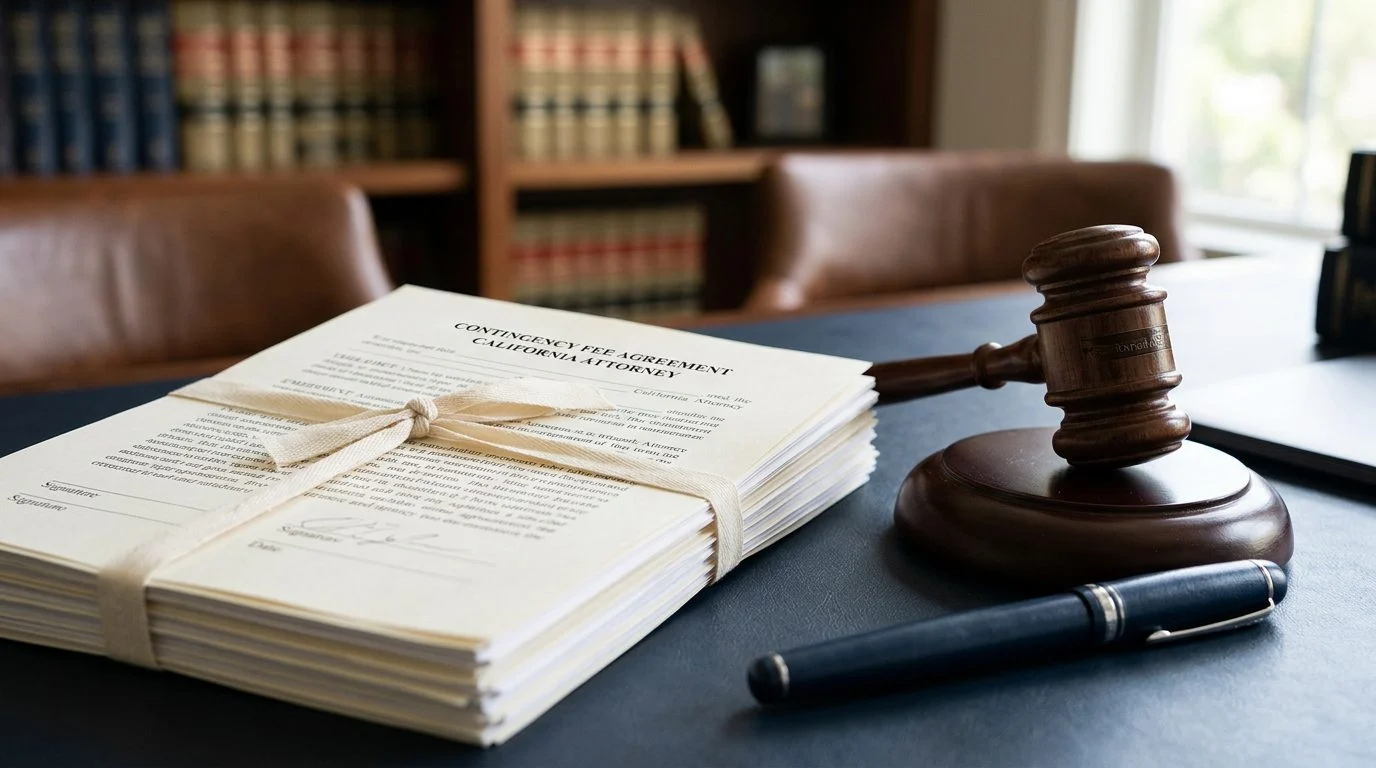
That is why the paperwork matters. Bus. & Prof. Code § 6147 requires a contingency fee contract to be in writing and signed by both the attorney and the client, except contracts for the recovery of workers’ compensation benefits. A duplicate copy goes to the client when the contract is entered into. Ask for the agreement early, so you can read it before any work begins. If a lawyer will not put the fee terms in writing, treat that as a reason to pause.
How Does a Contingency Fee Work, Step by Step?
A contingency fee is tied to the recovery, and the case moves through several stages before any money changes hands.
First comes a talk about what happened. Next, you and the lawyer sign the fee agreement. The lawyer then investigates the crash or incident, gathers records, and files the claim when the law requires it. Negotiation with insurers usually follows. The case ends in a settlement or, if none is reached, at trial.
Each stage takes time. The length of a claim varies with the injuries, the insurers involved, and whether the case must be filed in court.
The fee is taken from the recovery under the terms in your agreement. Ask whether it is figured on the gross amount recovered or after costs are subtracted. Under Bus. & Prof. Code § 6147, the agreement must explain how costs affect the fee and your recovery.
The contingency model ties the lawyer’s pay to your recovery, which can line up the client’s and lawyer’s interests. It does not predict what any case will bring.
What Are Case Costs, and Do I Owe Them if Nothing Is Recovered?
Case costs are out-of-pocket expenses paid to move a claim forward. They are separate from the attorney fee.
Common examples include court filing fees, charges for medical records and reports, fees for consultants and outside reviewers, and deposition and copying costs. A filing fee paid to the court is a cost. The percentage of a recovery is the fee.
Some agreements say the lawyer is paid only if money is recovered. A clear statement of this kind uses wording such as “You may still be responsible for costs advanced” or “You will not owe costs if we do not recover.”
Costs can build over a long case, so ask how and how often you will be told about them. Read the cost language before you sign, and ask about anything unclear.
How Is a Settlement or Verdict Divided?
In general, the fee, advanced costs, and liens are paid from the recovery before the client receives the rest.
Net to you equals the recovery, minus the fee, minus costs advanced, minus any liens or reimbursement claims paid. The order of these deductions should match your agreement and the settlement papers.
A medical lien is one way a provider can be paid later. According to Legality and Ethics of Lien Uses, a medical lien allows treatment to be provided immediately, with payment deferred until the claim is settled or resolved.
Some health plans also seek reimbursement from a recovery, so ask about any health plan claims early. Liens and reimbursement claims can be resolved during settlement talks, so ask who handles them.
Settlement taxes are a separate question.
Confirm the deduction order and each lien in writing before anything is signed. Settlement papers should show each deduction.
What Should a Written Fee Agreement Include?
Knowing how personal injury lawyers get paid helps you read a fee agreement. A contingency fee contract should state the rate, how costs affect the fee, and what you owe if there is no recovery.
Under Bus. & Prof. Code § 6147, the contract must also say whether you could owe the lawyer for related matters outside the contract. For most claims, it must also say the fee is not set by law but is negotiable.
If an agreement skips these requirements, the statute makes it voidable at the option of the plaintiff, the injured person bringing the claim. The attorney may then collect a reasonable fee. You should receive a duplicate copy of the signed contract.
Ask these questions before you sign:
- How is the fee calculated, before or after costs?
- How will liens and reimbursement claims be handled?
- Who owes costs if nothing is recovered?
- How and how often will I be updated on costs?
- What charges could I owe outside the contract?
Take time to review the agreement and ask about any term before you decide to hire anyone. Keep copies of everything you sign.
How Do Hourly Rates and Flat Fees Compare?
Hourly and flat-fee arrangements bill differently from a contingency fee, and each should be spelled out in writing.
An hourly rate charges for time spent on the case, so the bill grows as work is done. A flat fee charges a set amount for a defined service. Whatever the structure, ask what each charge covers and when it is due.
Injury claims are commonly handled with a fee that is paid only if there is a recovery, so the client does not pay by the hour as the case moves forward, and you may still be responsible for case costs advanced by the firm if there is no recovery.
Statutory fee limits apply to a narrow group of claims. Bus. & Prof. Code § 6146 limits contingency fees only in actions against a health care provider for professional negligence. So those limits do not govern most car, truck, motorcycle, bicycle, pedestrian, bus, dog bite, premises liability, or wrongful death claims.
Ask which structure applies to your matter, and check that the written terms match what you were told.
Why Does the Net Amount Vary From Case to Case?
The net amount that reaches a client is shaped by the facts of each case, so results differ when the facts differ. Ask about your own facts, not someone else’s story.
Fault matters.
In personal injury and wrongful death actions based on comparative fault, each defendant is liable for non-economic damages only in direct proportion to its own percentage of fault.
Time limits matter too. Code Civ. Proc. § 335.1 sets a two-year limitation period for an action for injury to an individual caused by another’s wrongful act or neglect.
Wrongful death claims are also subject to the two-year limitation period, which covers an action for the death of an individual caused by the wrongful act or neglect of another.
What Are Common Questions About Personal Injury Lawyer Pay?
The short answers below all point back to the written fee agreement.
How do personal injury lawyers get paid?
Many are paid a contingency fee, a share of what is recovered, with the rate set by written agreement. Ask for the terms in writing before work begins.
How much do personal injury lawyers make?
Lawyer earnings vary with the type of work, the mix of cases, and the costs involved. This page explains how clients are charged.
How hard is it to win a personal injury lawsuit?
The outcome turns on the facts, the evidence, the law that applies, and the defenses raised. No lawyer can ensure a particular result.
How much of a settlement do I keep?
You keep what remains after the fee, advanced costs, and any liens or reimbursement claims are paid, in the order your agreement sets.
What is the standard fee percentage?
No statute sets one for most injury claims, so compare the rate written in your agreement rather than a general figure.
Do I pay anything upfront?
With a contingency fee agreement, the attorney’s fee is paid out of any money recovered in the case, and you may still be responsible for costs advanced by the firm if there is no recovery; the written fee agreement explains how costs are handled. Whether any costs are due before then is stated in the signed agreement.
What should I ask before signing?
Ask how the fee is calculated, how costs and liens are handled, and what you owe if nothing is recovered.
Talk With Our Team About Your Fee Questions
Our team can walk you through how fees and costs would work in your own matter.
You may be reading this after a crash you did not choose, perhaps for an injured family member, while medical bills and insurance calls pile up. Questions about money feel urgent at a time like that.
Our first consultation is free, confidential, and carries no obligation to continue. Bring any letters, bills, or insurance papers you have, and we can review how the fee terms would apply.
To ask about your situation, contact Colvin Accident Lawyers in Bakersfield.
Colvin Accident Lawyers, Bakersfield, California — responsible for this site. Responsible attorney: Donald Norman Colvin.
What to ask before you sign
Get the fee terms in writing
Ask for the fee arrangement in a written agreement before any work begins, and read every term.
Ask how case costs are handled
Costs such as records, reports and filing fees are separate from the attorney's fee. Ask how they are handled and what you would owe at the end of the case.
Ask what happens if there is no recovery
Get a clear answer, in writing, about whether you would be responsible for costs if the case does not produce a recovery.
Ask who will handle your case
Find out who will work on your matter day to day and how you will receive updates.
Read the agreement before you decide
Fee percentages and cost terms depend on the written agreement you sign. Ask us to explain each term in plain language before you commit to anything.
Questions to bring to your first call
What is your fee?
Ask for the fee structure, including any percentage, and whether it is set out in writing.
What costs will I face?
Ask which costs the firm advances, which ones you may be responsible for, and when they are due.
What is the process?
Ask what steps your case involves, such as investigation, medical records and negotiations.
How will I stay informed?
Ask how often you will hear from the firm and who to contact with questions.
Have questions about fees or costs? Talk with us first.
Related practice areas
- How a Car Accident Claim Works in California: Steps, Deadlines and Who Pays