Motorcycle Accident Lawyer | Bakersfield, CA
Injured in a Motorcycle Crash in California? Start With a Free Consultation.
Learn how injury claims are built, what evidence matters most, and how a Central Valley law firm can help you take the next step.
By Donald Norman Colvin · Published November 15, 2026
Motorcycle Accident Injury Claims in California: How They Work, Who Pays, and What Riders Should Know
A motorcycle accident injury claim in California is a request for compensation from the people responsible for your crash, usually through their insurance company. In most cases, a rider starts with the at-fault driver’s liability coverage. If that process does not resolve the matter, the claim can become a lawsuit.
This guide explains how the process works, who may pay, which deadlines apply, and what riders and families should know. It is general information. Every crash turns on its own facts, so no outcome can be predicted from a page like this.
Not sure what your next step is?
Talk it through with our team — the first consultation is free, confidential, and carries no obligation.

How a Motorcycle Accident Injury Claim Works in California
The two-year filing period under Code of Civil Procedure section 335.1 generally applies, though exceptions exist.
A claim is a demand sent to an insurer, usually with records of your injuries and losses. Most cases begin this way. A lawsuit is filed in court when negotiations do not resolve the matter. Both paths rest on the same idea.
In plain steps, the path usually runs like this:
- The crash is looked into, and fault is examined.
- Your medical treatment is documented.
- A demand goes to the at-fault driver’s insurer.
- The insurer responds, often with questions or a low offer.
- Negotiations continue, or a lawsuit is filed.
Each step depends on the facts. Some claims resolve in negotiation, and others take longer. No timeline can be promised. Deadlines can also shape the path, so read the sections on filing limits closely.
Who Pays: Insurance Sources Available to Injured Riders
The at-fault driver’s bodily injury liability coverage is usually the first source of payment. That coverage pays for harm the driver’s negligence caused. Its limits set the most the policy will pay on the claim, so a serious injury can exceed them.
Limits vary from policy to policy, so the actual policy matters more than any general number. When limits fall short, other sources may matter. Your own policy can also help. Uninsured motorist coverage can apply when the at-fault driver has no insurance. Underinsured motorist coverage can apply when that driver’s limits are too low to cover your losses.
Medical payments coverage, if you carry it, may pay medical bills regardless of who caused the crash. Its terms vary, so check your policy. In some cases, a vehicle owner, an employer, or a property owner may share responsibility. Whether any of them does depends on the facts of the crash.
Steps to Take After a Motorcycle Accident
The most important steps after a crash are getting medical care, reporting the crash, and keeping records. Get checked even if you feel fine at the scene. Some injuries, including head and internal injuries, may not show symptoms right away. A prompt evaluation also creates a record that links your treatment to the crash.
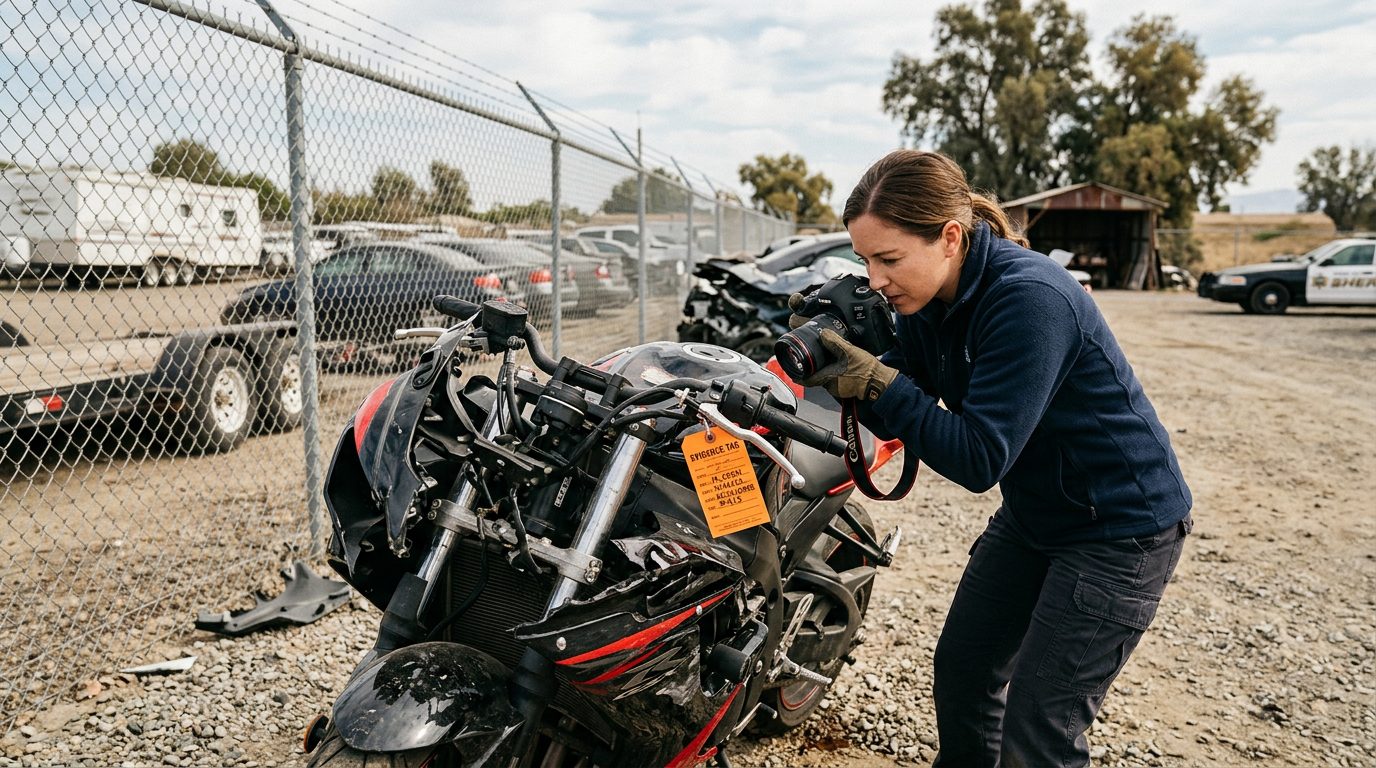
Report the crash to police and ask for the collision report. Take photos of the scene, the vehicles, the road conditions, and your injuries. Photograph your motorcycle and gear too. Keep damaged gear if you can, because it may help show how hard the impact was.
Write down the names and contact details of any witnesses. Avoid arguing about who caused the crash at the scene. Be careful with the other driver’s insurer. The adjuster may ask for a recorded statement or make an early offer. You do not have to decide on either right away, and an early offer may not reflect your medical needs.
Keep a file with medical bills, receipts, pay stubs, records of time missed from work, and trips to appointments. These records support your economic losses and show how the crash changed your daily life.
Proving Fault Under California Law
A rider must show that the other party owed a duty of care, broke that duty, and caused the injuries and losses. These are the core parts of a negligence claim. Under Civil Code section 1714, a driver must use ordinary care in managing their vehicle.
A driver who runs a red light, follows too closely, or changes lanes without checking may have breached that duty. Left-turn and lane-change collisions are one common fault pattern. These crashes often leave a rider little time to react.
Proof comes from several sources. The police report, vehicle damage, skid marks, and where the vehicles came to rest all matter. Vehicle data, traffic camera footage, and nearby business video may be overwritten or lost over time, so early action helps. Accident reconstruction professionals can study the scene and the physical evidence.
Courts use standard instructions when jurors decide negligence. The Judicial Council’s CACI jury instructions cover negligence, comparative fault, and damages in California civil cases.
Pure Comparative Fault: What Happens If the Rider Shares Blame
The award is reduced by the rider’s share of fault. It is not thrown out entirely. It reduces the amount in proportion to fault.
Insurers often raise comparative fault early. An adjuster may point to speed, lane position, or a lane change before the facts are sorted out. That statement is a negotiating position, not a final finding. Fault is decided on evidence, including the police report, witness accounts, and vehicle damage.
Partial fault changes the math, but it does not automatically end a claim. Because every crash is different, no fixed percentage applies to every case.
Not sure what your next step is?
Talk it through with our team — the first consultation is free, confidential, and carries no obligation.
Helmets, Lane Splitting, and Biker Bias
Helmet use and lane splitting often come up in motorcycle claims. Neither one decides a case on its own. Insurers may ask whether a rider wore a helmet, especially when the injury involves the head. How that question affects a claim depends on the medical evidence about what caused the injury.
Lane splitting, which means riding between lanes of traffic, should be checked against current Vehicle Code provisions before anyone draws conclusions. Its legal status matters, and so does how it played into the crash. Do not assume fault from riding style alone.
Riders also face bias. Insurers and jurors may picture a motorcyclist as reckless. Those assumptions are not evidence. Clear records of the road, the other driver’s actions, and your injuries help replace assumptions with facts.
Injuries and Damages Recoverable After a Crash
Damages are the money a claim seeks to make up for harm caused by the crash.
Civil Code section 1431.2 splits damages into two groups. Economic damages are objectively verifiable monetary losses, such as medical expenses, loss of earnings, and costs of repair or replacement. Non-economic damages are subjective losses, such as pain, suffering, emotional distress, and loss of companionship.
Some limits apply in motor vehicle cases. Under Civil Code section 3333.4, a person may not recover non-economic losses if they were operating in violation of Vehicle Code section 23152 or 23153 and were convicted. The same section covers certain uninsured owners and operators, with a separate exception in subdivision (c). The facts decide whether any of this applies.
Punitive damages are a separate question.
Serious injuries change the picture. The NINDS spinal cord injury page explains that cerebrospinal fluid and three layers of tissue cushion the spinal cord. Cervical nerves C1 to C7 control signals to the neck, shoulders, arms, hands, and diaphragm. An injury between C1 and C4 can stop breathing, so these cases often need long-term care planning. No claim value is predicted here. Amounts depend on the injuries, the evidence, and the facts of each case.
Passengers and Other Parties Who May Have Claims
A passenger hurt in a motorcycle crash may have a claim against the at-fault driver. The at-fault driver’s duty of ordinary care runs to others on the road, including passengers.
Passenger claims often start with the at-fault driver’s liability insurance. When more than one party shares fault, the picture gets more complex. Under Civil Code section 1431.2, each defendant is liable for non-economic damages only in direct proportion to its own percentage of fault.
Passengers should keep the same records as riders. Save medical bills, notes on time missed from work, photos, and any messages about the ride. A passenger who was not driving may still need the police report and insurance details to understand who may be responsible.
Fatal Motorcycle Crashes and Wrongful Death Claims
When a motorcycle crash is fatal, surviving family members may be able to bring a wrongful death claim. These claims generally fall under the same two-year period in Code of Civil Procedure section 335.1.
Wrongful death losses can include burial costs, which count as economic damages. The second group falls under the non-economic losses described in Civil Code section 1431.2.
In the days after a fatal crash, families can take practical steps. Get the police report number and keep the motorcycle and gear where they are. Gather medical and funeral records. Write down a timeline while memories are fresh. Read any insurance paperwork carefully before you sign it.
Filing Deadlines, Government Claims, and Fees
Damage to property can carry a longer, three-year period. These two clocks can apply to the same crash.
Code of Civil Procedure section 335.1 sets the two-year limit for injury to a person caused by another’s wrongful act or neglect. Code of Civil Procedure section 338 sets three years for injury to property, including goods and chattels. Do not assume the longer period covers everything. Exceptions exist that can change these dates, so check them against the facts of your crash.
If a crash involves a public agency, such as a road defect, the claim process can differ. Those claims follow their own rules and timing, so raise the issue early.
Any fee agreement should state, in the same place, whether you may still be responsible for costs advanced by the firm if there is no recovery. Read the written agreement before you sign it.
Not sure what your next step is?
Talk it through with our team — the first consultation is free, confidential, and carries no obligation.

Talking With a Colvin Accident Attorney About Your Motorcycle Crash
If you are still deciding whether to pursue a motorcycle accident claim, a consultation can help you sort out your options. Maybe the insurer keeps calling, bills are arriving, and you are unsure whether your injuries or your family’s losses warrant a claim. Those are the moments when many riders start weighing their next steps.
A consultation can review the facts of the crash, the deadlines that may apply, and how fault and insurance may work in your situation. No outcome can be predicted before the facts are reviewed.
If your crash is still unresolved, contact Colvin Accident Lawyers for a free case consultation. The firm serves riders and families in Bakersfield, Kern County, Fresno, Visalia, Lancaster, Palmdale, Delano, and Tehachapi.
Frequently asked questions
Property damage generally has a three-year period.
Who pays motorcycle accident medical bills in California?
The at-fault driver’s liability insurance is usually the first source. Your own medical payments or uninsured motorist coverage may also apply, depending on your policy.
Can I still recover if I was partly at fault?
Yes, in most cases.
Can a motorcycle passenger make a claim?
A passenger may have a claim against the at-fault driver. The facts of each crash decide who may be responsible.
Exceptions and the facts of the case shape the rules that apply.
Colvin Accident Lawyers, Donald Norman Colvin, Bakersfield, California — responsible for this site.
How Colvin Accident Lawyers Works With Injured Riders
Focused on injury claims
Colvin Accident Lawyers focuses on motorcycle, car, truck, and other accident claims for injured people and their families in Bakersfield and surrounding communities.
Organized case documentation
We help you gather police reports, medical records, repair estimates, and insurance correspondence so your claim is clearly presented.
Prompt attention to your case
Important evidence can disappear quickly after a crash, so we review the facts of your case as early as we can.
Support for families
We represent injured riders and families who have lost a loved one in a motorcycle crash, and we keep you informed at every step.
Free, confidential first consultation
La consulta inicial es gratuita, confidencial y sin compromiso de continuar. The initial consultation is free, confidential, and without obligation to continue.
Be Careful With Insurance Adjusters
The adjuster who calls you works for the insurance company, not for you. Before giving a recorded statement or signing any release, consider speaking with a lawyer about your situation.
What to Do After a Motorcycle Crash
Get medical attention
Even if your injuries seem minor, a medical evaluation creates a record connecting your injuries to the crash.
Report the crash
Make sure a police report is made so there is an official record of the collision.
Document the scene
Photos of your motorcycle, helmet, the roadway, vehicles involved, and visible injuries can be valuable later.
Keep your records
Save medical bills, prescriptions, repair estimates, and records of lost wages.
Talk with a lawyer
Contact Colvin Accident Lawyers for a free, confidential consultation about your motorcycle injury claim.