Motorcycle Accident Lawyer | Bakersfield and Kern County
Suing After a Motorcycle Crash in California: How the Process Works
When an insurance claim can't resolve your motorcycle accident, a personal injury lawsuit may be the next step. Here is what that involves, explained in plain language.
By Donald Norman Colvin · Published October 27, 2026
To sue after a motorcycle accident in California, you file a personal injury lawsuit in court against the party responsible for the crash. Most riders first deal with an insurance claim. A lawsuit comes into play when that claim cannot be resolved. This guide explains the steps in plain words.
If you’re reading this after a crash, you may be hurt, dealing with a damaged bike, and fielding calls from insurers. You may also be worried about someone you love.
What Suing After a Motorcycle Crash Actually Means
A lawsuit is a court case against the person or party responsible for the crash. It is separate from an insurance claim, which usually comes first.
An insurance claim is a request for payment. An adjuster reviews the crash, the injuries, and the damage. Many claims end without a court case. When they don’t, a lawsuit may be the next step. Filing a claim does not start a lawsuit on its own.
Does a minor-looking crash still count? Under Civil Code § 1714, everyone is responsible for an injury caused by want of ordinary care. Cal. Civ. Code § 1714 reads: “(a) Everyone is responsible, not only for the result of his or her willful acts, but also for an injury occasioned to another by his or her want of ordinary care or skill in the management of his or her property or person, except so far as the latter has, willfully or by want of ordinary care, brought the injury upon himself or herself.” The question is fault and injury, not how the crash looks. Low-speed impacts can still cause serious harm.
If a crash left you or someone you love hurt, you don't have to work out the deadlines alone. We're glad to talk through your facts. Talk it through with our team — the first consultation is free, confidential, and carries no obligation.

Deadlines: How Much Time You Have to File
Under Code of Civil Procedure § 335.1, a lawsuit for injury to a person or for death caused by another’s wrongful act or neglect must be filed within two years. The California courts deadline guide notes that these periods have exceptions and tolling, which are rules that pause the clock.
A separate rule decides who may bring a wrongful-death claim arising from the same crash.
Under Code of Civil Procedure § 377.60, a wrongful death case may be brought by the surviving spouse, domestic partner, children, and children of deceased children. If there are no such descendants, it may be brought by those who would inherit under intestate succession. Certain dependents, a minor who, at the time of death, had lived in the decedent’s household for the previous 180 days and depended on the decedent for half or more of their support, or the personal representative on their behalf may also bring it.
Public entities. If a city, county, or state may be responsible, such as for a road defect, Government Code § 911.2 requires a claim within six months for death or injury to a person or personal property. Other claims against a public entity generally need presenting within one year.
Each clock runs on its own. Exceptions exist, and how these dates apply depends on the facts of the crash.
Who Can Be Named in a Motorcycle Accident Lawsuit
The at-fault driver is usually the main party named. Other parties can be named depending on who was involved and why.
Under Vehicle Code § 17150, every owner of a motor vehicle is liable for death or injury to person or property caused by a negligent act in its operation. That includes a driver using the vehicle with the owner’s permission. So an owner may be named even when a friend or family member was driving.
If a road or property condition played a role, a public entity may be responsible. Under Government Code § 835, the plaintiff must prove the condition was dangerous at the time of injury, that it caused the injury, and that it created a reasonably foreseeable risk of the kind of injury incurred. The plaintiff must also show that a negligent or wrongful act or omission of a public entity employee within the scope of employment created the condition, or that the entity had actual or constructive notice of it in time to act.
Crashes involving buses, trucks, or other commercial vehicles can involve more parties, such as an employer, and more records. Identifying those parties and records early is worth doing.
Other Fault Rules That Apply to Riders
In a personal injury, property damage, or wrongful death action based on comparative fault, California Civil Code § 1431.2 makes each defendant’s liability for non-economic damages several only, in direct proportion to that defendant’s own percentage of fault. Under Civil Code § 1431.2, each defendant pays non-economic damages only in proportion to its own share of fault. Under Civil Code § 1431.2(a), each defendant’s liability for non-economic damages is several only and is limited to that defendant’s percentage of fault.
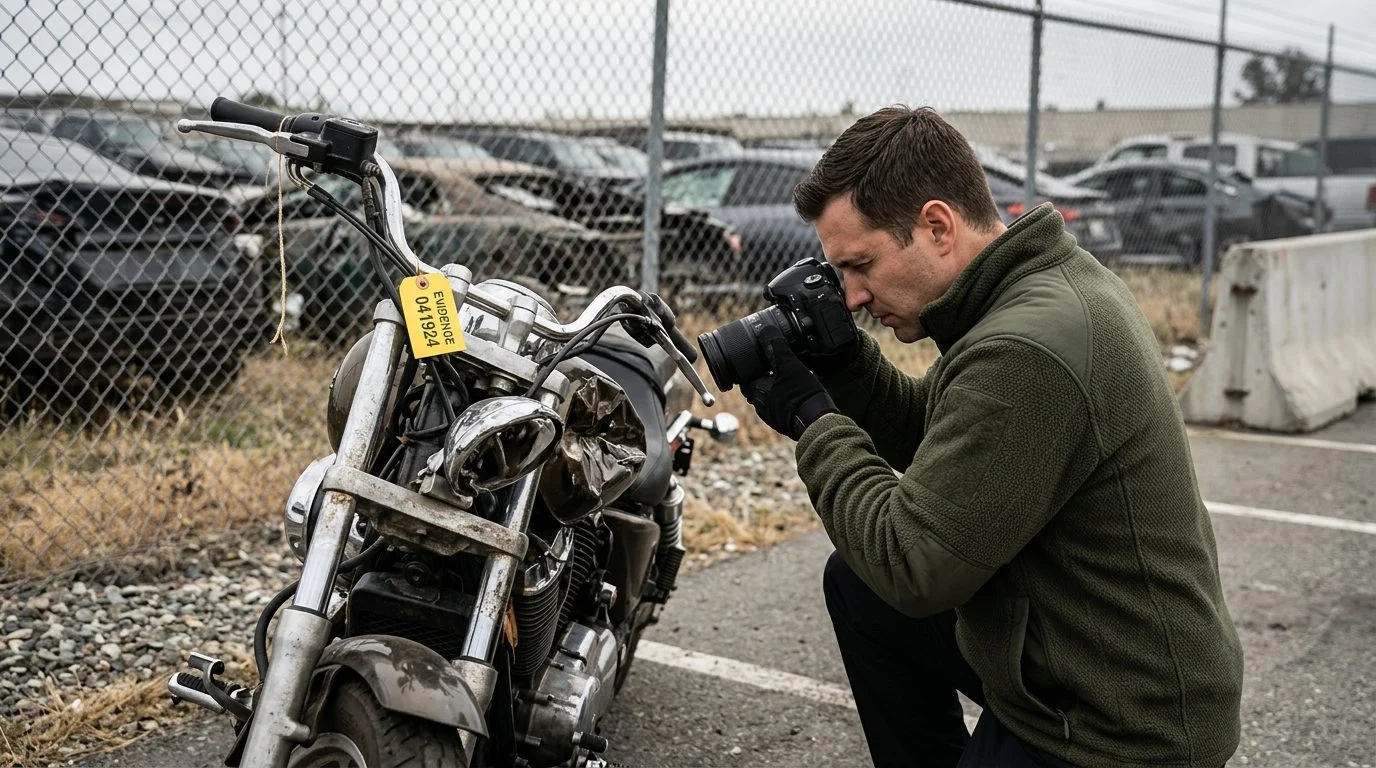
Useful evidence often includes the police report, photos of the scene and bike, witness statements, repair records, dashcam footage, and medical records. Write down your own account while your memory is fresh. Stick to what you saw and know.
The Steps From Filing to Resolution
The claim usually goes to the insurer first.
Under Vehicle Code § 16000, a driver in a crash causing bodily injury, death, or more than $1,000 in property damage to any one person must report it to the DMV within 10 days. The report can be made personally or through an insurance agent, broker, or legal representative.
The typical path looks like this:
- A demand letter to the insurer.
- A complaint filed in court and served on the defendant.
- Discovery, where each side requests documents and may take depositions (sworn testimony given outside court).
- Negotiation or mediation, where a neutral helper works with both sides.
- Trial, if the case does not settle.
A case can resolve at any stage. No lawyer can promise how an insurer or a court will respond.
Damages and What Comes Out of a Settlement
Damages come in two groups: economic losses, such as bills and lost pay, and non-economic losses, such as pain and suffering.
Under Civil Code § 1431.2, economic damages are objectively verifiable monetary losses. Examples include medical expenses, lost earnings, repair or replacement costs, and loss of use of property. Non-economic damages include pain, suffering, inconvenience, and emotional distress.
Each claim is valued on its own facts. Examples from other cases don’t carry over to yours, since every crash and injury differs.
A settlement amount is also not the amount the injured person keeps. Under Business and Professions Code § 6147, a contingency fee contract must be in writing. It must state the fee rate and how costs affect the fee and the client’s recovery.
Not sure what your next step is?
Talk it through with our team — the first consultation is free, confidential, and carries no obligation.
Protecting Your Claim While It Is Open
Keep your medical care steady, keep records, and think before you speak or post about the crash.
Keep up with appointments and follow your doctor’s treatment plan. Gaps in treatment can be used to question how serious the injuries were.
Be careful with statements to an insurance adjuster. Recorded statements and written accounts can be used later, so keep them short and factual.
Think before posting about the crash, your activities, or your injuries online. The other side may review social media.
Keep bills, receipts, repair estimates, and a simple daily log of pain and limits on work or daily life. A log can show how the crash changed ordinary days.

Talk With Colvin Accident Lawyers About Your Motorcycle Crash
If you’re weighing a lawsuit, talking through your own facts is the next step. You may be reading for yourself or for someone who was hurt. You don’t have to decide anything yet.
How long do I have to sue after a motorcycle accident in California?
For most injury claims, California generally allows two years from the injury (Code Civ. Proc. § 335.1). Exceptions and different rules for public entities can change that date.
How Partial Fault Affects Recovery
Do I have to report a motorcycle accident to the DMV?
If the crash caused bodily injury, death, or more than $1,000 in damage to any one person’s property, the driver must report it within 10 days under Vehicle Code § 16000.
Our first consultation is free, confidential, and carries no obligation to continue. If a crash left you or someone you love hurt, you don’t have to sort out the deadlines alone. Contact Colvin Accident Lawyers to talk about your facts.
Colvin Accident Lawyers, Bakersfield, California, responsible for this site. Responsible lawyer: Donald Norman Colvin.
How Colvin Accident Lawyers Approaches Motorcycle Cases
Focused on Motorcycle Crash Claims
Our practice includes motorcycle accident cases, and we handle the insurance negotiations and court filings that can follow a crash on California roads.
Careful Review of the Facts
We look at the crash report, medical records, property damage, and other evidence to understand who may be responsible and how the injuries affect your life.
Support for Riders and Families
We represent injured riders and the families of people killed in motorcycle crashes, and we keep communication clear at every stage.
A Free, Confidential First Consultation
Your first consultation is free, confidential, and carries no obligation to continue. You can ask questions and decide what comes next.
Before You Speak With an Insurance Adjuster
Insurance companies may ask for a recorded statement soon after a crash. Talking with a lawyer first can help you understand what to say and what to leave out while you are still recovering.
The Basic Steps in a Motorcycle Lawsuit
1. The Insurance Claim
Most motorcycle injury cases begin with a claim to the at-fault driver's insurer. A lawsuit usually follows only when that claim cannot be resolved fairly.
2. Investigation and Evidence
Crash reports, witness information, photos, medical records, and bike damage documentation help establish how the crash happened and what it cost you.
3. Filing the Complaint
If a lawsuit is needed, your attorney files a complaint in the appropriate court and names the party or parties responsible for the crash.
4. Discovery and Resolution
Both sides exchange information, depositions may take place, and the case may settle or move toward trial. Each case moves at its own pace, depending on its facts.