Motorcycle Accident Lawyer | Kern County
Hurt in a Motorcycle Crash in Kern County?
Colvin Accident Lawyers represents injured riders and the families of those who have died in motorcycle crashes in Bakersfield and throughout Kern County. Your first consultation is free, confidential, and carries no obligation to continue.
By Donald Norman Colvin · Published October 21, 2026
Colvin Accident Lawyers is a motorcycle accident law firm in Kern County, based in Bakersfield, California. We represent riders, passengers, and families after crashes that cause serious injury or death. This page explains what we handle, the California rules that shape these claims, and how to take the next step. For the broader guide, read our motorcycle accident lawyer overview.
Who We Represent in Motorcycle Accident Cases
We represent motorcycle riders, passengers, and families of riders in Kern County and nearby communities. Our work covers:
- Rider and passenger injuries after collisions with cars, trucks, and buses
- Wrongful death claims for families who lost a loved one
- Catastrophic injury claims, where medical and care needs can last for years
- Claims involving road hazards such as gravel, potholes, or debris
We also serve clients in Fresno, Visalia, Lancaster, Palmdale, Delano, and Tehachapi.
If you’re reading this after a crash, you may be dealing with pain, medical bills, lost work, and calls from an insurer. Those pressures are hard. Many riders are also unsure whether the other driver, a company, or a government agency may be responsible. That question is one of the first things we look at. Families often face the loss and the paperwork at the same time, and both can feel overwhelming.
If a crash left you hurt or you lost a rider you love, you may have a claim, and our team can talk through your options with you now. Talk it through with our team — the first consultation is free, confidential, and carries no obligation.
What Causes Motorcycle Crashes in California?
Many motorcycle crashes involve another vehicle that turns, changes lanes, or fails to yield. Common patterns include:
- A driver turning left across a rider’s path
- A car changing lanes into the space a motorcycle occupies
- A driver following too closely
- A driver failing to yield at an intersection
Under Vehicle Code § 21703, a driver may not follow another vehicle more closely than is reasonable and prudent.
Gravel, potholes, and debris can cause a rider to lose control. When a public agency runs the road, extra rules apply. Under Government Code § 835, a public entity can be liable for injury caused by a dangerous condition of its property, except as provided by statute, if the injury was proximately caused by the condition, the condition created a reasonably foreseeable risk of that kind of injury, and either an employee’s negligent or wrongful act within the scope of employment created the condition or the entity had actual or constructive notice of it in time to protect against it.
Lane splitting means riding between rows of stopped or moving vehicles in the same lane. Vehicle Code § 21658.1 defines it. Under Vehicle Code § 21658.1, lane splitting means driving a motorcycle that has two wheels in contact with the ground between rows of stopped or moving vehicles in the same lane. Who is at fault after a crash depends on the facts of each case.
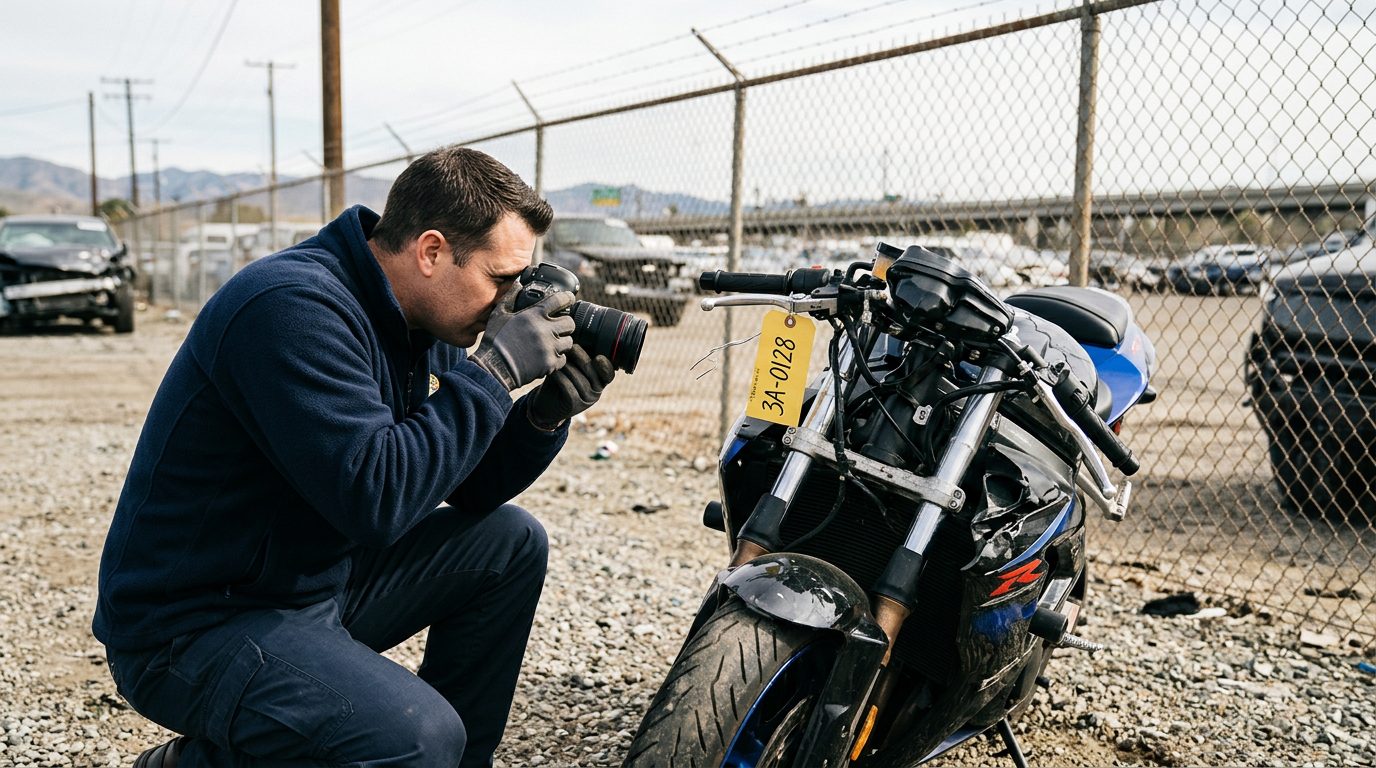
The police report, scene photos, and vehicle damage often show what happened. We review these records with you.
California’s Helmet Law and How Fault Is Decided
California requires riders and passengers to wear helmets. Vehicle Code § 27803 says a driver and any passenger must wear a safety helmet that meets the required standard. Cal. Veh. Code § 27803 reads: “(f) This section does not apply to a person operating, or riding as a passenger in, a fully enclosed three-wheeled motor vehicle that is not less than seven feet in length and not less than four feet in width, and has an unladen weight of 900 pounds or more, if the vehicle meets or exceeds all of the requirements of this code, the Federal Motor Vehicle Safety Standards, and the rules and regulations adopted by the United States Department of Transportation and the National Highway Traffic Safety Administration.” Under Cal. Veh. Code § 27803, a driver and any passenger must wear a safety helmet meeting the requirements of Section 27802 when riding a motorcycle, motor-driven cycle, or motorized bicycle on the highways, and it is unlawful to operate one if the driver or any passenger is not wearing a safety helmet as required. The Insurance Institute for Highway Safety publishes research on the safety benefits of helmets.
Under California Vehicle Code § 27803(b) and (c), it is unlawful to operate a motorcycle, motor-driven cycle, or motorized bicycle if the driver or any passenger is not wearing a safety helmet as required, and whether it affects a claim depends on the facts of each case.
Fault is judged from several sources:
- The police report and citations
- Witness statements
- Vehicle damage and the position of the vehicles
- Traffic signals, road markings, and other scene evidence
- The rider’s own actions, such as speed and following distance
What a Motorcycle Accident Claim Can Include
A motorcycle accident claim can seek economic damages and non-economic damages. Under Civil Code § 1431.2, economic damages are objectively verifiable monetary losses. Non-economic damages are subjective losses, such as pain and emotional distress.
Economic damages can include:
- Medical bills, both past and future
- Lost earnings and lost work opportunities
- Repair or replacement costs for the motorcycle and other property
Non-economic damages can include pain, suffering, inconvenience, emotional distress, and loss of companionship. For catastrophic injuries, the claim may also cover ongoing care and rehabilitation needs.
Under the same section, each defendant pays its share of non-economic damages in proportion to its percentage of fault. Code of Civil Procedure § 377.60 names who may bring a wrongful death claim, including a surviving spouse, domestic partner, children, and certain dependents.
Injury severity, medical records, treatment history, and evidence of fault all shape how a claim is evaluated.
How the Claim Process Works, Step by Step
The process starts with a free, confidential first consultation, with no obligation to continue.
- Consultation. We listen to what happened and answer your first questions.
- Evidence gathering. We collect the police report, scene and vehicle photos, witness contacts, medical records, and repair or total-loss paperwork.
- Investigation. We review fault, insurance coverage, and whether a government agency is involved.
- Insurer communication. We handle contact with insurers and prepare a demand once the injury picture is clear enough.
- Resolution. We negotiate. If needed, we file a lawsuit. Timelines vary with the facts and how insurers respond.
Bring these items to your consultation:
- The crash date and location
- The police report number
- Insurance cards
- Medical bills
- Photos of the scene and vehicles
Deadlines to Keep in Mind and Protecting Your Claim
For uninsured motorist claims under a policy issued under Insurance Code § 335.1, no cause of action accrues to the insured unless one of the listed actions is taken within two years from the date of the accident. Under Code of Civil Procedure § 335.1, an action for injury to, or death of, a person caused by another’s wrongful act or neglect falls under a two-year limit.
Claims against a public entity move on a shorter clock. Under Government Code § 911.2, a claim for death or injury generally must be presented within six months after the cause of action accrues. Earlier action matters here.
Your own auto insurance matters too. Insurance Code § 11580.2 requires uninsured motorist coverage in auto liability policies. The named insured can reduce or remove that coverage only by written agreement. Your policy may also include medical payments or collision coverage. Review your policy with us before you file.
Adjusters may ask for a recorded statement soon after a crash. Early offers may come before doctors know the full extent of your injuries. Talk with a lawyer before you give a statement or sign a release.
Not sure what your next step is?
Talk it through with our team — the first consultation is free, confidential, and carries no obligation.
Why Work With Colvin Accident Lawyers in Kern County
Colvin Accident Lawyers is based in Bakersfield, California.
Donald Norman Colvin is the attorney responsible for this site. Our attorneys handle motorcycle, car, truck, bicycle, pedestrian, bus, dog bite, premises liability, wrongful death, and catastrophic injury claims. Our team includes assistants and office staff who support our attorneys.
We represent clients in Kern County. We also serve riders and families in Fresno, Visalia, Lancaster, Palmdale, Delano, and Tehachapi. Each case turns on its own facts, so we review yours on its own terms.

Frequently Asked Questions About Motorcycle Accident Claims in Kern County
Here are short answers to common questions about motorcycle claims in Kern County.
What should I do right after a motorcycle crash?
Get medical care, note the police report number, and photograph the scene and vehicles. Keep comments about the crash brief.
Do I have to talk to the other driver’s insurance adjuster?
Talk with a lawyer before you give a recorded statement or sign anything.
How long do I have to file?
Most injury and death claims generally have a two-year limit. Claims against a public entity generally have a six-month window.
If a crash left you hurt, or you lost a rider you love, the decisions ahead can feel urgent. If you’re weighing whether to talk with an insurer or how to meet a deadline, contact Colvin Accident Lawyers now.
Donald Norman Colvin, Colvin Accident Lawyers, Bakersfield, California — responsible for this site.
How we can help after a motorcycle crash
Based in Bakersfield
We represent injured riders, passengers and families throughout Kern County, from Bakersfield to Tehachapi and Delano.
Speak with a lawyer first
Call us before you give a recorded statement to an insurance adjuster or sign any paperwork from an insurer.
Focus on motorcycle cases
Our team focuses on crashes involving motorcycles, including collisions with cars, trucks and buses.
Clear explanations
We explain each step of the claim process in plain language so you know what to expect as your case moves forward.
Free, confidential first consultation
Your first consultation is free, confidential and comes with no obligation to continue with our firm.
Support for families
When a motorcycle crash results in a death, we work with surviving family members on the legal process while they grieve.
Right after a motorcycle crash
Get medical care as soon as you can, even if you feel you are not badly hurt. Note the police report number, photograph the scene and the vehicles, and keep your comments about the crash brief. Speak with a lawyer before you give any recorded statement or sign anything.
Motorcycle accident matters we handle
Car and truck collisions
Crashes where a passenger car, pickup or commercial truck strikes a motorcycle or rider, including lane changes, left turns and failure to yield.
Bus and commercial vehicle crashes
Collisions involving buses or other commercial vehicles that leave riders with serious injuries or losses.
Catastrophic injuries
Serious injuries such as brain injuries, spinal cord injuries, fractures and amputations that require long-term medical care and affect daily life.
Wrongful death
Fatal motorcycle crashes where a family has lost a loved one and needs to understand its legal options.