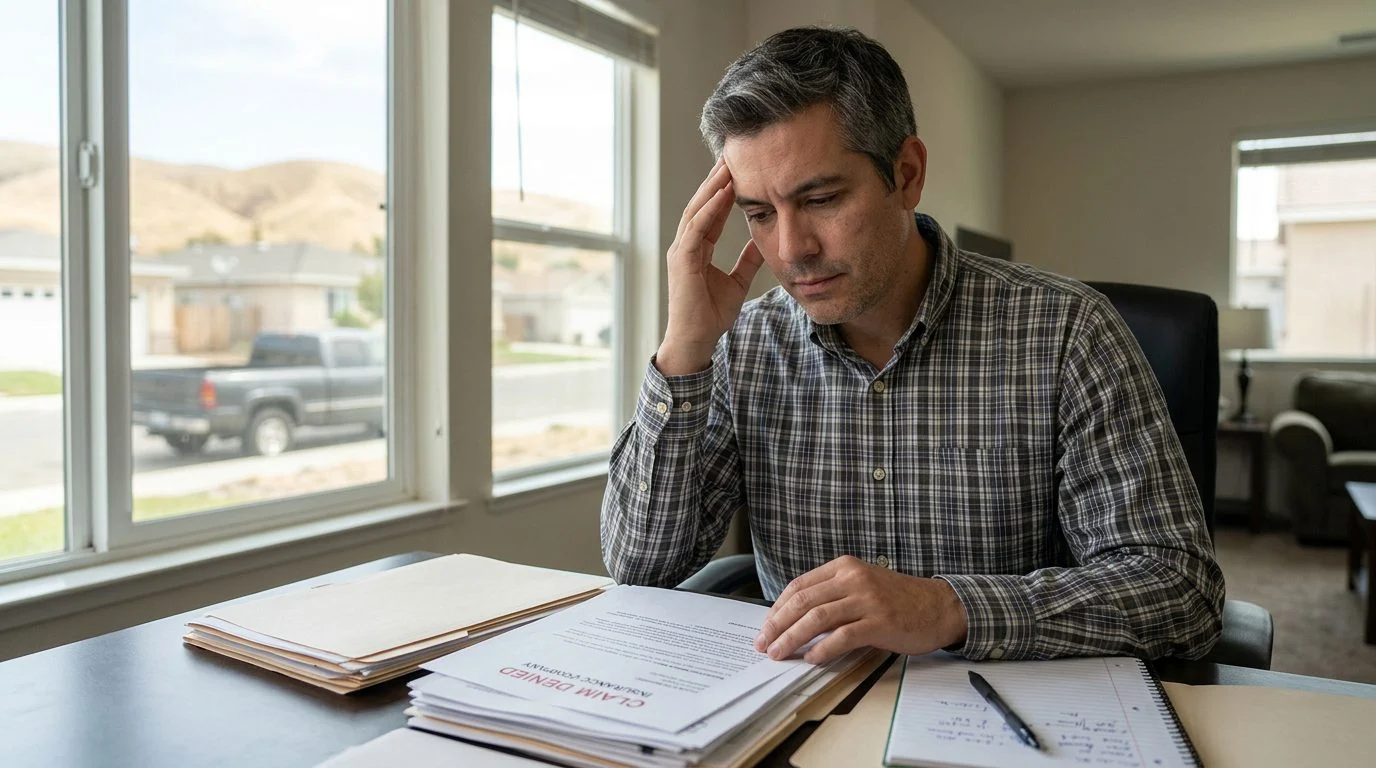
Denied Insurance Claims | Bakersfield, CA
When an Insurer Says No, You Still Have Options
Learn how a denial can be reviewed, what separates your own policy from a claim against the other driver, and how to decide your next step with clear facts in hand.
By Donald Norman Colvin · Published November 22, 2026
A letter saying your insurance company denied your claim can arrive while you’re hurt, grieving, or stuck with medical bills. It can feel like the decision is final.
Can you sue an insurance company for denying your claim in California? Sometimes, yes. A denial is the insurer’s position, not the final word. Whether a lawsuit fits your situation depends on the facts, the policy, and the type of claim.
Can I sue an insurance company for denying my claim?
A denial letter states the insurer’s position. It is not a court ruling, and it can be challenged. Insurers sometimes get the facts or the policy wrong, so a denial deserves a close look before you accept it.
Some denials rest on a policy term that may not fit the facts. Others rest on a dispute about how the accident happened or what caused a death. The letter itself often shows which kind you have, so reading it closely is the first step.
You can respond in writing. You can send records the insurer did not have, and you can ask it to explain its decision in detail. These steps don’t always change the answer, but they build the record any later dispute will rely on.
If the insurer keeps refusing, the next step depends on who owes you money and under what kind of coverage. No lawyer can say how a particular denial will end, and this page won’t forecast one. It explains the general framework California uses, so you know which questions matter. A lawsuit is one possible step, not an automatic one.
If an insurer's denial came after an accident or a death in your family, we can talk through the letter, the policy, and the deadlines with you. Talk it through with our team — the first consultation is free, confidential, and carries no obligation.

Why insurance companies deny accident and wrongful death claims
Insurers usually deny a claim for one of a few reasons. The common ones are disputed fault, doubts that the accident caused the injury or death, coverage exclusions, late or missing notice, and incomplete paperwork.
Fault and coverage are separate questions. Fault asks who caused the crash. Coverage asks whether the policy pays for this loss. An insurer can dispute one and accept the other, so a denial may rest on either.
Some policies require prompt notice of a loss. If you reported late, the insurer may point to the delay, even when the loss was real. Read the letter for the exact reason given. A vague reason is a reason to ask for more detail.
In a wrongful death case, the cause of death can become the center of the dispute. Medical records and the accident report then carry much of the weight. A case can stall for these reasons even when the underlying loss is real.
Two different paths: a dispute over policy benefits or a claim against the at-fault party
A claim on your own policy and a claim against the person who caused the harm follow different rules. Keeping them apart helps you see what the denial actually affects.
A claim on your own policy is a contract question. It asks what the policy agrees to pay and whether this loss falls within that agreement.
A claim against a driver, business, or property owner is a negligence claim. Under California Civil Code section 1714(a), a person is responsible for injury caused by want of ordinary care, except to the extent the injured person willfully or through want of ordinary care brought the injury upon himself or herself. Negligence means failing to use the care a reasonably careful person would use in the same situation. CACI No. 401 on negligence describes it that way.
If the at-fault driver has no insurance, your own auto policy may help. California Insurance Code section 11580.2 requires an insurer to provide uninsured motorist coverage in each bodily injury liability policy it issues covering liability arising from the ownership, maintenance, or use of a motor vehicle. The insurer and the applicant may, by written agreement, remove the coverage entirely, exclude it when the vehicle is operated by a natural person designated by name, or set it at an amount lower than the statute’s standard limits but not less than the financial responsibility requirements. Within the limits established by law, uninsured motorist coverage insures you, your heirs, or your legal representatives for sums you are legally entitled to recover as damages for bodily injury, including any resulting sickness, disease, or death, but it does not cover bodily injury for which you or your representative, without the insurer’s written consent, settle with or take to judgment an action against anyone who may be legally liable. It applies to damages owed by the owner or operator of an uninsured motor vehicle that is not owned or operated by you or a resident of your household, but it does not cover your bodily injury while you are in, upon, entering, or getting out of a vehicle other than the one described in your policy if that vehicle’s owner has similar insurance.
An insurer’s denial can affect either path. Which path applies turns on the policy and the facts of the loss.
How California law treats an insurer’s handling of a claim
California sets standards for how insurers handle claims.
California Insurance Code section 790.03 defines unfair methods of competition and unfair or deceptive acts in the insurance business. Subdivision (h)(15) of § 790.03 lists, when knowingly committed or performed with such frequency as to indicate a general business practice, “[m]isleading a claimant as to the applicable statute of limitations.” Subdivision (h)(14) lists another of these unfair claims settlement practices: “[d]irectly advising a claimant not to obtain the services of an attorney.”
Those items show that how a claim is handled matters, not just the final answer. A claim that an insurer acted unfairly looks at its conduct. That can include how it investigated, what it told you, and how it explained the decision.
Proof matters here. A denial letter shows the decision. It does not show how the claim was handled. Showing the handling takes facts about what happened after you filed, and when it happened.
Bad faith is a claim about conduct. It is not a label you can attach to every denial. Whether any of this fits your claim turns on what the insurer did and when it did it.
What to do with the denial letter
Start by finding the exact reason the insurer gave and the policy language it relies on.
- Read the stated reason. Note the policy section cited, the claim number, and the letter date.
- If the reason is vague, ask in writing for a full explanation.
- Keep every letter, email, and call note. Record the date, time, and name of each person you spoke with.
- Gather the policy, accident or medical records, police or incident reports, and proof of your losses.
- Don’t sign a release or accept a partial payment until you understand which rights it may give up.
Medicare can change the math too. If Medicare paid some of the bills, Medicare may have made a conditional payment. The Medicare Secondary Payer overview says that payment must be repaid when a settlement, judgment, award, or other payment is made. It also says federal law takes precedence over state laws and private contracts.
Why deadlines and evidence decide whether a denied claim can move forward
Deadlines and evidence often decide whether a denied claim can move forward.
The California Courts Self Help Guide explains that filing deadlines for civil lawsuits can have exceptions and tolling. Waiting to see what the insurer does can shrink your options.
Code of Civil Procedure section 338 sets three years for an action for injuring goods or chattels, which covers personal property. One crash can involve more than one type of claim, and each may have its own filing deadline.
Wrongful death claims have their own rules about who may bring them. Code of Civil Procedure section 377.60 lists a surviving spouse, domestic partner, children, and issue of deceased children, or, if there is no surviving issue of the decedent, the persons, including the surviving spouse or domestic partner, who would be entitled to the property of the decedent by intestate succession, along with certain dependent family members. The decedent’s personal representative may also bring the claim on their behalf.
Evidence often decides these disputes. Medical records that show how the injury happened, and how it connects to the crash, carry real weight. Some injuries take more documentation to tie to an accident, especially when symptoms show up later.
Not sure what your next step is?
Talk it through with our team — the first consultation is free, confidential, and carries no obligation.
How a Bakersfield accident lawyer can review a denied claim
A review usually means reading the policy, the denial letter, and the accident records side by side.
That review asks a few questions. Which path applies? Which deadlines might apply? Does the stated reason match the policy language and the evidence? No review can say how the matter will end, but these questions bring the facts into focus.
Colvin Accident Lawyers handles car, truck, motorcycle, bicycle, pedestrian, bus, dog bite, premises liability, catastrophic injury, and wrongful death cases. The firm is based in Bakersfield, California. Donald Norman Colvin is the responsible lawyer for this site. Our team works with the documents a denial letter raises, and the firm’s wrongful death page explains how those claims are handled.
Quick answers
Is an insurer’s denial the final answer?
No. A denial is the insurer’s position, and it can be reviewed and challenged.
Can I sue the at-fault driver if the insurer denies my claim?
Possibly. That negligence claim follows different rules from your own policy, so it is a separate question.
Does Medicare have a say if my insurer denies a claim?
Medicare may have made a conditional payment that must be repaid from a later settlement or judgment.

If the denial came after an accident or a death in your family
A denial letter that arrives during recovery or grief is a hard position to be in. You may be handling medical bills, a policy you don’t fully understand, and a deadline you’re not sure about, all at once.
You don’t have to sort those out alone. Have the letter and the policy ready, then contact Colvin Accident Lawyers through the contact page to talk through the denial, the policy, and the deadlines that may apply.
Your first consultation with Colvin Accident Lawyers is free, confidential, and comes with no obligation to continue.
Questions Injured Clients Ask After a Denial
Is a denial the final word?
No. A denial reflects the insurer's position at that point in time. It can be reviewed, questioned and challenged with the right information.
Can I pursue the at-fault driver instead?
Possibly. A claim against the at-fault driver is a negligence matter that works differently from your own policy, so it needs its own review of the facts.
What should I gather now?
Keep the denial letter, the police report, photos, medical records, bills and every message with the insurer. Organized records make the review faster and clearer.
Does a denial affect my medical bills?
It can. Bills, liens and benefit programs may each have their own rules, so an early conversation helps you understand what is at stake.
Do Not Assume the Story Ends With the Letter
A denial letter is often the start of a review, not the end of one. Avoid signing releases or making recorded statements about your injuries before you understand what you are agreeing to.
How We Approach a Denied Claim
We Read the Denial Closely
We review the reasons the insurer gave and compare them with the facts of the accident and your policy.
We Explain Your Options
You receive a plain-language explanation of the paths available to you, so you can decide with confidence.
We Focus on Protecting Your Position
We look at how each step could affect your claim before you take it.
We Keep You Informed
Our team answers your questions and keeps you updated as the review moves forward.