Wrongful Death Lawsuit in Kern County Superior Court
By Donald Norman Colvin · Published November 17, 2026
A sudden death in an accident leaves a family with grief, bills, and urgent questions. Here is the short answer: under California law, a wrongful death lawsuit is brought by the family members the statute names, or by the decedent’s personal representative on their behalf.
Who Can File a Wrongful Death Claim in California
Under California law, a spouse, domestic partner, child, or other family member named in the statute can bring the claim. Code Civ. Proc. § 377.60 names who may sue. The list includes:
- The surviving spouse or domestic partner.
- The children, and the children of a child who has died.
- If there is no surviving issue of the decedent, the persons who would be entitled to the property of the decedent by intestate succession.
- Certain persons, such as stepchildren, parents, a putative spouse, or, if the parents are deceased, the decedent’s legal guardians, may sue if they were dependent on the decedent, even if they are not in the first group.
- A minor who lived in the decedent’s household for the previous 180 days and depended on the decedent for one-half or more of their support.
A personal representative may also bring the action. Code Civ. Proc. § 377.30 covers a separate claim: the decedent’s own cause of action that survives death, which the personal representative brings, or, if there is none, the decedent’s successor in interest.
Code Civ. Proc. § 377.20 says a cause of action is not lost because the person died. It survives, subject to the deadline that applies.
Whether probate must come first depends on the estate. The California Courts probate guide explains how a personal representative collects property, pays debts, and distributes what remains.
Where a Kern County Wrongful Death Case Is Filed
Most Kern County wrongful death lawsuits are filed in the Kern County Superior Court, the state trial court in Bakersfield.
A case starts with a complaint. The California Courts Self Help Guide describes filing a wrongful death complaint on the Judicial Council form.
Filing fees, forms, and e-filing rules are set by the court and can change over time.
Government defendants change the path. If a county road, city street, or public transit agency may be responsible, a written claim must come first. The next section covers that deadline.
Deadlines That Control a Wrongful Death Case
Most wrongful death lawsuits in California must be filed within two years. Code Civ. Proc. § 335.1 sets that two-year limit for actions for the death of an individual caused by another’s wrongful act or neglect.
Two years is the general rule. Exceptions exist, so the exact date depends on the facts.
Two deadlines matter when a public agency is involved:
- Written claim: Gov. Code § 911.2 requires a claim for death to be presented within six months after the cause of action accrues.
- Relief from the waiting period: If an application for leave to present a claim is denied or deemed to be denied, a petition may be made to the court for an order relieving the petitioner from Gov. Code § 945.4 under Gov. Code § 946.6.
The six-month government claim deadline is much shorter than the two-year rule. Check it first, because it can pass before families realize it applies.
Evidence and First Steps After a Fatal Accident
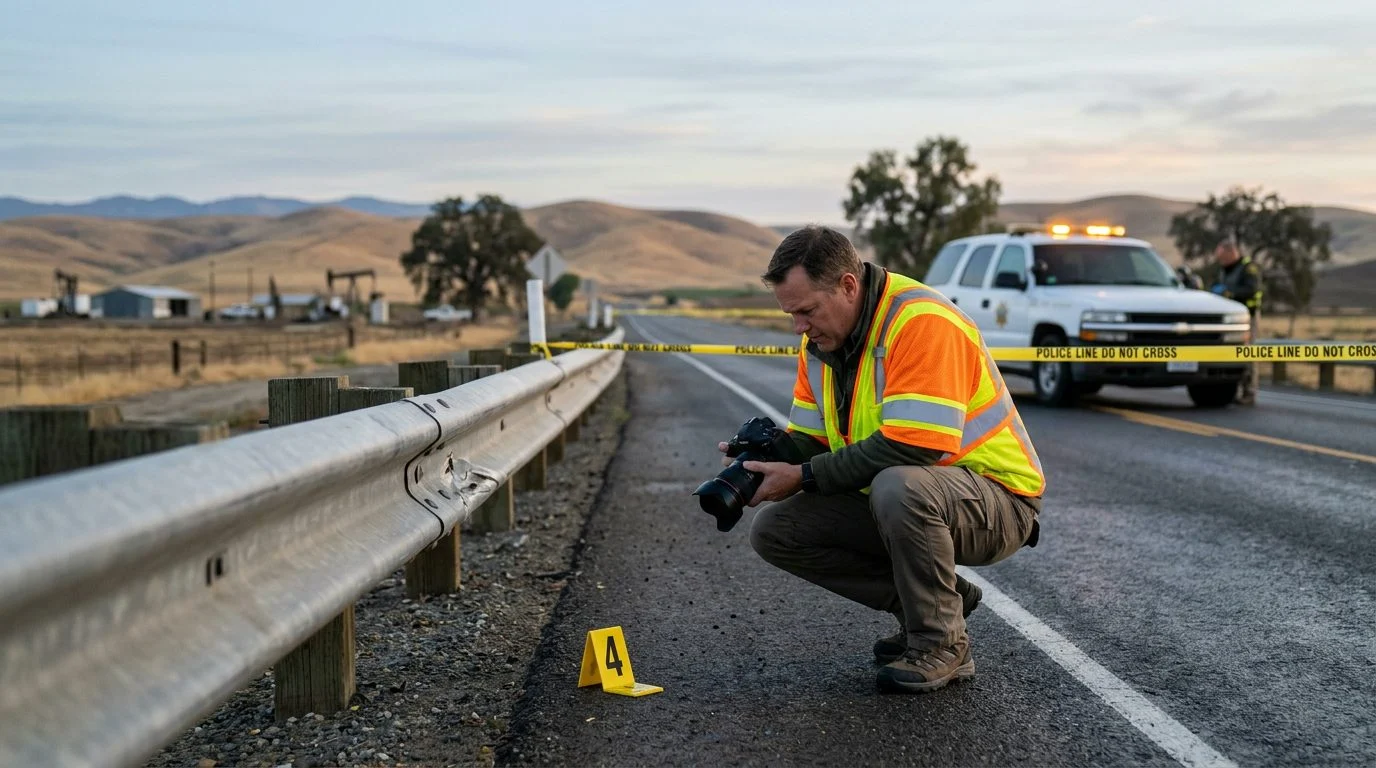
Protect records, photos, and witness details first, because they can be lost quickly. Start with these steps:
- Get the police or incident report number, the investigating agency, and any citations issued.
- Photograph or film the scene, vehicles, and visible conditions, and keep the original files.
- Write down witness names and contact details while memories are fresh.
- Keep medical, emergency response, and coroner records as they become available. Note who holds each one.
- Keep a log of bills, funeral costs, lost income, and household tasks the family has taken on.
A common mistake is giving a recorded statement to an insurance adjuster too soon. Those words can be used later. Before speaking with any insurer, talk with our team first. Limit social media posts about the accident and the person who died, too.
How a Wrongful Death Case Moves Forward
A wrongful death case usually moves through investigation, filing, discovery, and then settlement talks or trial. Here is the typical path:
- Investigation: Collect records, identify everyone who may be responsible, and confirm who has the right to bring the claim.
- Pre-suit demand: Present the claim to insurers. Some cases resolve here without a lawsuit.
- Filing: File the complaint in the Kern County Superior Court and serve the defendants.
- Discovery: Each side exchanges documents, written questions, and depositions of parties and witnesses.
- Settlement talks: Many civil cases include mediation or settlement discussions before trial.
- Trial: If the case does not resolve, a judge or jury decides liability and damages.
Timelines vary with case complexity, the number of parties, insurer responses, and court scheduling.
What a Wrongful Death Claim Can Recover
Damages are set under Code Civ. Proc. § 377.61. The statute allows damages that may be just under all the circumstances. Those damages may not include amounts recoverable under § 377.34.
In a survival claim, Code Civ. Proc. § 377.34(a) limits damages to the loss or damage the decedent sustained or incurred before death, including any penalties or punitive or exemplary damages the decedent would have been entitled to recover had the decedent lived. Those damages do not include pain, suffering, or disfigurement.
Section 377.34(b) allows pain-and-suffering damages only for actions granted a preference before January 1, 2022, or filed on or after January 1, 2022, and before January 1, 2026.
Shared fault reduces damages rather than barring them. Under California’s civil jury instruction on a plaintiff’s comparative fault, once the defense proves the injured person shared responsibility, the jury decides that person’s percentage of fault, the damages are reduced by that percentage, and the judge calculates the actual reduction. California follows pure comparative negligence (CACI No. 405, Sources and Authority; Li v. Yellow Cab Co. (1975) 13 Cal.3d 804): an injured person’s own negligence never bars recovery, and their damages are instead reduced in proportion to their percentage of fault, even if they were more at fault than the defendant.
Any amount depends on the evidence and law in each case.
Why Families Turn to Colvin Accident Lawyers
Colvin Accident Lawyers is a personal injury firm based in Bakersfield, California. The firm represents accident victims and families in car, truck, motorcycle, bicycle, pedestrian, bus, train, dog bite, premises liability, catastrophic injury, and wrongful death cases.
Donald Norman Colvin is the responsible lawyer for this page. The firm’s lawyers and support staff work together on accident and wrongful death matters.
Our team explains each step in plain language, including the deadlines and filing questions covered here. Families dealing with more than one party or insurer get a full view of their claims.
Our office is in Bakersfield, and we serve families across Kern County.
Frequently Asked Questions
How long do families have to file a wrongful death lawsuit in California?
Most claims must be filed within two years under Code Civ. Proc. § 335.1.
Does a wrongful death case have to go through probate first?
It depends on the estate and on who brings the claim.
Can a family still sue if the person who died was partly at fault?
Often, yes. The Judicial Council’s jury instruction on comparative fault of the plaintiff tells jurors that when the defendant carries this proof, the plaintiff’s damages go down by the share of responsibility the jury assigns to the plaintiff, and the court then computes the actual reduction.
Where would a Kern County wrongful death lawsuit be filed?
Most are filed in the Kern County Superior Court.
Losing a family member is hard, and the legal steps can feel like too much at once. If you’re still deciding what comes next, contact Colvin Accident Lawyers and we’ll talk through your family’s situation.
Your first consultation is free, confidential, and carries no obligation to continue. La consulta inicial es gratuita, confidencial y sin compromiso de continuar.
Colvin Accident Lawyers, Bakersfield, California — responsible for this site.