Motorcycle Accidents | Bakersfield, California
Who Is Usually at Fault in a Motorcycle Accident?
Fault is rarely decided by a single detail. Here is how the facts of a crash are typically weighed, and why the evidence from your own accident matters.
By Donald Norman Colvin · Published November 20, 2026
If you were riding when a car or truck hit you, or you’re helping a family member who was, the first question is usually who caused the crash. Fault depends on the facts of each crash. Still, some patterns come up again and again, and riders can share blame too.
The Short Answer: Who Is Usually at Fault in Motorcycle Accidents?
The crashes that repeat most often involve a driver who turned across a rider’s path, merged into it, or failed to yield. Riders can also share blame through speed, impairment, or unsafe lane use.
Under Cal. Civ. Code § 1714, everyone is responsible for an injury caused by his or her want of ordinary care. Cal. Civ. Code § 1714 reads: “(a) Everyone is responsible, not only for the result of his or her willful acts, but also for an injury occasioned to another by his or her want of ordinary care or skill in the management of his or her property or person, except so far as the latter has, willfully or by want of ordinary care, brought the injury upon himself or herself.” The same exception applies to everyone: an injured person’s own willful conduct or lack of ordinary care can reduce what they recover. Courts ask who failed to use ordinary care, and whether that failure was a substantial factor in the harm.
Riders are not automatically blamed, and drivers are not automatically cleared. The sections below cover the common patterns on each side, how California splits blame, and the evidence that tends to shape the result.
If a crash report doesn't match what happened, you don't have to sort out fault alone. Colvin Accident Lawyers can talk through your facts with you. Talk it through with our team — the first consultation is free, confidential, and carries no obligation.
How Fault Is Decided in California: Comparative Fault
California uses comparative fault. An injured rider can still recover even when the rider is partly to blame.
Here is a simple illustration, not a prediction. Suppose the total harm is 10 units and the rider is found 30 percent responsible. The rider would recover 70 percent of the harm. The rider’s own share reduces the amount, but it does not bar recovery.
California courts moved away from the all-or-nothing approach. According to the Judicial Council of California civil jury instructions, Sources and Authority, California follows pure comparative negligence under Li v. Yellow Cab Co. (1975) 13 Cal.3d 804: an injured person’s own negligence does not bar recovery, and damages are reduced in proportion to that person’s percentage of fault, even when that person is more at fault than the defendant. The Judicial Council of California’s jury instruction on apportionment of responsibility tells jurors that “you must then decide how much responsibility each has by assigning percentages of responsibility to each person listed on the verdict form. The percentages must total 100 percent.” The percentages must total 100 percent.
Common Fault Patterns When a Car or Truck Driver Is Responsible
The errors below come up again and again in motorcycle crashes. Each one can make a driver responsible in whole or in part.
- Left turns across a rider’s path. A driver turning left may misjudge a motorcycle’s speed or distance. Motorcycles are narrow and can look farther away than they are.
- Failure to yield. Intersections, stop signs, and merges are common places where a driver does not give a motorcycle the right of way.
- Unsafe lane changes. A driver who changes lanes without checking a blind spot can cut off a rider.
- Following too closely. Under Veh. Code § 21703, a driver shall not follow another vehicle more closely than is reasonable and prudent. That duty considers speed, traffic, and road conditions.
- Phone records, dashcam video, and witness accounts can show whether a driver was distracted.
Commercial trucks and buses can carry extra rules and records, and those records can matter to fault. Expect an insurance adjuster to argue that the rider was speeding or changed lanes unsafely. Each claim is judged on its own facts, so no one can predict the split from the pattern alone.
Common Fault Patterns When the Rider Is Responsible
A rider can share fault through speed, impairment, unsafe lane use, or riding that doesn’t match the road. These are the points that come up most in fault disputes.
- Speed. Stopping distance grows with speed. Higher speed also cuts the time other drivers have to react.
- Impairment. Alcohol or drug use can become a central issue. Toxicology results are often used to argue fault.
- Lane splitting. Veh. Code § 21658.1 defines lane splitting as a motorcycle that has two wheels in contact with the ground riding between rows of stopped or moving vehicles in the same lane. The California Highway Patrol explains lane splitting under California law. A rider’s conduct while splitting is still examined for fault.
- Unsafe lane changes and following too closely. These are judged the same way when a rider does them.
- Helmet use. Under Veh. Code § 27803, a driver and any passenger must wear a safety helmet that meets the statute’s requirements when riding a motorcycle, motor-driven cycle, or motorized bicycle on the highway, except a fully enclosed three-wheeled motor vehicle that meets the statute’s listed requirements. The Insurance Institute for Highway Safety reports that helmets have safety benefits and that unhelmeted riders face increased injury risk. Helmet use is a separate question from who caused the crash.
Licensing status can come up in a dispute too. It is one piece of evidence, not an automatic finding of fault.
Road Conditions, Property Owners, and Other Responsible Parties
Roads and property can share blame when a hazard was not fixed, marked, or warned about. A rider who hits a pothole or debris may have a claim against whoever controlled that area.
A condition on the property created an unreasonable risk of harm, the owner knew or, using reasonable care, should have known about that condition, and the owner did not fix it, guard against it, or adequately warn visitors about it. The condition must create an unreasonable risk of harm. The owner must have known or should have known about it. The owner must then have failed to repair it, protect against it, or warn about it. The visitor must also show an actual injury and that the owner’s carelessness was a substantial factor in bringing it about. Every case turns on its own facts, so this general description cannot predict how a particular claim would be decided.
Claims against a public agency, such as a city or county, follow different rules. Under Gov. Code § 911.2(a), a claim for injury to a person must be presented not later than six months after the cause of action accrues. That is a shorter clock than the deadline for filing a lawsuit.
A defective part or a poor repair can also be part of the analysis. When more than one party is at fault, each party’s share is evaluated on its own record. For non-economic damages such as pain and emotional distress, Civ. Code § 1431.2(a) says each defendant is liable only for its own percentage of fault.
The 12-Second Rule and Insurance: What Each Does and Does Not Decide
Insurance decides what coverage may apply. Fault decides who is legally responsible. These are related questions, but they are separate.
Many riders hear about a 12-second following gap. It is a safety rule of thumb taught in some training courses. It is not the legal test for fault. California’s following-distance rule is in Veh. Code § 21703, which asks for a distance that is reasonable and prudent.
Your own policy may include uninsured or underinsured motorist coverage. California’s uninsured motorist statute is Ins. Code § 11580.2. Coverage terms vary by policy, so the policy language controls what it pays.
Under California cases such as Zahn v. Canadian Indemnity Co. and Shaolian v. Safeco Insurance Co., an injured person generally cannot sue the at-fault driver’s insurer directly. Filing a claim with that insurer is allowed. An adjuster’s early view of fault is not a final decision. The split is set by the factfinder.
Quick answers
Are motorcycle accidents covered by insurance?
Coverage depends on the policies involved. Each policy’s terms control what it pays.
Filing a claim with that insurer is allowed.
Is a helmet required in California?
Yes. Under Veh. Code § 27803, a driver and any passenger riding a motorcycle, motor-driven cycle, or motorized bicycle on the highway must wear a safety helmet meeting the section’s requirements; a fully enclosed three-wheeled motor vehicle meeting the section’s specifications is exempt.
Not sure what your next step is?
Talk it through with our team — the first consultation is free, confidential, and carries no obligation.
Evidence That Shapes Who Is Found at Fault
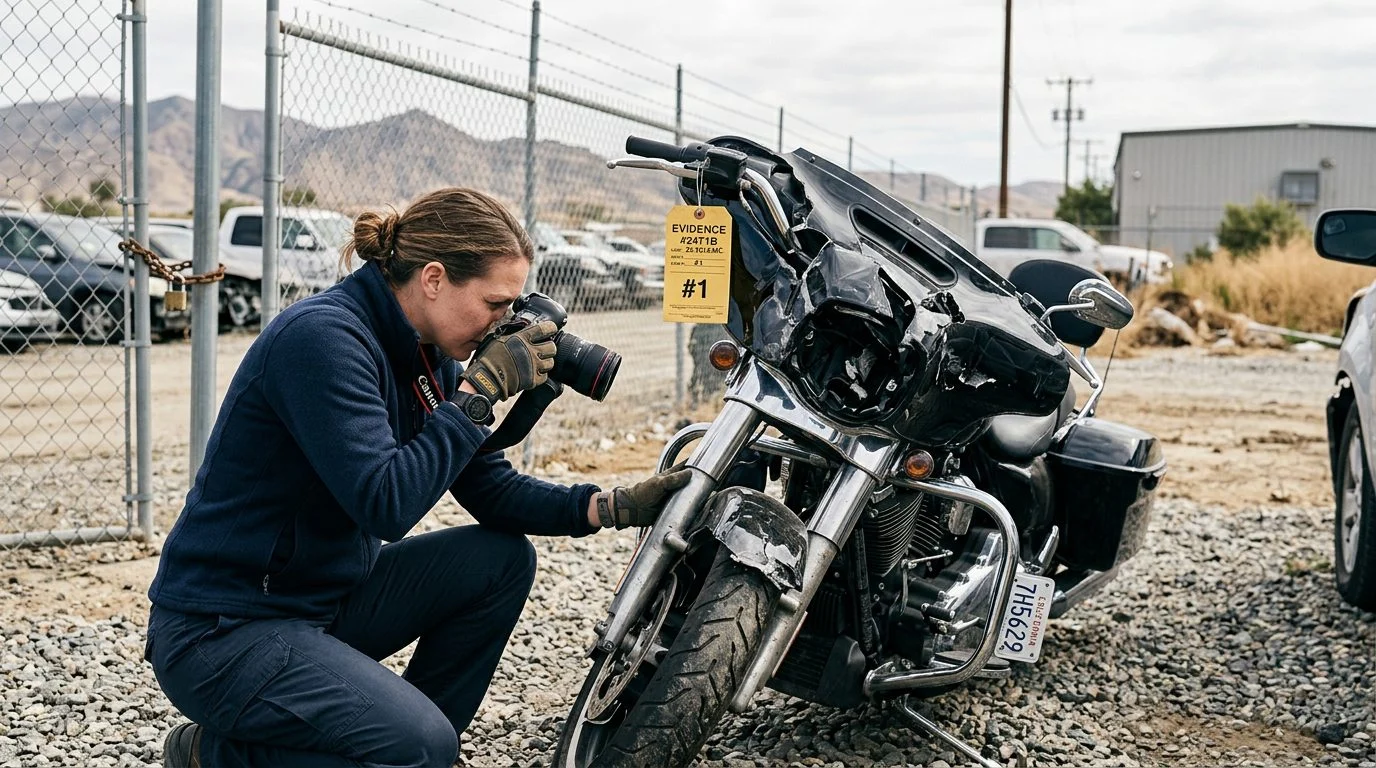
Evidence gathered early matters because footage gets overwritten and memories fade. Several kinds of proof often decide the fault question.
- The written report. Under Veh. Code § 20008(a), a driver of a vehicle, other than a common carrier vehicle, involved in an accident resulting in injury or death must make or cause to be made a written report within 24 hours. The report goes to the California Highway Patrol, or to the city’s police department if the crash was inside a city. A police report mixes officer observations with opinions, and it is not always the final word.
- Witness statements. Statements taken soon after the crash are harder to dispute than statements given months later.
- Dashcam, traffic camera, and business video. This footage can be overwritten quickly. Requests to preserve it should go out early.
- Physical evidence. Vehicle damage, skid marks, final rest positions, and roadway markings can show how the crash happened.
- Phone and vehicle data. Preservation requests matter here too.
- Statute violations. Under Evid. Code § 669(a), failure to use due care is presumed only if a person violated a statute, ordinance, or regulation of a public entity, the violation proximately caused death or injury to person or property, the harm resulted from an occurrence the rule was designed to prevent, and the injured person was in the class the rule was adopted to protect. The presumption can be rebutted.
Timing matters too. Under Code Civ. Proc. § 335.1, an action for assault, battery, or injury to, or for the death of, an individual caused by the wrongful act or neglect of another must be filed within two years, subject to any applicable exceptions and tolling rules. California Code of Civil Procedure section 335.1 provides that an action for injury to, or for the death of, an individual caused by the wrongful act or neglect of another must be brought within two years, subject to exceptions and tolling.
Talking Through a Disputed Crash With Colvin Accident Lawyers
Many people reading about fault are sorting out a crash they did not choose. The crash report may not match what they remember. An adjuster may be asking for a recorded statement while injuries are still healing.
Colvin Accident Lawyers is based in Bakersfield, California. The firm can talk through the facts of your crash and who may be responsible. You can contact Colvin Accident Lawyers to start that conversation. For the broader claim process, see the firm’s motorcycle accident lawyer page.
La consulta inicial es gratuita, confidencial y sin compromiso de continuar.
Colvin Accident Lawyers, Bakersfield, California — responsible for this site. Responsible lawyer: Donald Norman Colvin.
What Shapes the Fault Question
The Police Report
Official crash documentation records what was observed at the scene and can be a useful starting point for reviewing the facts.
The Scene and Conditions
Road layout, visibility, weather, and roadway hazards all help explain how a collision happened.
Every Party Involved
Drivers, riders, passengers, and sometimes property owners or vehicle makers may each play a role in a crash.
A Review of Your Facts
Our team looks at the details of your accident before drawing conclusions about who may be responsible.
Be Careful Before Speaking to an Insurer
Insurance adjusters may ask for a recorded statement soon after a crash. Speak with our team before you give one, so your account is not used in ways you did not intend.
Common Motorcycle Crash Situations
Left Turns Across a Rider's Path
A driver turning in front of an oncoming motorcycle is a frequent collision pattern. Who is at fault depends on what the evidence shows about each vehicle's movements.
Lane Changes and Merging
Vehicles shifting lanes near a rider can cause sudden contact. The timing, signaling, and position of each vehicle are central to the review.
Road Hazards and Conditions
Potholes, debris, gravel, or poor road design can contribute to a crash. Responsibility may extend to parties other than another driver.
Following Distance and Speed
Rear-end and sudden-stop collisions raise questions about speed, distance, and reaction time. These details are reviewed case by case.