Motorcycle Accidents | Bakersfield, CA
Were You Partly at Fault in a Motorcycle Crash? Understand the Key California Rules
Plain-language answers from Colvin Accident Lawyers. Start with a free, confidential first consultation with no obligation to continue.
By Donald Norman Colvin · Published October 28, 2026
This guide explains how that rule works, which fault arguments come up most, and what evidence shapes them.
What It Means to Be Partly at Fault in a Motorcycle Crash
Being partly at fault means your own actions helped cause the crash, along with someone else’s actions. A crash can have more than one cause.
A motorcycle crash usually involves the rider and at least one other driver. Sometimes a property owner or another party is involved too. Each person’s conduct gets examined. That review looks at the facts of the specific crash, not the type of vehicle alone.
A motorcycle is not automatically at fault in a crash. A car is not automatically blameless either. Take a common case. A driver turns left in front of a rider who was also going too fast. Both people may share some fault. The other side will often argue that the rider’s share should be large.

How California’s Pure Comparative Fault Rule Works
The percentage of fault assigned to each party is a key number in a comparative fault case.
When more than one defendant is involved, a second rule applies to non-economic damages. Civil Code § 1431.2 limits each defendant’s liability for non-economic damages to its own percentage of fault. Economic damages are objectively verifiable losses, such as medical bills and lost earnings. Non-economic damages are subjective losses, such as pain, suffering, and emotional distress.
Common Fault Arguments in Motorcycle Crash Claims
Fault disputes in these cases can involve lane position, speed, following distance, left turns, and signals. Each one often ties to a specific rule the other side may cite.
Lane position and sudden lane changes are a frequent point of dispute. An insurer may argue the rider moved into a car’s path. The rider may say the car moved first.
Speed is another. Vehicle Code § 22350 bars driving faster than is reasonable or prudent for the weather, visibility, traffic, and road. It also bars any speed that endangers people or property. Speed is often reconstructed from the physical evidence.
Following distance matters too. Vehicle Code § 21703 says a driver shall not follow another vehicle more closely than is reasonable and prudent.
Left turns cause many collisions with motorcycles. The California Driver Handbook explains the rules for yielding when turning. Drivers often say they never saw the motorcycle.
When a statute, ordinance, or regulation of a public entity was violated, Evidence Code § 669 can create a presumption that the person failed to use due care, but only if the violation proximately caused death or injury, the harm was of the kind the rule was designed to prevent, and the injured person was in the class the rule protects. That presumption can be rebutted by showing the person did what a reasonably prudent person, acting under similar circumstances and wanting to comply with the law, would have done.
Lane Splitting and Helmet Use: How Each Can Come Up
Lane splitting and helmet use are two issues that often come up in these claims. The facts of each crash decide how they apply.
California law defines lane splitting. Vehicle Code § 21658.1 describes it as driving a motorcycle with two wheels on the ground between rows of stopped or moving vehicles in the same lane. The statute provides that the California Highway Patrol may develop educational guidelines relating to lane splitting. Whether lane splitting was involved, and how the evidence describes it, is a question of fact.
Helmet use is the other issue. Vehicle Code § 27803 requires a driver and any passenger to wear a safety helmet meeting requirements established pursuant to Section 27802 when riding on a motorcycle, motor-driven cycle, or motorized bicycle operated on the highways, and it does not apply to a person operating, or riding as a passenger in, a fully enclosed three-wheeled motor vehicle that meets the conditions set out in subdivision (f). It is unlawful to operate a motorcycle when the driver or a passenger is not wearing one as required. The Snell Memorial Foundation notes that helmets reduce the impact forces sent to the head. How a helmet issue affects a particular claim depends on the facts and the injuries involved.
Impairment is a separate limit. Civil Code § 3333.4 bars recovery of non-economic losses when the injured person was driving in violation of Vehicle Code § 23152 or 23153 and was convicted of that offense.
Evidence That Shapes the Fault Percentage
The scene, the police report, witness accounts, and medical records usually show who did what. Each piece of evidence can support either side’s version of events.
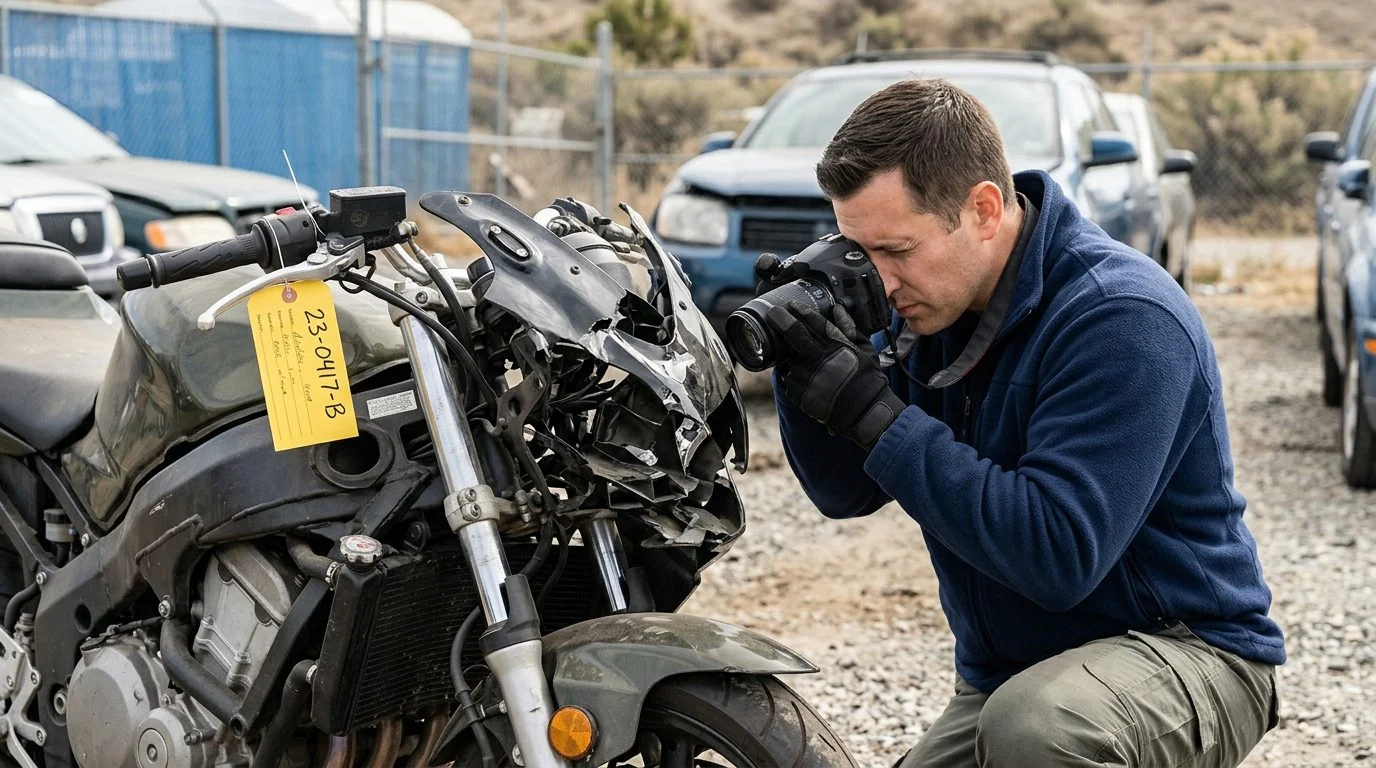
Start with the scene. Photos of the vehicles, the damage pattern, and where debris and skid marks came to rest can show each vehicle’s path. Traffic camera footage, dashcam video, and phone video may also exist. Witnesses can describe signals, lane positions, and timing.
Some reports are required by law. The report can be made personally or through an insurance agent, broker, or legal representative.
Medical records matter too. They document the nature of the injury and the timing of treatment. Keep every bill and record.
Preserve the physical items. The motorcycle, helmet, and gear can show impact points and damage. Don’t repair or discard them before the evidence is reviewed.
Who Else Can Share Fault in a Motorcycle Crash
More than one driver can share fault. In some crashes, another party may also be responsible.
Under Civil Code § 1714, a person is responsible for injury caused by a lack of ordinary care, except so far as the injured person has, willfully or by want of ordinary care, brought the injury upon himself or herself. That principle can reach property owners or others responsible for road conditions when the facts support it.
Claims against a California public entity move on a shorter clock. Government Code § 911.2 requires a claim for death or for injury to a person to be presented not later than six months after the claim accrues. This matters when a road condition or a public agency vehicle is involved.
Wrongful death cases follow the same fault principles. Comparative fault rules apply to wrongful death actions too. The decedent’s own conduct can be part of that analysis. Code of Civil Procedure § 377.60 lists who may bring a wrongful death claim.
Not sure what your next step is?
Talk it through with our team — the first consultation is free, confidential, and carries no obligation.
Steps to Protect Your Claim After a Partly-at-Fault Crash
Report the crash, get medical care, and keep records from the start. These steps protect the evidence you may need later.
Call the police and get the report number. Get medical care even if you feel okay. Some injuries show up days later. Keep every bill, receipt, and record.
Write a timeline while the details are fresh. Note the lanes, the signals, the weather, and what you saw and heard. Think carefully before giving a recorded statement or describing fault to the other insurer. Stick to what you know.
California generally allows two years to file a personal injury lawsuit. Code of Civil Procedure § 335.1 covers an action for injury to an individual caused by the wrongful act or neglect of another. Claims against a public entity have the shorter six-month deadline noted above.

Talk Through Your Crash With Colvin Accident Lawyers
If you were partly at fault, the fault question turns on your crash’s facts. You don’t have to sort it out alone.
Reading this after a crash, or on behalf of a rider you care about, is stressful. You may be dealing with pain, medical bills, time off work, and calls from an adjuster. Colvin Accident Lawyers is a personal injury firm based in Bakersfield, California. Donald Norman Colvin is the responsible lawyer for this site.
Can I still recover damages if I was partly at fault?
It depends on the facts and the law.
Does lane splitting make a rider automatically at fault?
How long do I have to file a motorcycle accident lawsuit in California?
California allows two years under Code of Civil Procedure § 335.1 for an action for assault, battery, or injury to, or for the death of, an individual caused by the wrongful act or neglect of another. Claims against public entities can have a shorter deadline.
Can family members file a wrongful death claim after a motorcycle crash?
Yes, certain family members listed in Code of Civil Procedure § 377.60 may bring the claim.
Our first consultation is free, confidential, and comes with no obligation to continue (consulta inicial gratuita, confidencial y sin compromiso). If you’re weighing your own share of blame, contact Colvin Accident Lawyers to talk through the facts of your crash.
Steps That Can Help Protect Your Claim
Write down what you remember
Record the date, time, location, weather, road conditions, and how the crash happened while the details are still fresh.
Get medical care promptly
Seek evaluation even if your injuries seem minor. Medical records create a clear link between the crash and your condition.
Keep your records together
Save photos, repair estimates, bills, and any messages about the crash in one place so nothing gets lost.
Be careful with recorded statements
Speak with a lawyer before giving a recorded statement to an insurance company about how the crash happened.
Do Not Assume You Have No Claim
Sharing some blame for a crash does not automatically end a claim. How fault is assessed depends on the facts of your crash and the evidence available. Talk with us before you decide what to say to anyone.
Questions to Bring to Your Consultation
What happened at the scene?
Tell us about the other vehicle, the road, and any witnesses or police report numbers you have.
What injuries and treatment do you have?
Share your medical visits, ongoing symptoms, and any work time you have missed.
What has the insurer said?
Bring any letters, calls, or settlement offers so we can review them with you.
What are your next steps?
We will explain the options that may apply to your situation and answer your questions at no cost to you.