Motorcycle Accidents | Bakersfield, CA
Hit a Pothole on Your Motorcycle? Let's Talk About Your Claim Against the City
Colvin Accident Lawyers helps riders injured by road defects in Bakersfield and Kern County understand how a claim against a public entity works and what steps to take next.
How We Approach Pothole Crash Claims
Focused Practice
Our practice focuses on personal injury cases, including motorcycle accidents and claims arising from dangerous road conditions.
Careful Claim Preparation
We review the road defect, the crash details, and your medical records so your claim is documented from the start.
Clear Communication
We explain each step in plain language so you know what is happening and what decisions are ahead.
Attention to Your Recovery
We understand that a crash can affect your health, work, and family. We keep your needs at the center of the case.
By Donald Norman Colvin · Published October 16, 2026
A motorcycle crash pothole claim against a city or county in California starts with a short clock. If the road belongs to a public agency, a written government claim generally must be presented within six months of the crash. That is much shorter than the two-year window most people expect. This page explains who can be responsible, what evidence matters, and which deadlines to watch. It’s written for injured riders in Bakersfield and Kern County, and for family members acting on their behalf.
What a Pothole or Road Defect Motorcycle Claim Is
A road defect claim seeks payment for injuries when a hazard in the road helped cause a rider to lose control. Common hazards include potholes, buckled pavement, missing manhole covers, loose debris, and unmarked obstacles. The claim can be brought by the injured rider. A family member can also act for a rider who was injured or died.
This kind of claim differs from a crash with another driver. The party responsible is often a public agency, and public agencies follow special claim rules. Claims against a city or county for a road defect are governed by statute, not by the general negligence rule in Civil Code § 1714. Public-entity liability exists only where a statute provides it (Gov. Code § 815), and under Gov. Code § 835 a dangerous-condition claim requires proof that the property was in a dangerous condition at the time of injury, that the condition caused the injury, that it created a reasonably foreseeable risk of the kind of injury incurred, and that either a negligent or wrongful act or omission of a public employee within the scope of employment created the condition, or the agency had actual or constructive notice of it in time to protect against it. Whether a particular road defect meets the statutory elements required against a public agency turns on the facts of your crash.
If a road defect threw you off your motorcycle, you may have a claim, and our team can talk through the deadlines with you at no cost. Talk it through with our team — the first consultation is free, confidential, and carries no obligation.

Who Can Be Responsible for a Road Defect
The right defendant depends on who owns and maintains the road, and several parties may be involved. Identifying the correct agency early matters, because the written claim goes to that entity.
- City streets: the city that owns and maintains the road.
- County roads: the county, for roads it maintains outside city limits. In Kern County, this can mean the county itself.
- State highways: Caltrans, when the defect is on a state route.
- Private contractors: a company whose construction or utility work created the hazard.
A single crash can involve more than one party. Each one may need to be identified and evaluated separately.
California Claim Deadlines: The Six-Month Government Claim Window
For a road owned by a public agency, a written government claim generally must be presented within six months after the crash. Put that date on your calendar first.
Outside of claims against public entities, a personal injury lawsuit generally must be filed within two years (Code of Civil Procedure § 335.1). If a public entity such as a city, county, or Caltrans rejects the claim in writing, suit generally must be filed within six months of that notice (Gov. Code § 945.6). It does not replace the six-month claim window for cities, counties, and Caltrans.
Keep these points in mind:
- A written claim is a required first step before suing a public agency.
- Against a public entity, a wrongful death claim is generally governed by the deadline that runs from a written rejection of the claim: suit generally must be filed within six months of that notice (Gov. Code § 945.6), rather than the two years from the death under Code Civ. Proc. § 335.1.
- When a public entity is involved, the government claim requirement also applies to wrongful death cases.
- Build your calendar from the crash date, then add each later deadline.
The exact dates depend on the entity and the facts.
Proving a Road Defect Caused the Crash
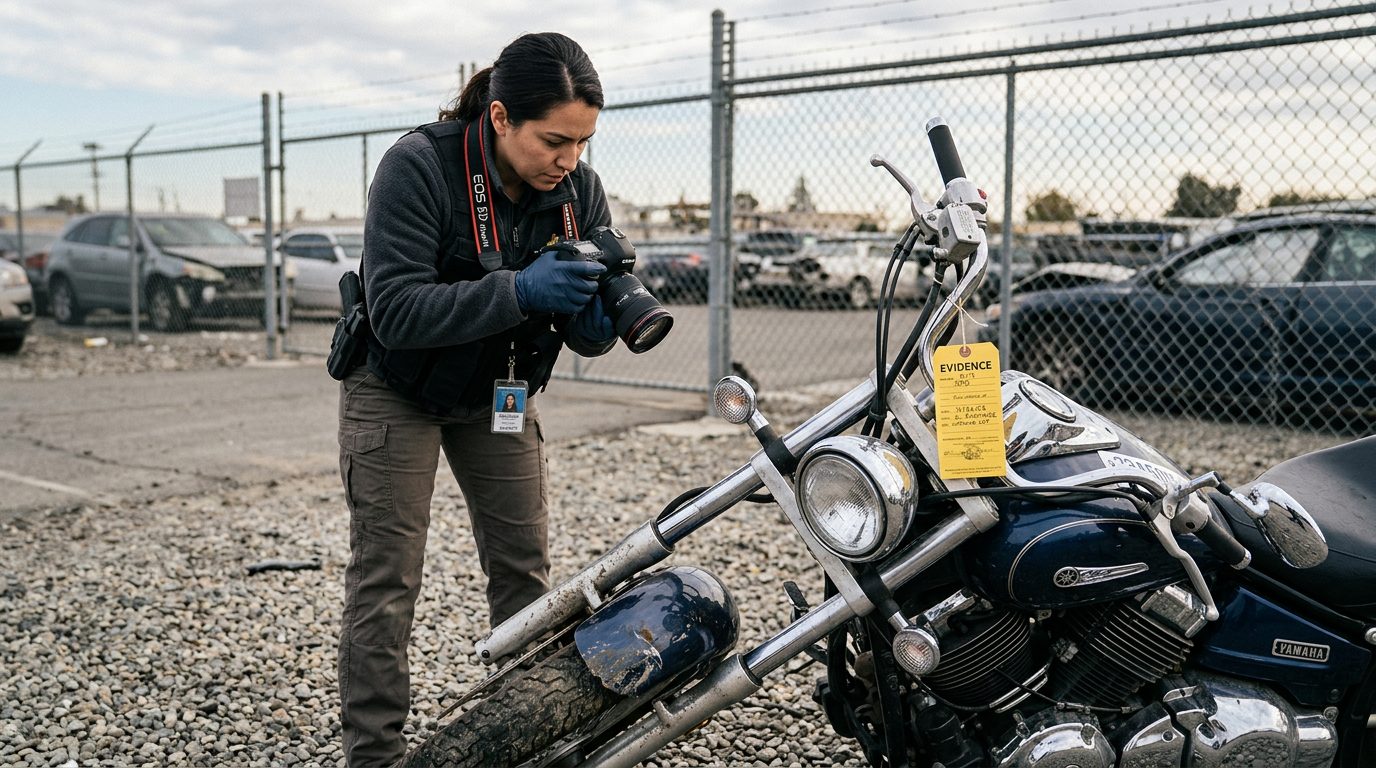
Proof usually comes from the scene, the motorcycle, public records, and medical care. Road conditions change fast. A hole can be patched within days, so early photos matter.
- Photos and video of the defect and the surrounding roadway, taken as soon as it’s safe.
- Measurements of the defect’s depth and size, if you can record them safely.
- Police, fire, and dispatch records from the scene.
- Damage to the motorcycle and gear, plus tire marks where they exist.
- Witness details, including other riders who hit the same defect.
- Public records requests for prior complaints, maintenance logs, service requests, and repair history. These can show whether the agency knew about the hazard.
- Medical records that connect your injuries to the crash.
Keep the bike, helmet, and clothing in their post-crash condition until you’ve discussed them with a lawyer.
How the Claim Process Works, Step by Step
The process moves in stages, from medical care to the agency’s response. Timelines vary, and no timeline is certain.
- Get medical care. Keep every bill, record, and appointment note.
- Preserve evidence. Save your helmet, gear, and bike. Avoid posting about the crash on social media.
- Review the facts. A free consultation covers the crash location, the defect, the agency, and the deadlines.
- Investigate. Request public records on the agency’s notice and repair history.
- File the written claim. Present it to the correct agency within the six-month window.
- Await the response. The agency investigates and responds. If it rejects the claim or does not act, a lawsuit may follow under the rules that apply.
Each step builds on the one before it. Missing an early step can make later steps harder.
Comparative Fault, Injuries, and What Can Be Included
Damages fall into two main groups:
- Economic damages are objectively verifiable monetary losses. These include medical expenses, loss of earnings, and costs of repair or replacement, such as for a motorcycle or gear (Civil Code § 1431.2).
- Non-economic damages are subjective losses. These include pain, suffering, emotional distress, and loss of companionship (Civil Code § 1431.2).
When more than one defendant is involved, each defendant pays its share of non-economic damages in proportion to its own fault (Civil Code § 1431.2). Damages may also be awarded for harm certain to continue in the future (Civil Code § 3283).
Not sure what your next step is?
Talk it through with our team — the first consultation is free, confidential, and carries no obligation.
Frequently Asked Questions
Can I sue the city if I hit a pothole on a motorcycle?
Possibly. A written government claim is generally required first, and the six-month window applies.
What happens if you hit a pothole on a motorcycle?
A pothole can cause loss of control, a fall, and injuries. Whether a claim exists turns on the defect and the facts.
How long does a claim take?
Timing varies with the agency’s response and whether a lawsuit is needed. No timeline is certain.
What if I waited?
The six-month window is short, so early action matters. Ask about your dates as soon as you can.
Can I still recover if I was partly at fault?
Possibly. Your recovery is reduced by your share of fault, but it is not automatically barred.
Does a pothole claim cover my motorcycle?
Repair or replacement costs for the bike and gear can be economic damages. Whether they apply to your crash turns on the facts.
Why Colvin Accident Lawyers Handles These Claims
Colvin Accident Lawyers is a personal injury practice based in Bakersfield, California. It handles motorcycle, car, truck, bicycle, pedestrian, premises liability, and wrongful death cases.
Donald Norman Colvin is the lawyer. Our team includes support staff who help with the file, records, and dates. We work with riders and families in Kern County and nearby communities.
Each case turns on its own facts, so no result can be predicted. Our first consultation is free, confidential, and carries no obligation to continue.

Talk With Colvin Accident Lawyers About Your Crash
You may still be recovering. You may be worried about a deadline, or helping a family member decide what comes next. If a road defect caused the crash, you may have a claim worth reviewing.
Contact us to schedule your free first consultation. We’ll go over the crash facts and the claim dates with you.
Colvin Accident Lawyers, Bakersfield, California — responsible for this site.
Act Promptly
Claims against a city or county usually involve a formal written government claim and procedural steps that can be easy to miss. Speak with our office early so the important details of your crash are preserved.
What to Gather After a Pothole Crash
Photos of the Road
Pictures of the pothole, its size and location, and any warning signs or lack of them can help document the road condition.
The Scene and Your Bike
Photos of the motorcycle, damaged gear, and the area where you went down can support the details of your crash.
Medical Care and Records
Prompt evaluation and treatment create records of your injuries. Keep copies of every bill, prescription, and appointment note.
Witnesses and Reports
Names and phone numbers of anyone who saw the crash, plus any police or incident report, can be valuable to your claim.