Motorcycle Accident Lawyer | Bakersfield, CA
Understanding your motorcycle accident case, step by step
A plain-language guide from Colvin Accident Lawyers, a Bakersfield personal injury practice that represents motorcycle riders and their families after serious crashes.
By Donald Norman Colvin · Published October 15, 2026
How Does a Motorcycle Accident Case Work in California? The Short Answer
If you want to know how does a motorcycle accident case work in California, the short answer is that it moves through a few stages. These include finding out who caused the crash, identifying the insurers, documenting your losses, sending a demand to the insurer, and filing a lawsuit if talks fail before the deadline. Most claims end without a trial. No one can predict how long a specific claim will take or what it will involve.
Every case turns on its own facts. The rules below come from California statutes and court decisions. This page explains how those pieces fit together for riders, passengers, and families.
We walk through each stage in order. We cover the first steps after a crash, how fault is decided, who may be responsible, who pays, the deadlines, the building of a claim, and the common questions people ask. Nothing on this page is a promise about how any claim will turn out.
Not sure what your next step is?
Talk it through with our team — the first consultation is free, confidential, and carries no obligation.

Steps to Take Right After a Motorcycle Crash
The first steps protect your health and your evidence. Medical care comes first, and records should start on day one.
Get a medical evaluation even when injuries seem minor. Some injuries, including soft-tissue and head injuries, may not show symptoms until hours or days later. A medical record made soon after the crash helps connect your injuries to the collision.
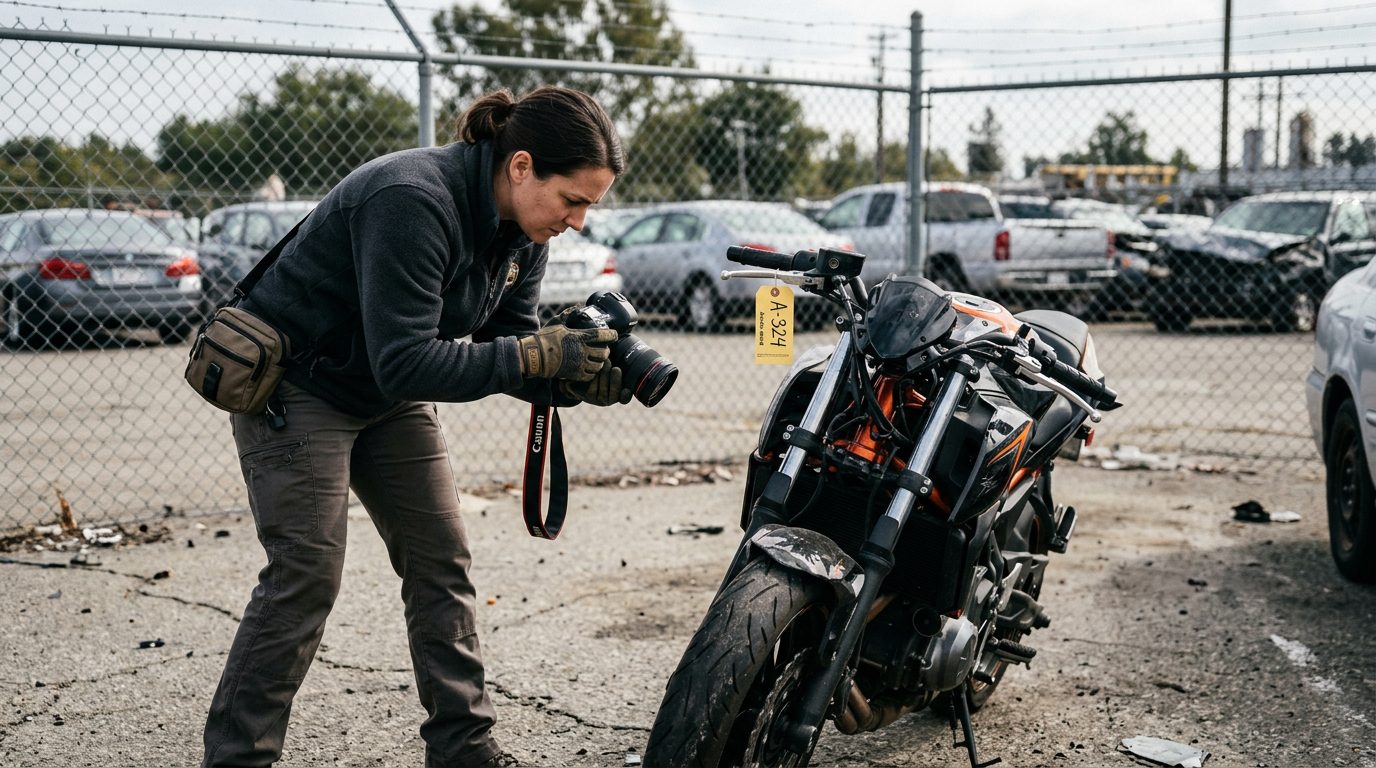
If you can, photograph the scene, the vehicles, the road surface, any skid marks, and your helmet and gear. Write down witness names and the other driver’s insurance details. Ask for the police report number before you leave.
Keep a simple log of medical visits, time missed from work, and out-of-pocket costs. These records show the real impact of the crash, and insurers ask for them early.
Be careful with recorded statements and releases. An insurer may ask for a recorded statement within days. Before you agree, understand what you’re saying and what any release would give up. Our catastrophic injury lawyer page explains how serious injuries are documented.
How Fault Is Decided Under California Law
Fault is decided by comparing each party’s conduct with the care a reasonable person would use. Under Civ. Code § 1714, everyone is responsible for injuries caused by a want of ordinary care. The exception covers injuries the injured person brought upon themselves through a want of ordinary care.
Did the other party owe a duty of care? Did they break it? Did that break cause the crash? Did you suffer damages? The Judicial Council’s civil jury instructions describe these elements for juries.
Under California’s negligence statute, Civil Code section 1714, a person whose negligence causes injury is generally responsible for that harm, subject to certain exceptions and limits. California also applies pure comparative fault under Li v. Yellow Cab Co. (1975) 13 Cal.3d 804, so a rider who shares some of the fault may still recover, with the award reduced in proportion to their share of the fault (Li v. Yellow Cab Co. (1975) 13 Cal.3d 804).
Investigation usually starts with the police report, scene measurements, vehicle damage, and witness statements. Traffic or business camera footage can also matter. Insurers run their own review, and disputes often center on lane changes, left turns across traffic, and whether a driver saw the rider. The evidence decides these points.
Who May Be Responsible: Drivers, Companies, Road Defects, and Uninsured Drivers
The at-fault driver is the most common responsible party. In many crashes, the claim goes to that driver’s liability insurer. Depending on the facts, a claim may also reach a company whose vehicle or driver was involved. Our truck accident lawyer page covers commercial vehicle crashes.
A pothole or unsafe road surface may involve a city, a county, or another public agency. Claims against a public agency follow different rules and shorter deadlines. The deadlines section below covers those timing rules.
When the at-fault driver has no insurance, your own uninsured motorist coverage may matter. California also limits recovery in some cases involving uninsured or impaired drivers. Under Civ. Code § 3333.4, an injured person cannot recover non-economic losses in some motor vehicle cases. This applies if the person was the owner of a vehicle that was not insured as required by state financial responsibility laws. It also applies if the injured person was convicted of driving under the influence in the crash. The statute has an exception for certain injuries caused by an impaired motorist. The facts matter.
Who Pays: Insurance Coverage, Medical Bills, and Liens
Insurance is the main source of payment in most motorcycle claims. The at-fault driver’s liability coverage pays for harm that driver caused, up to the policy limits. If you carry uninsured motorist or medical payments coverage, your own policy may also apply. Check your policy’s declarations page after a crash.
Medical bills are often paid through health insurance or other programs. Those payers may seek repayment from your claim. Lost wages and future medical care are also part of many claims.
Damages fall into two main groups. Economic damages are objectively verifiable money losses, such as medical bills, lost earnings, and property repair or replacement. Non-economic damages are subjective losses such as pain, suffering, and emotional distress. Under Civ. Code § 1431.2, each defendant is liable for non-economic damages only in proportion to that defendant’s fault.
Future losses can also be part of a claim, such as future medical care.
Deadlines That Control a California Motorcycle Claim
Deadlines are often the most important part of a motorcycle claim. A missed deadline can bar a claim, so timing should be reviewed early.
For most personal injury lawsuits, the main deadline is two years. Under Code Civ. Proc. § 335.1, an action for injury to, or for the death of, an individual caused by the wrongful act or neglect of another must be filed within two years.
Families should review those rules early, and our wrongful death lawyer page explains the claim process.
Claims against a public entity have an earlier deadline. Under Gov. Code § 911.2, a claim for death or for injury to person or personal property must be presented not later than six months after the cause of action accrues. Other claims against a public entity must be presented not later than one year after accrual.
Property damage to your motorcycle may have its own deadline. Check that deadline for your facts rather than assuming it matches the injury deadline.
Not sure what your next step is?
Talk it through with our team — the first consultation is free, confidential, and carries no obligation.
Building the Claim: Evidence, Damages, and Factors That Affect Value
The value of a claim depends on documented losses and on how the injury affects your daily life. Under Civ. Code § 3333, the measure of damages for an obligation not arising from contract is the amount that compensates for all the detriment proximately caused. This includes harm that could not have been anticipated.
Medical records, treatment plans, and a doctor’s opinion on the severity and permanence of injuries are the core evidence. Tell every treating provider about every symptom, because gaps in records can be used against a claim.
Several factors shape how insurers and courts view a claim. These include injury severity and permanence, the allocation of fault, available insurance limits, and the quality of evidence. Serious or lasting injuries are covered on our catastrophic injury lawyer page.
Published averages do not predict an individual claim. Those figures mix cases with different injuries, fault positions, and coverage. Your claim depends on its own facts.
Negotiation, Demand, and Filing a Lawsuit
A demand letter is a written request to the insurer. It explains who was at fault and lists your damages with supporting records. The insurer reviews the letter and may respond with a counteroffer. Talks can take several rounds, and some cases use mediation when talks stall.
If talks do not resolve the claim, a lawsuit may be filed before the deadline. Discovery then begins. Discovery is the exchange of information through written questions (interrogatories), depositions, and document requests. Many cases resolve before trial, but some do go to trial.
Timelines vary for good reasons. Medical treatment may need to finish before a claim can be fully valued. Disputes over fault, insurer review, and court schedules can also extend the process. No reliable timeline can be set at the start of a case.
Common Questions About Motorcycle Accident Claims in California
Who is usually at fault in motorcycle accidents?
Fault is decided from the evidence in each case. Lane changes, left turns, and visibility are common points of dispute.
How long does a motorcycle settlement take?
No reliable timeline can be promised at the start. Medical treatment, fault disputes, and insurer response all affect timing.
What is the average settlement for a motorcycle accident?
General averages do not predict an individual claim. Each claim depends on its own injuries, fault, and available coverage.
How much compensation can a motorcycle claim involve?
A claim may include medical costs, lost income, property damage, and non-economic losses like pain and suffering. No dollar amount can be assigned without reviewing the specific facts.
Can a motorcycle passenger make a claim?
Who may be responsible depends on the facts of the crash.

Talk With Colvin Accident Lawyers About Your Motorcycle Crash
If you’re a rider or a family member working through medical care, insurer calls, and a deadline you don’t yet understand, you don’t have to sort it out alone. Donald Norman Colvin and our team at Colvin Accident Lawyers in Bakersfield can review the facts of your crash, the deadlines that may apply, and the possible sources of payment. Our initial consultation is free, confidential, and carries no obligation to continue. Contact us to schedule one. No outcome can be predicted, because every case depends on its own facts.
Colvin Accident Lawyers, Bakersfield, California — responsible for this site.
The main stages of a motorcycle accident case
1. Free first consultation
A first consultation is confidential and comes with no obligation to continue. We review what happened, your injuries, and any paperwork you have so far.
2. Investigation and evidence
Police reports, photos, witness statements, and vehicle data can all matter. Preserving this evidence early helps build an accurate picture of the crash.
3. Medical care and records
Getting prompt medical evaluation protects your health and creates the records that document your injuries and treatment over time.
4. Insurance claims and negotiation
Insurers often review a claim carefully before responding. We communicate with the insurance companies involved and present the facts and documentation supporting your claim.
5. Resolution or litigation
Some cases resolve through negotiation. If a fair resolution cannot be reached, we discuss with you the option of filing a lawsuit and what that process involves.
Why riders contact us early
Confidential first talk
Your first consultation is private, and there is no obligation to continue after it.
Evidence gets preserved
Early steps such as collecting reports, photos, and records help keep important details from being lost.
Injuries come first
We keep your medical needs in view throughout the case so that treatment does not get lost in paperwork.
Focused on accident victims
Colvin Accident Lawyers represents injured riders, drivers, passengers, and families of people killed in accidents.
Based in Bakersfield
We are a Bakersfield-based practice that represents clients in Kern County and nearby communities.
Be careful with insurance adjusters
An insurance company may contact you soon after a motorcycle crash. Before you give a recorded statement or sign any release, consider speaking with a lawyer first. Every case is different, and what you say early can affect your claim.
Talk with Colvin Accident Lawyers about your motorcycle accident
Related practice areas
- Motorcycle Crash With an Uninsured or Underinsured Driver in California
- What Injuries Can I Claim After a Motorcycle Crash in California?
- Who Pays Medical Bills After a Motorcycle Crash in California?
- What Factors Affect the Value of a Motorcycle Injury Claim in California?
- What happens if someone hits you in a company vehicle?
- How a Car Accident Claim Works in California: Steps, Deadlines and Who Pays