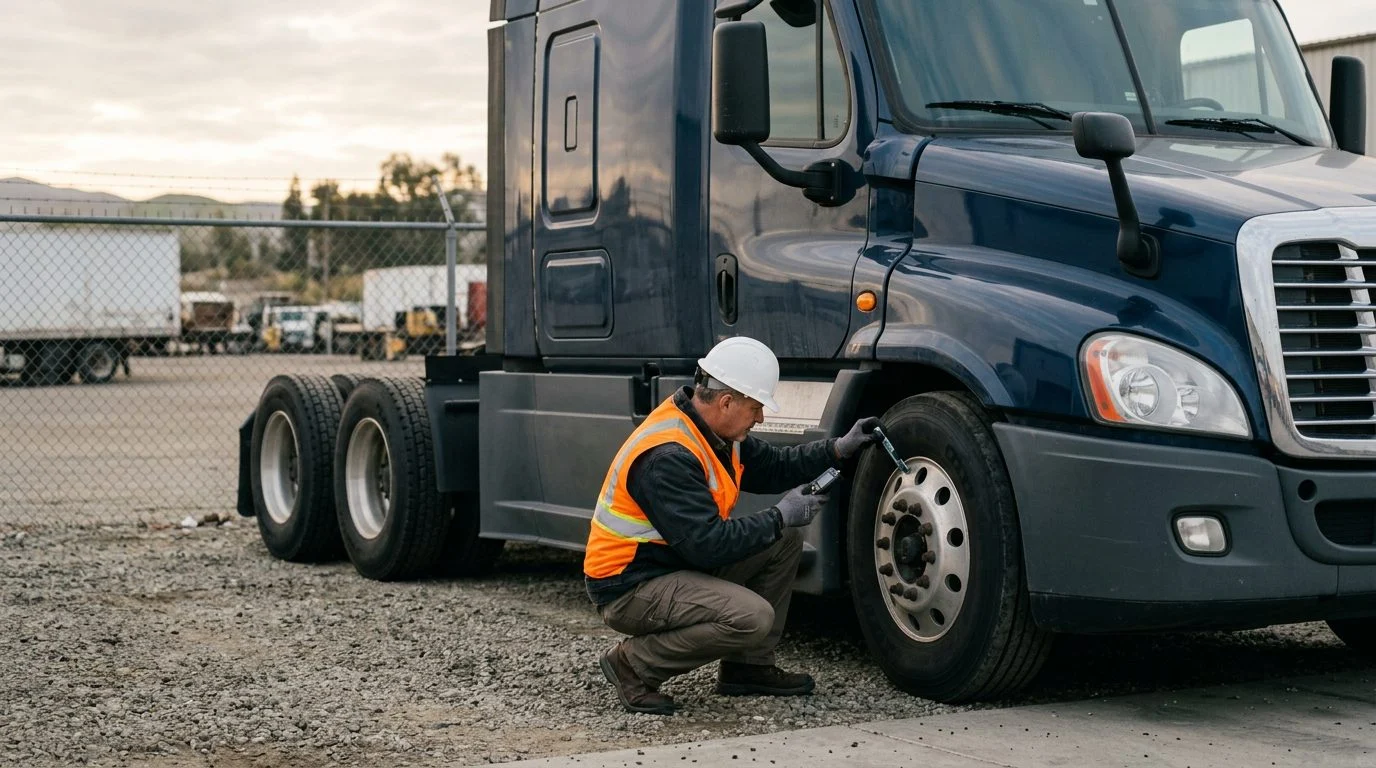
Truck Accidents | Bakersfield and Kern County
Truck Accident Lawyer Bakersfield: Who Pays in California?
Truck crashes often involve several parties and several insurance policies. Learn which parties may be involved after a crash in California, then talk with Colvin Accident Lawyers about your situation.
By Donald Norman Colvin · Published October 24, 2026
After a truck crash in California, more than one party may be responsible for your losses. The driver, the company that employs the driver, the truck’s owner, and sometimes a cargo company or parts maker can all be part of the picture. Insurance policies are how most of these claims get paid, and which policies apply depends on the facts of your crash.
This guide explains who pays after a truck accident in California, one party at a time. It also covers how fault is divided, which losses can be claimed, and the deadlines that matter most. Colvin Accident Lawyers is based in Bakersfield. This page is general information to help you understand the process.
Why the Question of Who Pays Is Harder After a Truck Crash
A truck crash usually involves more than one company and more than one insurance policy. A car crash may involve two drivers. A truck crash can involve the driver, the company that hired and dispatched the driver, the company that owns or leases the truck, a freight broker, a cargo loader, and the insurers behind each of them.
Many injured people don’t know who employed the driver. They may not know who owns the truck or which insurer covers the load. That information often comes out slowly, through the crash report, the driver’s paperwork, and the claim itself.
Two questions drive the analysis. The first is liability: who is legally responsible for the crash? The second is recovery: what losses can be claimed, and which coverage pays them? This page covers both. It starts with the driver and works outward to the companies, owners, insurers, and other parties.
Not sure what your next step is?
Talk it through with our team — the first consultation is free, confidential, and carries no obligation.
The Truck Driver: Personal Liability for Negligent Driving
The driver can be personally liable when careless driving causes a crash. California’s general negligence rule says everyone is responsible for an injury caused by a lack of ordinary care in managing their person or property (Civ. Code § 1714).
For a driver, that can mean speeding, distraction, fatigue, following too closely, or an unsafe lane change. Proof often comes from the crash report, witness statements, phone records, and data the truck recorded.
A driver’s own auto policy may apply. Commercial trucks, however, are often insured under commercial policies with different limits. An individual driver’s personal assets may also be far smaller than a serious injury claim. That is one reason these claims often reach the trucking company and its insurer, too.
The driver’s share of fault also matters, because fault can be divided among several parties. Keep every document you receive from the driver or the scene. Keep your own photos, too.
The Trucking Company: Liability for an Employee Driver
The key question is whether the driver was working for the company when the crash happened. A driver hauling a load for a carrier is a clear example. A driver on a personal errand presents a harder question. Dispatch records, delivery paperwork, and the driver’s logs can help answer it.
The company may also face claims about its own conduct. Facts such as prior safety violations or a driver’s history may bear on those claims. Punitive damages, discussed below, can apply in some cases based on the company’s own conduct.
If the driver was on the job, the company’s coverage may be part of the picture.
The Truck Owner and Lessor: Vehicle Code Owner Liability
The owner of a vehicle can be liable when it lets someone else drive, but that liability has limits. California Vehicle Code § 17150 makes an owner responsible for death or injury to person or property resulting from a negligent or wrongful act or omission in operating the vehicle, when the driver uses it with the owner’s express or implied permission (Veh. Code § 17150).
Section 17151 caps that owner liability. It sets $15,000 for one person hurt or killed in one accident, $30,000 for more than one person, and $5,000 for damage to others’ property (Veh. Code § 17151). The cap applies to liability that does not arise from a principal-agent or master-servant relationship.
That distinction matters. An owner who also employs the driver may be responsible in a different way than a leasing company that only rents the truck. The owner isn’t liable for punitive damages meant to punish the driver. It can still face damages for its own wrongful conduct.
Lease agreements, registration papers, and trip records can show who owns the truck and who controls it. Those documents often show which rules apply.
Insurers and Coverage: Commercial Policies, Limits, and Your Own Coverage
Insurance policies are how most truck crash claims get paid, and several policies can respond to one crash. The real question is which policy applies to which party.
Federal rules set minimum financial responsibility for motor carriers. The federal schedule in 49 C.F.R. § 387.9 lists $750,000 for for-hire carriage of nonhazardous property in interstate or foreign commerce, for trucks rated 10,001 pounds or more. Those figures are minimums. Other limits apply to other types of cargo.
Your own coverage matters too. California requires insurers to include uninsured motorist coverage in bodily injury policies for sums you’re legally entitled to recover from an uninsured driver, but the insurer and the applicant may agree to delete the coverage completely or when a vehicle is operated by named persons (Ins. Code § 11580.2). Cal. Ins. Code § 11580.2 provides that ‘uninsured motor vehicle’ also means an insured motor vehicle where the liability insurer thereof is unable to make payment with respect to the legal liability of its insured within the limits specified therein because of insolvency. Your own policy may also include medical payments coverage.
Insurance adjusters work for the insurer, not for you. Early settlement offers are often made before the full extent of injuries is known. Think carefully before you give a recorded statement or sign a release.
Other Parties Who May Share Responsibility
Cargo loaders, maintenance shops, parts makers, freight brokers, and public agencies can also share responsibility in some crashes.
Cargo that is loaded badly or not secured can shift or fall. A crash caused by that cargo may point to the company that loaded it. Brake, tire, or steering failures may point to a maintenance provider or parts maker, depending on what caused the defect.
Freight brokers arrange transport between shippers and carriers.
Public agencies come into play when a road condition contributed to a crash. For claims involving death or injury, California requires the claim to be presented within six months after the cause of action accrues (Gov. Code § 911.2). Missing that deadline can limit or end the claim against that public party.
Have questions about what happened?
Ask our team directly. The first conversation is free, confidential, and there is no obligation to continue.
How Fault Is Divided in California: Comparative Negligence
If a court found you 20 percent at fault, your award would shrink by that share.
Fault can be split among several defendants. Under Civ. Code § 1431.2, each defendant is liable for non-economic damages, such as pain and emotional distress, only in direct proportion to its own percentage of fault. The trucking company, the driver, and a parts maker may each answer for a different share.
Evidence used to assign fault includes the crash report, driver logs, electronic control module data, dashcam footage, inspection records, and witness statements. Each piece can point in a different direction. Fault in a truck case is rarely clear on the first day.
What Losses Can Be Recovered: Medical Bills, Lost Wages, and Other Damages
Injured people can typically claim economic losses, such as medical bills and lost pay. They can also claim non-economic losses, such as pain and suffering.
Under § 1431.2, economic damages are objectively verifiable monetary losses. They include medical expenses, loss of earnings, loss of business or employment opportunities, and costs of repair or replacement (Civ. Code § 1431.2). Non-economic damages are subjective losses, such as pain, emotional distress, and loss of companionship. Those are harder to measure.
Lost wages are documented with pay stubs, tax returns, employer records, and medical work restrictions. Self-employed people usually rely on invoices, business records, and tax filings instead.
Punitive damages are different. Under Civ. Code § 3294, they require proof by clear and convincing evidence of oppression, fraud, or malice. Cal. Civ. Code § 3294 reads: “(b) An employer shall not be liable for damages pursuant to subdivision (a), based upon acts of an employee of the employer, unless the employer had advance knowledge of the unfitness of the employee and employed him or her with a conscious disregard of the rights or safety of others or authorized or ratified the wrongful conduct for which the damages are awarded or was personally guilty of oppression, fraud, or malice.” That is a higher standard of proof than ordinary negligence. For a corporate employer sued over an employee’s acts, the advance knowledge, conscious disregard, authorization, ratification, or act of oppression, fraud, or malice must be on the part of an officer, director, or managing agent of the corporation.
When Workers’ Compensation Applies to a Truck Driver’s Injury
A driver hurt while working may have a workers’ compensation claim against the employer. Under Lab. Code § 3600, liability for workplace injuries arising out of and in the course of employment exists without regard to negligence in those cases where the conditions of compensation set out in the statute concur. The key question is whether the injury happened on the job.
Under Lab. Code § 3852, an employee’s compensation claim does not affect the right to pursue damages against someone other than the employer. A driver hit by another driver, or hurt by a defective part, may have both a workers’ comp claim and a claim against that third party.
The two claims run on separate tracks.
Deadlines That Affect Who Can Be Paid
In most California injury cases, the general deadline to sue is two years. Code Civ. Proc. § 335.1 sets a two-year limit for an action for injury to, or death of, an individual caused by another’s wrongful act or neglect. Code of Civil Procedure § 335.1 provides that an action for assault, battery, or injury to, or for the death of, an individual caused by the wrongful act or neglect of another must be brought within two years. Other provisions may affect this deadline.
Claims against public agencies start sooner. The six-month presentation rule discussed above applies first, so that deadline needs early attention when a public party may be involved.
Federal rules also set testing timelines. The FMCSA post-accident testing rules require alcohol and drug testing for a commercial driver involved in a qualifying crash, within set windows.
Truck data, electronic logs, and video can be overwritten or lost. Early requests to preserve these records help protect them.
Want to know where you stand?
Tell us what happened and our team will walk you through the options available to you, at no cost.
Talk With Colvin Accident Lawyers About Your Truck Accident
If you’re reading this after a crash, you may have a family member in the hospital. You may have a loved one who didn’t come home. You may also be facing bills and unanswered questions about which company and insurer will pay.
Common Questions
Who pays after a truck accident in California?
Usually, the at-fault party’s insurance pays through a claim or lawsuit. Workers’ compensation or Medicare may also be involved.
Can I sue the trucking company as well as the driver?
In many cases, yes.
How long do I have to file a lawsuit after a truck accident?
Generally two years from the injury (Code Civ. Proc. § 335.1).
How does being partly at fault affect recovery?
Yes.
Colvin Accident Lawyers is based in Bakersfield, California, and represents accident victims and families in truck crash cases. Our first consultation is free, confidential, and carries no obligation to continue. If a truck crash has left you or someone you love facing these questions, reach out through our contact page to review the driver, the carrier, the owner, and the insurers involved.
Colvin Accident Lawyers, Bakersfield, California — responsible for this site. Responsible lawyer: Donald Norman Colvin.
How we approach your truck accident case
A free, confidential first consultation
Your initial consultation is free, confidential and carries no obligation to continue.
Careful review of the facts
We look at the crash report, medical records, photos and other documents to understand what happened and who may be involved.
Clear answers for you and your family
We explain the parties, insurance and legal issues in plain language so you can make informed decisions.
Parties that may be involved after a truck crash
The truck driver
The driver's conduct, hours on the road and compliance with traffic laws may all be relevant to a claim.
The trucking company
Carriers may be connected to a crash through hiring, training, supervision or dispatch practices.
Other drivers and vehicle owners
A crash can involve more than one vehicle, and more than one driver may share responsibility.
Maintenance and equipment providers
Brake, tire, cargo and other equipment problems can sometimes be traced to a company that serviced or manufactured the parts.
Preserve evidence early
Photos, dashcam video, electronic logs and witness contact information can disappear quickly. Keep copies of everything you have, and speak with a lawyer about preserving evidence before it is lost.