Motorcycle Accidents | Bakersfield and Kern County
When a Motorcycle Crash Takes a Life, Proving Fault Comes First
Colvin Accident Lawyers helps families in Kern County, Fresno, Visalia, Lancaster, Palmdale, Delano, and Tehachapi understand how fault is shown in a fatal motorcycle crash in California.
By Donald Norman Colvin · Published November 5, 2026
Learning how to prove fault in a fatal motorcycle crash in California starts with one question: what did the other driver do wrong? The rider can’t testify, so that proof comes from the crash report, physical evidence, electronic data, witnesses, and records. This guide explains each source for families in Bakersfield, Kern County, Fresno, and Visalia.
Why Proving Fault Is Harder When the Rider Has Died
When the rider dies, no one is left to describe the crash from the rider’s seat. The claim has to rest on physical evidence, records, and witness accounts instead.
California law decides who may bring the claim. Under California Code of Civil Procedure § 377.60, a wrongful death claim may be asserted by the decedent’s surviving spouse, domestic partner, children, and issue of deceased children, or, if there is no surviving issue, by the persons who would be entitled to the decedent’s property by intestate succession. The decedent’s personal representative may also assert the claim on their behalf, and certain dependents, such as a putative spouse, stepchildren, or parents who depended on the decedent, may also qualify. Others who depended on the rider, such as parents or stepchildren, may qualify too (Code of Civil Procedure § 377.60). Under California Code of Civil Procedure § 377.60, certain surviving family members and other qualifying persons may bring a wrongful death cause of action.
Evidence has a short shelf life. Video gets recorded over, damaged vehicles get repaired, and phone data can be lost. Acting early protects the proof. This page covers the proof itself. Our wrongful death page covers the wider claim process.
Someone may be responsible for your family's loss, and our team can talk with you about what the evidence shows in your situation. Talk it through with our team — the first consultation is free, confidential, and carries no obligation.

What You Must Show: Duty, Breach, Causation, and Damages
Each one needs its own proof.
California law starts with ordinary care. Everyone is responsible for injuries caused by a want of ordinary care in managing their property or person, except so far as the injured person has, willfully or by want of ordinary care, brought the injury upon themselves (Civil Code § 1714). Every driver owes that duty to other road users.
A breach is a specific act or failure. Common examples include a left turn across the rider’s path, a failure to yield, distracted driving, or an unsafe lane change. Speed counts too. No one may drive faster than is reasonable or prudent for the weather, visibility, traffic, and road (Vehicle Code § 22350).
Causation links the breach to the fatal impact. Reconstruction and medical evidence often do that work. Damages include medical bills and burial costs. They also include losses like companionship, which the law treats as non-economic (Civil Code § 1431.2).
Start With the Official Crash Report and the Timeline
A collision report is usually the first official record of the crash. Responding agencies, such as the California Highway Patrol or local police, record the parties, vehicle positions, observations, and any citations.
A driver involved in a crash that causes death or injury must report it within 10 days. The report can be filed personally or through an insurance agent, broker, or legal representative. The driver must also identify anyone complaining of bodily injury (Vehicle Code § 16000). That driver’s account becomes another record to compare.
The officer’s findings are evidence, not a final ruling. A report can state a conclusion about fault that doesn’t match the skid marks, the damage, or a witness’s account. Check each finding against the rest of the file.
Build a timeline next. Write down the time of day, lighting, weather, and the order of movements before impact. A clear timeline makes gaps and contradictions easier to spot.
Physical and Scene Evidence That Shows What the Other Driver Did
Physical evidence shows where vehicles were and how they moved. It can test a driver’s account against hard facts.
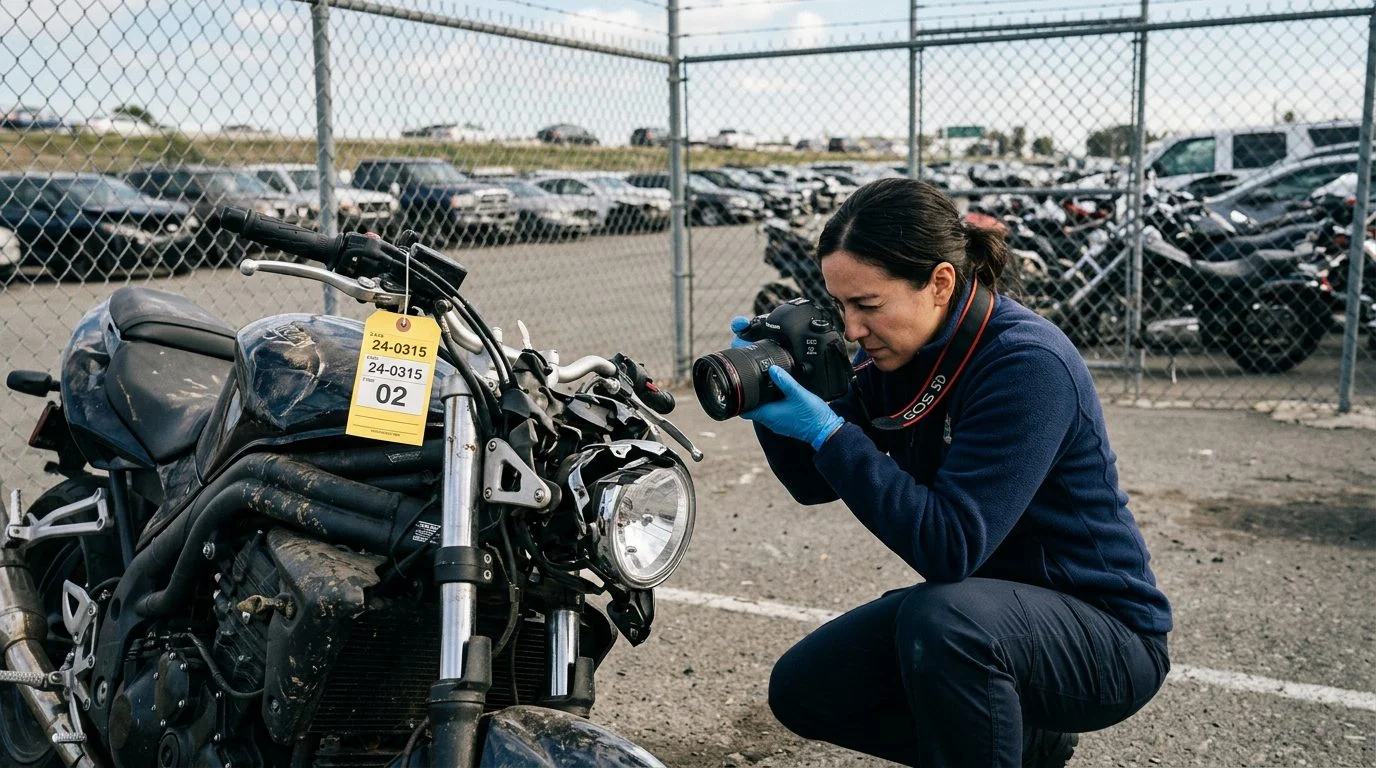
Start with the scene. Skid marks, gouges, debris fields, and the final rest positions of the motorcycle and the other vehicle show the path each one followed. Damage on the other vehicle matters too. A contact point on a side panel can show the angle of approach or a turn across the rider’s lane.
Video often disappears first. Many surveillance, traffic, and dashcam systems record over old footage on a schedule. Ask for footage promptly and in writing.
Witnesses are most useful close to the event. Bystanders, other motorists, and people who called 911 can describe what they saw before memories fade. Write down their names and contact details early.
Road design counts as well. Sight lines, signage, posted speed limits, and lane markings show whether the other driver had a fair chance to see and avoid the rider.
Electronic Data, Phone Records, and Rider-Side Evidence
Electronic data can show speed, braking, and distraction. It often must be preserved before the vehicle is repaired or sold. Many newer vehicles have event data recorders that may store speed and braking information for a few seconds before a crash.
Phone records can show whether the other driver was texting or on a call at impact. In a lawsuit, those records are pursued through formal discovery, the court-supervised exchange of evidence. Early requests make records easier to secure.
Rider-side evidence matters too. The motorcycle’s condition, maintenance history, lighting, and the rider’s helmet and gear can all belong in the reconstruction. The Snell Memorial Foundation explains that helmets reduce the forces of impact and describes the testing standards helmets must meet (Snell Memorial Foundation helmet FAQ). Helmet standards don’t decide fault, so the reconstruction must still show how the crash happened.
Defense arguments about the rider’s speed or lane position get answered the same way: with measurements, not assumptions.
How Insurers and Courts Weigh Fault, Including Comparative Fault
Non-economic damages follow a separate rule. Each defendant is liable only for its own percentage of fault (Civil Code § 1431.2).
An adjuster’s fault percentage reflects the insurer’s file. A court or jury may view the same facts differently. The Judicial Council publishes the California civil jury instructions on negligence and comparative fault (CACI jury instructions).
Be careful with words about who caused the crash. Expressions of sympathy about a death are not admissible as an admission of liability. A statement of fault, however, is not protected (Evidence Code § 1160).
If an insurer gives you a deadline, check it yourself. Misleading a claimant about the statute of limitations is listed as an unfair claims settlement practice when an insurer does it knowingly or so often that it indicates a general business practice (Insurance Code § 790.03).
Not sure what your next step is?
Talk it through with our team — the first consultation is free, confidential, and carries no obligation.

Key Takeaways and Deadlines to Keep in Mind
The strongest proof ties the report, physical evidence, electronic data, and witness accounts into one consistent timeline. Fault disputes usually focus on the gaps and contradictions.
Two deadlines matter most. California sets a two-year limitation period for an action for the death of an individual caused by another’s wrongful act or neglect (Code of Civil Procedure § 335.1). If the claim is against a public entity, a claim relating to a cause of action for death must be presented not later than six months after the accrual of the cause of action (Government Code § 911.2). The exact deadline depends on the facts of the case, so confirm it early.
Frequently Asked Questions
Who can file a wrongful death claim for a motorcyclist in California?
Usually the surviving spouse, domestic partner, children, or issue of deceased children. If none of them survives, the decedent’s parents or other intestate heirs may also qualify without showing dependency. Persons who depended on the rider, such as stepchildren, may also qualify.
Does a traffic violation help prove fault?
It can.
Is the police report the final word on fault?
No. It is evidence that should be checked against physical proof and witness accounts.
If your family is left asking what the other driver did, you don’t have to sort through the evidence alone. Our team offers a free, confidential first consultation with no obligation to continue. You can contact Colvin Accident Lawyers to start that conversation.
What Helps Show Fault in a Fatal Motorcycle Crash
Official Crash Reports
Police reports, citations, and collision diagrams can record the scene, the vehicles involved, and the officers' initial observations.
Witness Accounts
Statements from drivers, passengers, and bystanders can help confirm how the crash happened, often while memories are still fresh.
Physical and Vehicle Evidence
Skid marks, debris patterns, damage to the bike and vehicles, and preserved helmets or gear can all help reconstruct the collision.
Early Evidence Preservation
Video from nearby businesses, traffic cameras, and phones may be overwritten quickly, so acting early matters.
Before You Speak With an Insurance Company
Insurance adjusters may contact a family soon after a fatal crash. Anything said in a recorded statement can be used later. Consider speaking with a lawyer before giving a statement or signing any release.
How Fault Is Typically Examined
Reviewing the Collision
Investigators and attorneys look at how the crash unfolded, including speed, lane position, right-of-way, and the actions of each driver or rider.
Connecting the Injuries to the Crash
Medical records, autopsy findings, and coroner reports help establish the cause of death and link it to the collision.