Wrongful Death Claims · Bakersfield & Kern County
Medical Bills and Liens Shouldn't Add to Your Family's Burden
Hospital statements and government claims can arrive while your family is still grieving. We help you understand what is owed and who is asking for it.
By Donald Norman Colvin · Published November 18, 2026
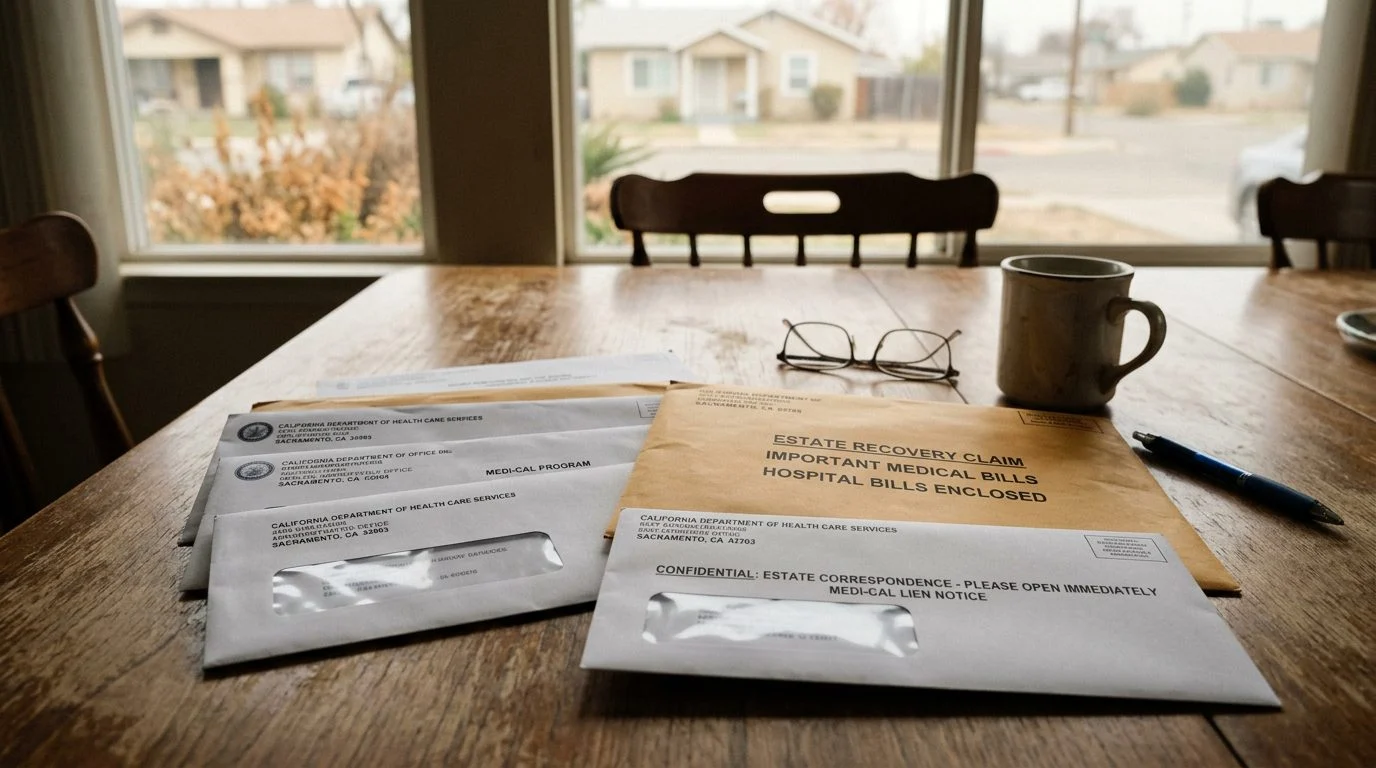
After a fatal accident, a family can receive a hospital bill, a collection letter, and a Medi-Cal lien notice in the same month. These are three different things. A Medi-Cal lien is the state’s claim to be repaid from money a family may later recover, and it covers only the medical part of that recovery.
A lien is not an ordinary bill. It attaches to a possible recovery, not to a monthly account. Each paper needs its own response.
What a Lien Is, and How It Differs From a Bill
A bill asks for payment for care that was already given. A lien is a claim against money that may come later from someone else. California defines a Medi-Cal lien as “the director’s claim for recovery, from a beneficiary’s tort action or claim, of the reasonable value of benefits provided on behalf of the beneficiary” (Welf. & Inst. Code § 14124.70).
Most liens attach to a settlement or judgment. They do not arrive as an account to pay. That is why a family may get both a bill and a lien notice. The bill concerns the account. The lien concerns the recovery. Answering one does not answer the other.
The paperwork looks alike, so families often mix these up. Read each letter closely. Check who sent it, what it claims, and what it asks you to do. A lien notice describes a claim against a future recovery.
If your family received a Medi-Cal or hospital lien notice after a loved one died in a crash, our team can help you sort those papers from the bills and the claim. Talk it through with our team — the first consultation is free, confidential, and carries no obligation.
Which Claims Can Attach After a Fatal Accident
Several claims can reach a recovery after a death. Medi-Cal is one. A hospital can hold a lien too. Other medical providers may send their own bills.
Section 14124.70 of the California Welfare and Institutions Code defines a Medi-Cal “lien” as the director’s claim for recovery, from a beneficiary’s tort action or claim, of the reasonable value of benefits provided on behalf of the beneficiary. The state keeps the part of a collected amount needed to reimburse its medical payments. Whether any part of a recovery remains for the individual depends on the facts of the case and on liens and other prior claims under California law.
A “beneficiary” under the state definition includes a person’s “estate or survivors” (Welf. & Inst. Code § 14124.70).
A hospital that gave emergency or ongoing care may also hold a lien. When the injured person dies, that lien reaches damages recovered by the heirs or personal representative, to the extent of the reasonable and necessary charges of the hospital and any hospital affiliated health facility (Civ. Code § 3045.1).
Medicare can pay first and seek repayment too. CMS explains that a conditional payment “must be repaid to Medicare when a settlement, judgment, award, or other payment is made” (CMS recovery process).
How a Medi-Cal Lien Is Calculated and Limited
A Medi-Cal lien covers only the medical part of a recovery. Recovery of the lien “is limited to that portion of a settlement, judgment, or award that represents payment for medical expenses, or medical care, provided on behalf of the beneficiary” (Welf. & Inst. Code § 14124.76).
The starting measure is the Medi-Cal rate. Outside managed care, “reasonable value of benefits” means the Medi-Cal rate of payment for the services rendered (Welf. & Inst. Code § 14124.70). Cal. Welf. & Inst. Code § 14124.70 reads: “(1) Except in a case in which services were provided to a beneficiary under a managed care arrangement or contract, “reasonable value of benefits” means the Medi-Cal rate of payment, for the type of services rendered, under the schedule of maximum allowances authorized by Section 14106 or, the Medi-Cal rate of payment, for the type of services rendered, under regulations adopted pursuant to this chapter, including but not limited, to Section 14105.” The claimed amount follows what Medi-Cal paid, not the hospital’s original bill.
Timing matters. No settlement, judgment, or award in a beneficiary’s action or claim for injury damages, where the director has an interest, is final or satisfied until the state gets notice and a reasonable opportunity to perfect and satisfy its lien (Welf. & Inst. Code § 14124.76). A settlement can stall if the lien is not addressed.
If the sides cannot agree on the medical portion, a court decides. The court is guided by Arkansas Department of Health and Human Services v. Ahlborn (2006) 547 U.S. 268. Either side may appeal the final ruling.
Ask for the lien amount, its legal basis, and the payment history in writing. Keep copies. Don’t accept or dispute a figure until you have those papers.
Hospital Bills: Who Owes What After a Death
Who pays a hospital bill after a death depends on the facts. Those facts include the estate’s assets, any insurance, and any papers signed during care.
A hospital lien has a notice rule.
A payer that ignores a valid notice carries its own risk. A payer that pays after receiving the notice, without paying the hospital its lien amount or so much of it as can be satisfied out of 50 percent of the moneys due under a judgment, compromise, or settlement after paying any prior liens, can be liable to the hospital for that amount (Civ. Code § 3045.4).
Claims against a dead person move through the estate process. A pending action or proceeding against the decedent that does not abate can continue against the personal representative, or to the extent provided by statute against the successor in interest, but the court may not permit it to continue against the personal representative unless proof of compliance with the Probate Code creditor claim rules is first made (Code Civ. Proc. § 377.41).
Signed hospital forms are worth reading closely. They can change who the bill is addressed to. Answer collection letters in writing, and keep copies.
How Medical Expenses Fit Into a Wrongful Death or Survival Claim
Wrongful death belongs to certain family members. These include a surviving spouse, domestic partner, children, and issue of deceased children; if there are no surviving issue, those entitled by intestate succession (which can include parents); and, if dependent on the decedent, parents, stepchildren, or a putative spouse. Any of them may sue directly or through the decedent’s personal representative (Code Civ. Proc. § 377.60).
Its damages are limited to the loss the decedent sustained or incurred before death, including any penalties or punitive or exemplary damages the decedent would have been entitled to recover had the decedent lived, and exclude pain, suffering, or disfigurement unless subdivision (b) applies (Code Civ. Proc. § 377.34). That wording reaches medical expenses the decedent incurred before dying. Pain, suffering, or disfigurement damages are excluded unless subdivision (b) applies, which depends on whether the action or proceeding was granted a preference pursuant to Section 36 before January 1, 2022, or was filed on or after January 1, 2022, and before January 1, 2026.
(CACI, Comparative Fault of Plaintiff)
Medical expenses and lien amounts affect how a recovery is divided and paid. Track the bills and the claim together.
No dollar figure can be predicted from bills alone.
Records and Deadlines to Protect Now
Start with the paperwork. Gather itemized bills, payment records, insurance explanations, lien and collection notices, the hospital discharge or death summary, and any Medi-Cal or Medicare notices.
Time matters. California gives two years to file an action for the death of a person caused by another’s wrongful act (Code Civ. Proc. § 335.1). A claim filed late may not proceed.
Keep a dated log of every call, letter, and payment. Note the name of each person you speak with. Keep originals of everything you sign.
Never ignore a lien or collection notice. A written response protects the family better than silence.
Not sure what your next step is?
Talk it through with our team — the first consultation is free, confidential, and carries no obligation.
Talk With Colvin Accident Lawyers About Your Family’s Bills
If your family holds a Medi-Cal or hospital lien notice after a loved one died in a crash, you may be facing bills and a claim at the same time. Colvin Accident Lawyers can help you separate the lien papers from the bills and see how each fits a wrongful death or survival claim. Contact Colvin Accident Lawyers to start the conversation.
La consulta inicial es gratuita, confidencial y sin compromiso de continuar.
Frequently Asked Questions
What is a Medi-Cal lien after a fatal accident?
It is the state’s claim to be repaid from a recovery for medical care it paid. It is limited to the medical portion of a settlement or judgment.
Is a hospital lien the same as a hospital bill?
No. A bill asks for payment for care. A hospital lien is a claim against a possible recovery under California’s hospital lien statute.
Who can bring a wrongful death claim in California?
Certain family members, including a surviving spouse, children, and dependent parents, may bring it, or the personal representative may bring it for them.
How long do families have to file?
California gives two years for an action for the death of a person caused by another’s wrongful act.
Donald Norman Colvin, Colvin Accident Lawyers, Bakersfield, California — responsible for this site.
Before you sign anything
Do not sign a settlement, release, or payment agreement until the medical bills and any liens connected to the claim have been reviewed. Ask for every lien claim in writing.
How we help families with medical bills and liens
Review the bills
We look at hospital statements, emergency care charges, and other medical records connected to the fatal accident.
Identify the claims
We work to find out which bills and liens have been asserted, including any Medi-Cal or hospital lien claims.
Handle the collection calls
We can respond to creditors and lienholders on your family's behalf so you do not have to field those calls alone.
Keep you informed
We explain each step in plain language so you know what has been asked for and what questions remain open.
Common medical charges after a fatal accident
Emergency and ambulance care
Charges from the scene, transport, and emergency room may arrive from several providers at once.
Hospital bills
A hospital bill requests payment for care. It is separate from a lien, and each should be reviewed on its own terms.
Medi-Cal liens
The state may assert a claim for medical care it paid.
Hospital liens
A hospital may file a lien against a potential recovery. We review whether a lien was properly asserted and what it covers.