Accident Claims | Bakersfield, CA
Will Your Insurance Pay for Pain and Suffering in California?
Medical bills and lost wages are only part of what an injury takes. Here is how pain and suffering fits into an insurance claim, and what to keep in mind as you pursue one.
By Donald Norman Colvin · Published November 16, 2026
After a crash, an insurance letter can leave you with more questions than answers. Will your insurance pay for pain and suffering? Pain and suffering can be part of an injury claim in California, and it is usually sought from the at-fault driver’s liability insurer, not from your own medical coverage.
Many people reading this are weighing an offer for their own injury, or for a family member’s. The details decide how a claim is valued, so here is what to know.
What Pain and Suffering Means in an Injury Claim
Pain and suffering is the part of an injury claim that covers harm beyond the bills. Lawyers call it a non-economic loss.
Non-economic losses cover physical pain, mental suffering, emotional distress, and loss of enjoyment of life. Economic losses cover costs you can point to with a bill or a pay stub, such as medical care and lost wages. Insurers often review these two groups separately, so a stack of medical bills doesn’t answer the pain question.
California’s damages rule is broad. Under Civil Code § 3333, damages for breach of a duty not based on contract cover “all the detriment proximately caused,” even if it could not have been anticipated.
The claim centers on your experience of the injury. The crash matters because it caused that harm. Two people in the same collision can have very different injuries and recoveries, so their claims can look very different too.
Not sure what your next step is?
Talk it through with our team — the first consultation is free, confidential, and carries no obligation.
Does Auto Insurance Pay for Pain and Suffering?
Usually, a pain and suffering claim goes to the at-fault driver’s liability insurer, because that policy pays for injuries the driver caused. Your own policy works differently.
The California Department of Insurance auto guide explains that liability coverage does not cover injuries to the insured or household members. Medical payments coverage can be purchased for them.
Under Insurance Code § 11580.2, uninsured motorists coverage insures the insured for damages the insured is legally entitled to recover for bodily injury from the owner or operator of an uninsured motor vehicle not owned or operated by the insured or a resident of the same household, and an uninsured motor vehicle includes an underinsured motor vehicle as defined in subdivision (p) of Section 11580.2. It also includes one whose insurer denies coverage. Your policy’s wording controls how that coverage applies.
Some drivers face a hard limit. Under Civil Code § 3333.4, a person who was operating a vehicle in violation of Vehicle Code § 23152 or 23153 at the time of the accident, and was convicted of that offense, shall not recover non-economic losses such as pain, suffering, and other nonpecuniary damages; however, under subdivision (c), a person described in paragraph (2) of subdivision (a) who was injured by a motorist convicted of violating Vehicle Code § 23152 or 23153 is not barred from recovering non-economic losses. Whether any of this applies depends on the facts of the accident.
How Insurers Evaluate Pain and Suffering
Insurers look at how severe the injury is, what treatment it required, how long recovery takes, and whether it continues. They also weigh how the injury changed work, family life, and daily tasks.
Two methods come up often. The per diem method applies a daily amount across the recovery period. The multiplier method takes economic losses, like medical bills, as a base and multiplies that base to reflect non-economic harm. Neither method produces one fixed answer, and both rest on documented facts.
Insurers also apply their own internal valuation practices. An offer therefore reflects that company’s evaluation. It is not a legal standard for what your claim is worth. An early offer is often made before treatment is finished, so the number may not reflect the full injury.
Is There a Set Price for Pain and Suffering?
No. No single price or formula fits every injury.
Online averages and sample numbers describe other people’s cases. They don’t measure your injury, your treatment, or your recovery. The value of a claim rests on documented facts: the injury, the treatment, the time spent recovering, and the evidence that ties them to the crash.
A useful question is what evidence supports each part of an offer. Be careful with any offer presented as final before the full extent of the injury is known. Some injuries take time to show their full effect, including effects on sleep, work, and mood.
The Judicial Council civil jury instructions cover damages in injury cases. They are the official instructions California courts use for civil juries.
What Evidence Supports a Pain and Suffering Claim
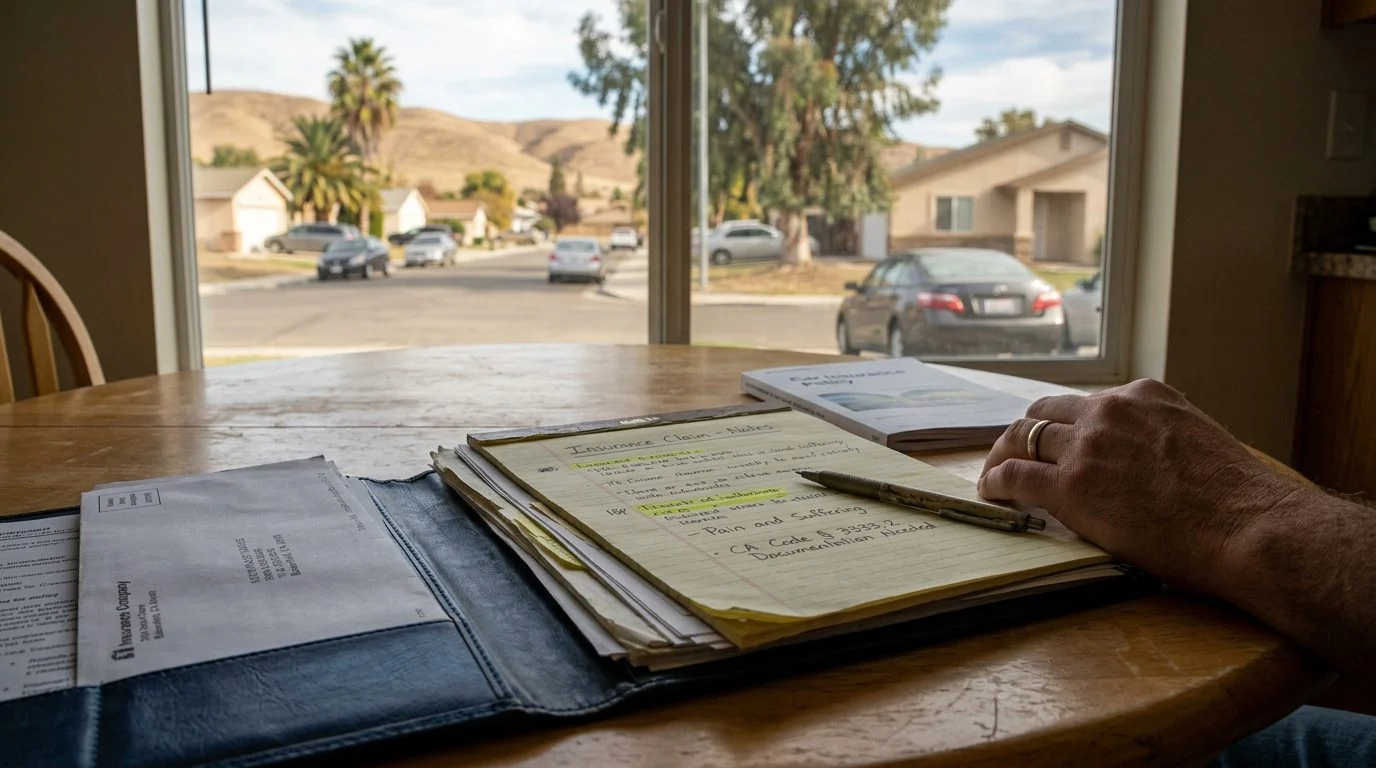
The strongest support is a complete record that ties your injuries to the crash and shows how they changed your life.
Medical records do most of this work. They include emergency and treatment records, imaging, physician notes, physical therapy notes, prescriptions, and records of follow-up care.
Other materials help show daily life. A journal of pain levels, limits, and missed activities can help. So can photos of injuries as they heal, and statements from family or coworkers about changes they noticed. This is the kind of detail your records and journal should capture.
Consistent treatment matters. Gaps in care give an insurer a reason to question how severe or lasting the pain was. Follow the treatment plan your doctor gives you.
Your words matter too. Statements to an insurer, and records made after the accident, can affect how a claim is evaluated. Keep notes of what was said and when.
What Personal Injury Protection and Medical Payments Coverage Generally Do Not Cover
Personal injury protection and medical payments coverage generally pay medical bills and, depending on the policy, related losses such as lost income. They generally do not pay general pain and suffering damages.
Paying a medical bill through your own policy does not settle a claim against the at-fault driver. Those are separate claims, with separate rules and separate payers.
Policy definitions and exclusions control what each coverage pays. A coverage’s name does not decide it. The exact terms of each coverage on your policy decide what it pays.
Not sure what your next step is?
Talk it through with our team — the first consultation is free, confidential, and carries no obligation.
What to Consider If the Insurance Offer Seems Too Low
Treat a first offer as an opening evaluation, not the final value of your claim.
Ask the insurer for the basis of its evaluation. California’s Insurance Code § 790.03 lists, as an unfair claims settlement practice when done knowingly as a general business practice, not attempting in good faith to effectuate prompt, fair, and equitable settlements of claims in which liability has become reasonably clear. The same section lists misleading a claimant about the statute of limitations.
Signing a release usually ends the claim. Know the full extent of your injuries and future treatment before you sign anything.
Time limits matter. Under Code of Civil Procedure § 335.1, an action for injury caused by another’s wrongful act generally must be filed within two years. Other deadlines can apply, depending on the case.
If Medicare paid for treatment, a settlement can affect repayment. The CMS secondary payer overview says a conditional payment must be repaid when a settlement, judgment, award, or other payment is made. Under Medicare.gov coordination of benefits, a provider may bill Medicare when an insurer does not pay promptly, usually within 120 days.
If the injury was fatal, the rules differ. Code of Civil Procedure § 377.34 limits what a decedent’s claim may recover. Its pain-and-suffering exception applies only to actions granted a preference under Section 36 before January 1, 2022, or filed on or after January 1, 2022, and before January 1, 2026. Our wrongful death lawyer page covers that path.
Frequently asked questions
Does car insurance pay for pain and suffering?
Usually the at-fault driver’s liability insurer pays this kind of claim. Your own medical payments coverage generally pays medical bills instead.
Is the first insurance offer final?
Not necessarily. An early offer can come before the full extent of an injury is known.
Is there a set amount for pain and suffering?
No. No single price or formula fits every injury.
Talk With Colvin Accident Lawyers About Your Situation
Holding an insurer’s letter after a crash you did not choose is stressful. Whether the injury is yours or a family member’s, the decisions ahead can feel heavy. You don’t need every answer before you call.
Our team can talk through the accident, the injuries, and the offer with you. Colvin Accident Lawyers is based in Bakersfield and represents people in Kern County, Fresno, Visalia, Lancaster, Palmdale, Delano, and Tehachapi.
La consulta inicial es gratuita, confidencial y sin compromiso de continuar.
Contact Colvin Accident Lawyers to set up your free case consultation.
Colvin Accident Lawyers, Bakersfield, California — responsible for this site.
How Colvin Accident Lawyers Can Help
Free first consultation
The initial consultation is free, confidential, and carries no obligation to continue.
Focused on injury claims
Our practice focuses on car, truck, motorcycle, bicycle, pedestrian, bus, dog bite, premises liability, catastrophic injury, and wrongful death cases.
Support for families
We represent accident victims and the families of those who have died in accidents.
Serving Bakersfield and nearby communities
Our office is based in Bakersfield, California, and we work with clients across the surrounding region.
Be Careful With Early Offers
An insurance company may contact you soon after an accident with a quick offer. Before you accept any payment or sign a release, make sure you understand the full extent of your injuries and their long-term effects.
Types of Accident Claims We Handle
Vehicle Crashes
Claims arising from car, truck, motorcycle, and bus accidents, including collisions with commercial vehicles.
Pedestrian and Bicycle Accidents
Claims for people struck while walking or riding a bicycle, where serious injuries are common.
Premises and Dog Bite Injuries
Claims involving unsafe property conditions and injuries caused by dog bites.
Catastrophic and Wrongful Death
Claims for life-changing injuries and for families who have lost a loved one in an accident.