Your Family May Still Have Options After a Fatal Crash
By Donald Norman Colvin · Published November 25, 2026
When a driver dies in a crash that hurt or killed someone you love, one question comes first: can you sue a deceased driver in California? In some cases, yes. A claim can sometimes be pursued against the driver’s estate and against the driver’s liability insurance, depending on the policy and the facts. This page explains how that path works and what to confirm first.
The Short Answer: Yes, a Claim Can Sometimes Still Be Made
A driver’s death does not automatically end a claim for the harm the crash caused (Code Civ. Proc. § 377.20). Often, the claim moves through the driver’s estate, and the driver’s liability insurance is the source of payment. Three questions shape the answer. Who was the driver? Did liability insurance apply to the crash? When did the death happen, compared with the crash?
Those facts come first. The family’s early steps matter too. Gathering the crash report, the insurance details, and the death certificate helps with every later step. The rest of this page covers the estate process, the filing deadline, proof of fault, and where payment may come from.
How a Claim Against a Deceased Driver Moves Through the Estate
A claim against a driver who has died is pursued against the estate, through the person who manages it. California law says a cause of action against a decedent that survives may be asserted against the decedent’s personal representative, subject to the probate rules for creditor claims (Code Civ. Proc. § 377.40). A personal representative is usually an executor or administrator the court appoints to handle the estate.
Probate is the court-supervised process for collecting the decedent’s property, paying debts, and distributing what remains. California’s creditor-claim procedure is used to assert money owed by a deceased person’s estate. It has filing requirements, and missing a deadline has consequences (creditor’s claim guide).
The estate’s own assets and the driver’s insurance limits are separate questions. The estate may have little to pay with. Liability insurance, when it applied, is often the main source, up to its policy limits. Ask both questions early, and keep the crash report and insurance information together in one place.
How Long Your Family Has to File
California gives two years to file an action for the death of an individual caused by the wrongful act or neglect of another (Code Civ. Proc. § 335.1). The date of death is the key date.
Because the exact deadline turns on the facts of each case, confirm it soon after the crash. Waiting for the estate to be set up or the insurance claim to settle can use up time the family cannot get back. A family may also have more than one claim from the same crash, such as a wrongful death claim by relatives and a claim against the estate. Each one should be checked against its own timing.
If a public agency such as a city, county, or transit operator was involved, separate notice rules may apply. Those rules can run on their own timelines, so they need their own check.
Who Can Bring a Wrongful Death Claim in California
Specific family members may bring a wrongful death claim, and California’s statute names them (Code Civ. Proc. § 377.60).
A wrongful death claim seeks the family’s own losses from the death. A survival claim covers the harm the decedent suffered before dying. The estate’s representative pursues the survival claim.
A common mistake is assuming only one relative can act. The statute can name more than one family member, so the full list should be checked. Who may sue, and in what order, turns on each family’s situation and the statute’s terms.
Proving Fault When the Driver Cannot Testify
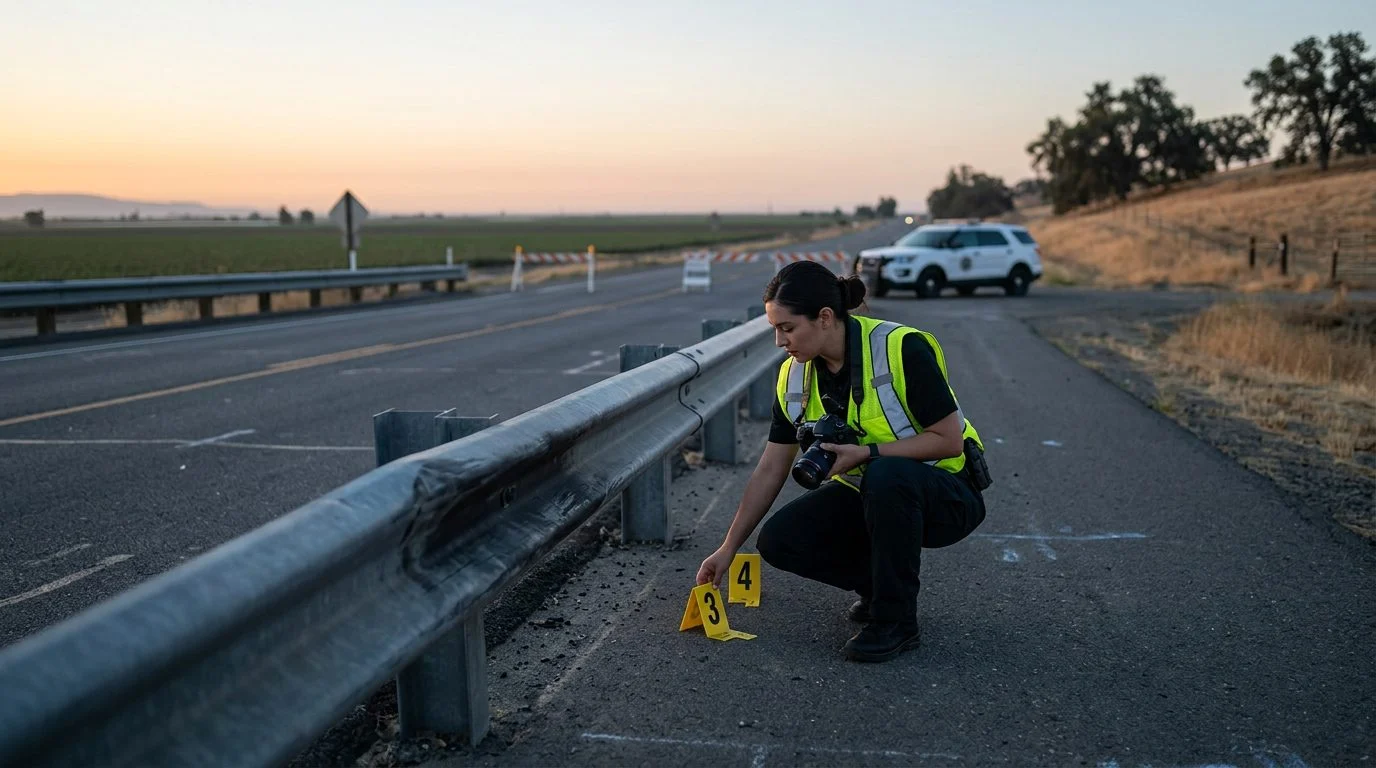
Without the driver’s account, fault is proven through other evidence, and that evidence should be gathered early. The most useful sources usually include police and collision reports, witness statements, photographs and scene measurements, vehicle damage and any recorded vehicle data, traffic camera or dashcam footage, and the medical records of the injuries.
Fault in California is tested through negligence. The claim must show a duty of care, a breach of that duty, causation, and harm. The driver’s death does not change those elements. It changes where the proof comes from, because the driver can no longer explain what happened.
Evidence is often lost quickly. Vehicles get repaired or scrapped, and camera footage can be overwritten. Early preservation is one of the most important steps a family can take.
The family’s claim can also be affected if the decedent shared some fault for the crash. California’s civil jury instruction on a plaintiff’s comparative fault tells jurors that if the defendant proves the above, the plaintiff’s damages are reduced by the jury’s determination of the percentage of the plaintiff’s responsibility, and that the judge will calculate the actual reduction (Judicial Council of California Civil Jury Instructions).
Where Compensation May Come From: Insurance and Other Sources
The driver’s liability insurance is often the main source, up to its policy limits. California sets minimum liability limits for auto policies by statute (Veh. Code § 16056). Those minimums may be lower than the full losses in a fatal crash, so the driver’s actual policy limits matter.
Your family’s own uninsured motorist coverage may apply if the driver had no insurance or too little.
If the driver was working, driving a company vehicle, or driving a commercial vehicle, other parties may be involved. Their coverage needs to be identified early.
If the decedent was a Medicare beneficiary, the claim has a reporting step.
What Damages May Be Sought in a Fatal Crash Claim
A wrongful death claim seeks the losses the family suffered because of the death. The decedent’s own losses before death fall under the survival claim, and that claim is limited by statute. Survival damages are generally limited to losses the decedent sustained before death, but for actions filed on or after January 1, 2022, and before January 1, 2026, they may include damages for pain, suffering, or disfigurement. Under subdivision (a), damages recoverable in these actions exclude pain, suffering, and disfigurement, except as subdivision (b) allows for an action granted a preference under Section 36 before January 1, 2022, or filed on or after January 1, 2022, and before January 1, 2026 (Code Civ. Proc. § 377.34).
The statute carves out a narrow exception for actions that were granted a preference before January 1, 2022, or that were filed between January 1, 2022 and January 1, 2026.
Each category of loss turns on the facts of the case. Keep every bill and receipt, since they help show the losses. Records of the decedent’s income, work, and role in the household often shape the family’s claim. No outcome can be predicted here.
Frequently Asked Questions
Can the deceased driver’s insurance pay if the estate has few assets?
Often, yes. Insurance is frequently the main source of payment, up to the policy limits.
Does the two-year rule always apply?
It is the general rule. Separate notice rules can apply when a public agency was involved.
Do I need to act right away?
Yes. Confirming deadlines and keeping evidence early matters, and a consultation can review those steps with you.
Talk With Colvin Accident Lawyers About Your Family’s Situation
If your family lost someone in a crash and the driver also died, you may be facing questions about the estate, the insurance, and the deadlines all at once. You don’t have to sort them out alone. Reach out to Colvin Accident Lawyers through the contact page to talk through the crash, the driver’s coverage, and the dates that may apply to your family. The first consultation is free, confidential, and carries no obligation to continue.
Donald Norman Colvin is the responsible lawyer for this page. Colvin Accident Lawyers is based in Bakersfield, California.
How We Approach These Cases
Based in Bakersfield
We represent accident victims and families from Kern County, Fresno, Visalia, Lancaster, Palmdale, Delano and Tehachapi.
Plain-language guidance
We explain your options clearly, so you can make decisions while you are grieving.
Review of the records
We look at the crash report, insurance information and estate paperwork with you, case by case.
A free first consultation
The initial consultation is free, confidential, and carries no obligation to continue.
Act Early to Protect the Evidence
Crash reports, witness information, vehicle data and insurance records can be harder to obtain as time passes. Speaking with us early helps us preserve what is still available.

Questions Families Often Ask
Can the driver’s insurance pay?
Auto insurance is often a central source of recovery in these cases. Whether a specific policy applies depends on its terms and the facts of the crash, and we review both with you.
What if the estate has few assets?
The estate’s value is only one part of the picture. We look at available insurance and other potential sources before discussing next steps.
Was a public agency involved?
Some crashes involve a city, county or state entity. Those situations can involve different procedures, so we review them separately from the start.
What should we gather now?
Keep the crash report, medical and funeral bills, photos, and any letters from insurers. Bring them to your consultation so we can review them together.