Kern County · Wrongful Death
When a Fatal Crash Takes a Loved One, Get Clear Answers About Your Family's Options
Colvin Accident Lawyers helps Kern County families understand wrongful death claims in California. Start with a free, confidential first consultation with no obligation to continue.
By Donald Norman Colvin · Published October 19, 2026
A fatal crash claim is a civil lawsuit that seeks money for losses caused when someone’s careless act leads to a death. Eligible family members or the estate can bring it in California. The rules depend on who you are, what role you hold, and how quickly you act. This guide explains the main rules for families in Kern County and Bakersfield, and it points to deeper pages for each question.
What Is a Fatal Crash Claim?
A fatal crash claim is separate from any criminal case against the driver. A criminal case is brought by the government and asks whether the driver broke a criminal law. A civil claim is brought by the family or the estate and asks who must pay for the losses.
The two tracks run on different rules, different proof and different timelines. Each track is handled on its own terms.
In impaired-driving crashes, the driving rules matter. California makes it unlawful to drive with 0.08 percent or more, by weight, of alcohol in the blood, or to drive under the influence of alcohol or any drug, under Veh. Code § 23152. For a closer look, read our guide on wrongful death versus a criminal case in a DUI crash.
If a crash took someone you love, you may have a claim, and you don't have to sort out the deadlines alone. Our team can talk it through with you. Talk it through with our team — the first consultation is free, confidential, and carries no obligation.

Who Can Bring a Wrongful Death Claim in California?
The surviving spouse, domestic partner, children and issue of deceased children can bring the claim. If none of them exist, the persons who would take the decedent’s property by inheritance can sue. The rule appears in Code Civ. Proc. § 377.60.
Other dependent relatives can also sue. These include a putative spouse, stepchildren, and parents. If the parents have died, legal guardians may act. A minor may sue if the minor lived in the decedent’s household for the previous 180 days and depended on the decedent for at least half of their support.
A domestic partner must have been in a registered domestic partnership at the time of death, but for a death occurring prior to January 1, 2002, a person may maintain a cause of action as a domestic partner of the decedent by establishing the factors listed in paragraphs (1) to (6) of subdivision (b) of Family Code Section 297. Parents may have standing in some family setups, and our guide on whether parents can sue after an adult child’s death covers that question. A relative outside the statute’s list generally cannot bring the claim alone. A related scenario appears in our page on a driver who killed a spouse with no insurance.
A person filing for an estate must sign an affidavit under penalty of perjury. The affidavit states the decedent’s name, the date and place of death, and that no estate proceeding is pending in California. A certified death certificate must be attached, under Code Civ. Proc. § 377.32.
Wrongful Death Action Versus the Survival Action
Under Cal. Code Civ. Proc. § 377.60, a cause of action for the death of a person caused by the wrongful act or neglect of another may be asserted by any of the persons listed in the statute, or by the decedent’s personal representative on their behalf. One is the family’s wrongful death claim. A separate claim, which the decedent could have brought, is pursued by an estate representative or successor in interest under a different statutory provision than § 377.60.
Section 377.60 concerns a cause of action for a death caused by the wrongful act or neglect of another, and does not address loss the decedent suffered before death. Under Code Civ. Proc. § 377.34, those damages generally do not include pain, suffering or disfigurement. The statute makes narrow exceptions for older filing dates. For actions filed on or after January 1, 2026, those exceptions do not apply.
The wrongful death damages are separate. Code Civ. Proc. § 377.61 Section 377.61 provides that, in an action under that article, damages may not include damages recoverable under § 377.34. Some families also need an estate step first, and our page on probate before a wrongful death claim explains that path.
What Can a Family Recover for Economic Losses?
Economic losses are the measurable money losses a death causes. Many families look at lost income and financial support, household help the person provided, and bills tied to the death. Funeral and burial costs are a common worry, and our guide on who pays funeral costs after a fatal car accident covers that question.
Under Code Civ. Proc. § 377.61, in a wrongful death action brought under the article that begins at § 377.60, damages may be awarded that are just in light of all the circumstances of the case, but those damages may not include damages recoverable under § 377.34, and the court determines the respective rights in an award of the persons entitled to assert the cause of action. The court also decides how an award is shared among the people entitled to bring the claim.
Families usually prove economic losses with records. Pay stubs, tax returns, medical bills and receipts are common examples. Keep originals and copies of everything. Dollar values depend on the facts of each case, and no fixed number applies to every family.
What Can a Family Recover for Non-Economic Losses?
Non-economic losses are the harder-to-price losses of a death. Families often describe the loss of companionship, guidance, care and protection. These losses are personal, and they are real even though no bill shows them.
The relationship matters. A spouse, a minor child, an adult child and a parent each lose a different kind of daily life with the person. The proof of that relationship, such as family history and day-to-day involvement, shapes how these losses are presented.
No one can promise how a court or jury will view these losses in a particular case.
Who May Be Liable in a Fatal Crash?
The at-fault driver is the most common party in a fatal crash claim. Other parties may share responsibility in some crashes.
Vehicle ownership can matter too. Under Veh. Code § 17150, a motor vehicle owner is liable for death or injury caused by a negligent act in operating the vehicle by a person using it with the owner’s permission.
Commercial trucks and buses raise separate questions. Our page on fatal truck crash lawsuits in California explains how these claims are built.
Premises liability is another source. A dangerous condition on private property can lead to a claim where the facts support one. It is never assumed just because a death occurred.
Not sure what your next step is?
Talk it through with our team — the first consultation is free, confidential, and carries no obligation.
How Are Motorcycle, Bicycle and Pedestrian Fatal Crashes Different?
Fatal motorcycle, bicycle and pedestrian crashes follow the same core claim rules. The proof often centers on the roadway, the crossing and the crash scene. Our page on a motorcycle fatal crash claim in California covers the evidence that is usually reviewed.
For pedestrians, the law gives a specific rule. A driver must yield to a pedestrian within a marked crosswalk, or an unmarked crosswalk at an intersection, under Veh. Code § 21950, except as otherwise provided in this chapter. The same section says a pedestrian must still use due care for their own safety.
Caltrans publishes annual collision data with categories that include fatal, pedestrian and bicycle crashes. Bicycle crash data also appears in a SafeTREC bicycle safety report. For a pedestrian death, our guide on pedestrian fatal crash family claims goes deeper.
What Insurance Limits and Other Sources Can Affect Recovery?
The at-fault driver’s liability insurance is often the first source a family looks at. Its limits can cap what the insurer pays. Our page on fatal crash insurance limits when the at-fault driver is insured explains how those limits are reviewed.
Hit-and-run crashes raise separate steps. Under Ins. Code § 11580.2, where the bodily injury arose out of physical contact of the automobile with the insured or with an automobile the insured is occupying, the insured or someone on their behalf must report the accident within 24 hours to the police department of the city where the accident occurred or, if the accident occurred in unincorporated territory, to the county sheriff or the local California Highway Patrol headquarters. Cal. Ins. Code § 11580.2 reads: “As used in this section, “uninsured motor vehicle” shall not include a motor vehicle owned or operated by the named insured or any resident of the same household or self-insured within the meaning of the Financial Responsibility Law of the state in which the motor vehicle is registered or that is owned by the United States of America, Canada, a state or political subdivision of any of those governments or an agency of any of the foregoing, or a land motor vehicle or trailer while located for use as a residence or premises and not as a vehicle, or any equipment or vehicle designed or modified for use primarily off public roads, except while actually upon public roads.” A sworn statement must also be filed with the insurer within 30 days. Those steps apply under the conditions the statute sets out.
If the at-fault driver is uninsured or underinsured, other policies the family holds may be relevant. Our guide on a fatal crash with no insurance explains this scenario. Early insurance review helps families see every source.
Deadlines: The Two-Year Rule and the Six-Month Public Claim
A wrongful death lawsuit against a private party generally must be filed within two years. Code Civ. Proc. § 335.1 sets this period for an action for the death of an individual caused by another’s wrongful act or neglect.
A claim against a public entity works differently. A county, city or other public agency may be responsible for a roadway. Under Gov. Code § 911.2, a claim for death must be presented not later than six months after the cause of action accrues. The statute counts the claim as presented to the Department of General Services on the date it is submitted with a $25 filing fee; if a fee waiver is granted, the date is when the fee-waiver affidavit is submitted, and if a waiver is denied, the affidavit date counts only if the fee is paid within 10 calendar days of the denial notice.
The shorter public deadline is the trap. A family can lose a claim by waiting, so the rules should be checked early. Families should not wait to learn which deadline applies.
What Do Kern County Crash Reports and Evidence Show?
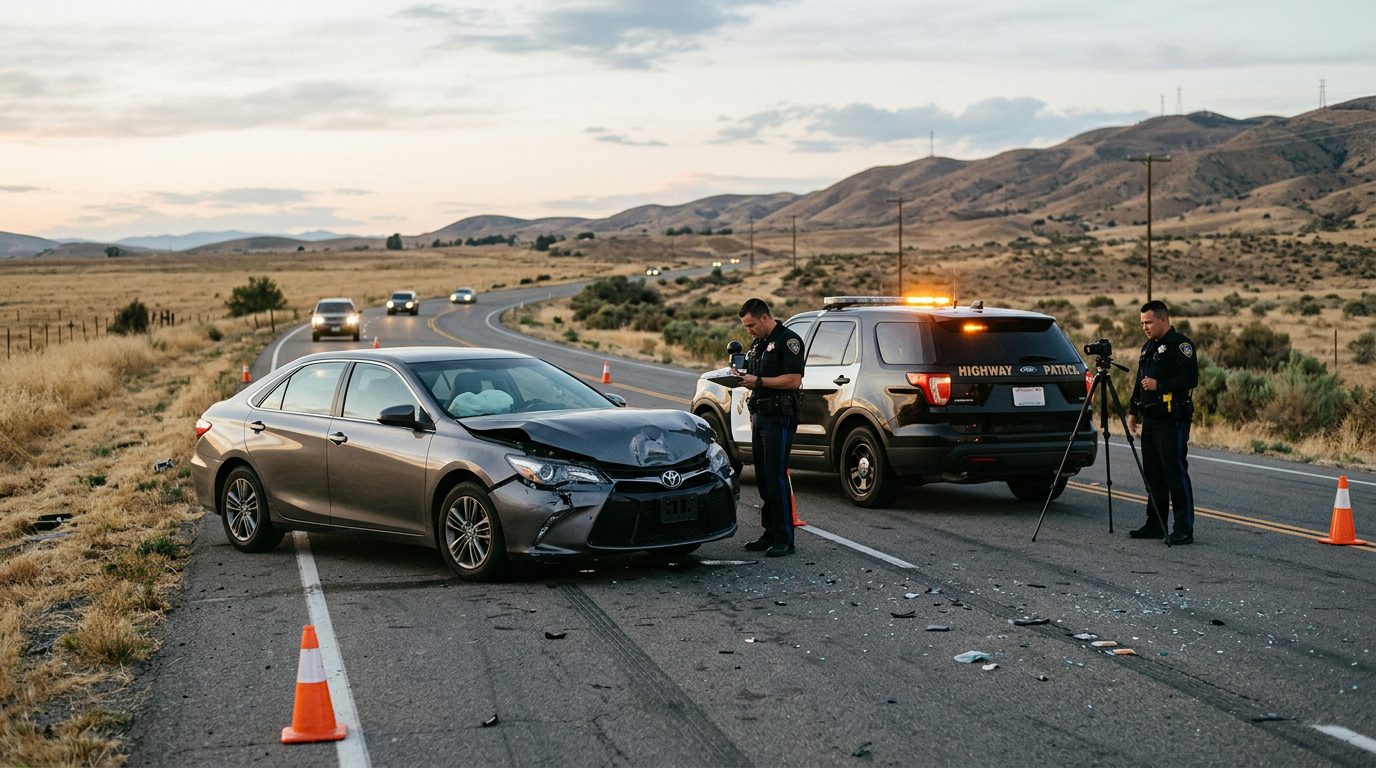
The crash report and the scene evidence often form the first record of a fatal crash claim. Our page on fatal accident police reports in Kern County explains how these reports are created and why they matter.
Highway 99 and Highway 58 run through the Bakersfield area. Our guide on fatal crashes on Highway 99 and 58 in Bakersfield covers the roadway context. The state’s 2021 crash data on state highways includes county-level crash information for reference.
Some evidence can be lost quickly. Keep vehicle data, photographs, witness contact details and medical records. Families who are unsure how to request these records can raise those questions in a consultation.
What Should a Family Do First After a Fatal Crash?
Start by saving every record. Keep the crash report number, the medical records, and all funeral and bill receipts. Write down the names of responding officers and witnesses while you still remember them.
Be careful with insurers. Do not give a recorded statement before you understand the claim and the rules that apply. A short conversation can prevent statements that are hard to undo later.
The first months after a death are often when evidence is most at risk. Early review helps protect what the family may need later. Early review also helps confirm whether an estate representative must act first.
If a crash took someone you love, you may have a claim, and you don't have to sort out the deadlines alone. Our team can talk it through with you. Talk it through with our team — the first consultation is free, confidential, and carries no obligation.
Talk With Colvin Accident Lawyers About Your Family’s Claim
If you’re asking who can sue and when the deadline starts, you don’t have to work that out alone. Colvin Accident Lawyers, based in Bakersfield, California, works with families in Kern County and the surrounding area. Our team can help you sort through the crash, the possible defendants and the deadlines that apply.
To talk about your situation, call Colvin Accident Lawyers or use the contact page. The first consultation is free, confidential and carries no obligation to continue.
Frequently asked questions
Who can file a wrongful death claim in California?
The surviving spouse, domestic partner, children and certain other heirs may sue under Code Civ. Proc. § 377.60.
Under Gov. Code § 911.2, a claim relating to a cause of action for death or for injury to person or to personal property must be presented not later than six months after the accrual of the cause of action.
Donald Norman Colvin, Colvin Accident Lawyers, Bakersfield, California — responsible for this site.
Why Families Contact Colvin Accident Lawyers
Focused on families
We focus on the people left behind: spouses, children, parents and other loved ones who lost someone in a crash.
Free first consultation
Your initial consultation is free, confidential and comes with no obligation to continue.
Plain-language explanations
We explain how a fatal crash claim works in clear terms so you can make informed decisions at your own pace.
Serving Kern County
Based in Bakersfield, we serve families in Kern County and the surrounding communities.
Compassionate guidance
Losing someone suddenly is hard enough without facing insurance companies alone. Our team is here to listen.
Important: Crash Evidence Can Be Hard to Recover
Vehicle data, photographs, police reports and witness contact information can become harder to obtain over time. Contacting us early helps us work to preserve the information that matters to your family's situation.
Questions Families Often Ask
Who may bring a claim?
California law sets out who may bring a wrongful death claim. How that applies depends on family relationships and the facts of each case, and we can explain how it applies to yours.
What losses can a claim address?
Every family's losses are different. We discuss the financial and personal impact of your loss during your free consultation.
What if a truck, bus or motorcycle was involved?
Fatal crashes involving commercial trucks, buses, motorcycles, bicycles or pedestrians can raise different questions about who may be responsible. We review those details with you.
Why speak with a lawyer early?
Records, evidence and witness memories can be harder to gather as time passes. Early conversations help families understand their situation and what steps may be involved.