Motorcycle Accident Lawyer | Bakersfield, CA
Protect Your Claim with the Right Motorcycle Crash Evidence
After a crash, details fade fast. Learn which records, photos, and witness details can help document what happened, and how Colvin Accident Lawyers can help you collect them.
By Donald Norman Colvin · Published November 19, 2026
A motorcycle crash can leave you hurt, short on answers, and unsure what to save. So what evidence do you need for a motorcycle accident claim? The core list is the crash report, photos of the scene and the bike, witness contact details, medical records, proof of money lost, and a written record of every insurer contact.
Each item shows something different: how the crash happened, who may be at fault, what injuries followed, and what they cost. This page covers each category in plain terms, with the California rules that set your timing. It is general information, not advice on a specific case.
Why Evidence Matters in a Motorcycle Accident Claim
A motorcycle accident claim rests on facts you can show, not on who sounds more convincing. Riders often face doubt from other drivers and insurers. Clear, dated records answer that doubt before it grows.
California law starts from a simple rule. A person must use ordinary care, and someone who fails to do so is responsible for the injury that follows, except so far as the injured person’s own willful or careless conduct brought the injury upon themselves (Civil Code § 1714). Each category of evidence answers one question: what happened, who did what, what was hurt, and what it cost.
Whether the crash happened in Bakersfield or elsewhere in Kern County, these same state rules apply. If you are the rider, you may be sore and waiting on bills. If you are a family member, you may be the one holding the paperwork. Either way, start with the records that are easiest to lose.
If you are sorting out a crash that hurt you or someone you love, we can help you think through what you have gathered so far, with no pressure. Talk it through with our team — the first consultation is free, confidential, and carries no obligation.

The Police Report and the Crash Record
The police or crash report is the first official record of your crash, and it is worth getting a copy. California requires the driver of a vehicle, other than a common carrier vehicle, involved in an injury crash to make a written report within 24 hours (Vehicle Code § 20008). That report goes to the California Highway Patrol or, for a crash inside a city, to the CHP or that city’s police department (Vehicle Code § 20008).
The DMV has its own clock. Under Vehicle Code § 16000, a driver in an accident on a street or highway, or in a reportable off-highway accident, with bodily injury or death, or with damage to the property of any one person over $1,000, must report it within 10 days, unless the motor vehicle involved was owned or leased by, or under the direction of, the United States, this state, another state, or a local agency. The report goes on a form approved by the department. It can be made personally or through an insurance agent, broker, or legal representative. Our page on the DMV SR-1 report in California explains that filing.
Once you have the report, read it closely. Check the date, time, location, the parties involved, and the officer’s notes and diagrams. Ask the agency that wrote it for a copy, and ask early, because processing times vary. The report won’t settle the claim alone, but its facts often shape the rest of the file.
Photos, the Scene, and the Motorcycle Itself
Photos taken soon after the crash capture details that can change quickly, such as skid marks, debris, and where vehicles came to rest. If it is safe, photograph vehicle positions, lane markings, traffic signs and signals, road hazards, weather, and lighting. Never step into traffic to get a picture.
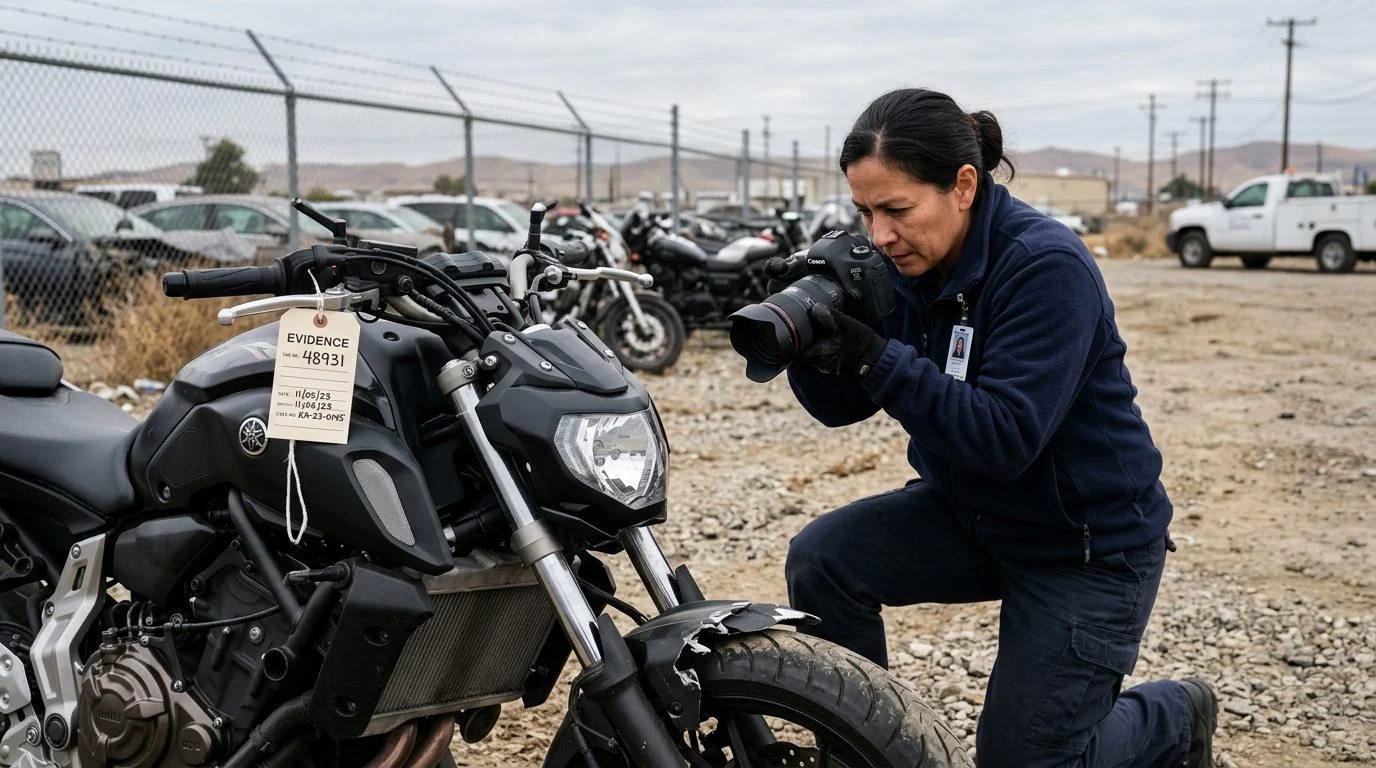
Dated video from a phone, a nearby business, or a traffic camera can matter too. Ask for it soon, since many systems keep footage only for a limited time. Your motorcycle, helmet, and riding gear are evidence as well. Photograph the damage from several angles, keep broken parts if you can, and save every repair estimate and invoice.
Photos rarely settle fault alone.
Witness Statements and Contact Information
Witness contact details are worth collecting at the scene. An outside person’s account can support or challenge what the drivers say. Write down each witness’s full name, phone number, and email address. Ask for a short written account of what they saw, and ask them to write it while the memory is fresh.
Witnesses can move away or become hard to reach. Early contact details keep your options open. Other drivers, passengers, and nearby pedestrians may each have seen part of the event. Compare each account with the report and your photos. Where accounts agree, that agreement carries weight. Where they differ, write down the difference.
Keep every request calm and short. Do not chase witnesses or press them for a statement. A friendly, factual request is more likely to get a useful answer.
Medical Records and Treatment Documentation
Medical records tie the crash to your injuries, so start collecting them at the first emergency visit. Useful records include emergency department notes, imaging results, surgery reports, therapy notes, prescriptions, and discharge instructions. Ask each provider for copies as you go.
Keep every follow-up appointment you can. Gaps in care can be questioned, so write down why any visit was missed. Keep a simple daily log of symptoms, work limits, and activities you cannot do. Save bills, insurance explanations of benefits, and receipts in one folder.
Report every symptom to your doctor, even ones that seem minor. Motorcycle crashes can cause serious injuries, and some injuries are catastrophic.
If you have Medicare, the payment order changes. CMS explains that liability insurance pays first for accident-related care, and Medicare pays second. A Medicare beneficiary must also notify Medicare when a claim is made, by reporting the case or contacting the Benefits Coordination & Recovery Center (CMS reporting guidance). A payment Medicare makes is conditional and must be repaid from a later settlement or award (CMS on conditional payments).
Proving Economic Losses: Lost Wages, Bills, and Property
Bills, receipts, and pay records show the money side of your injury. Each one needs a place in your file. Gather medical bills, travel costs such as rides to appointments, damage to property, and lost income. Each item should carry a date and a receipt or statement.
For lost wages, keep pay stubs from before the crash. Add a letter from your employer showing time missed, time-off records, and tax returns. Our guide to lost wages after a motorcycle accident in California covers this in more detail.
Self-employed riders can use invoices, booking calendars, and client messages to show work lost after the crash. Reduced hours can be documented as well as missed shifts. Store everything in one place, organized by date. A simple folder or spreadsheet works well.
Not sure what your next step is?
Talk it through with our team — the first consultation is free, confidential, and carries no obligation.
Insurance Communications and Recorded Statements
Keep a written record of every call, letter, and email with any insurance company. Note the claim number, the adjuster’s name, the date, and what was said. Save each letter and email.
An insurer may ask for a recorded statement. You can ask to review the request and your own policy before you answer. Our page on recorded statements to an insurer covers what to expect.
California law draws a line here. Under Evidence Code § 1160, sympathy expressed to an injured person or their family after an accident is not admissible as evidence of an admission of liability in a civil action. A statement of fault is treated differently. “I’m sorry you were hurt” is not the same as “I didn’t see the bike.”
Gather your own auto policy too, including any medical payments or uninsured motorist coverage. Read it before you sign anything. Do not sign a release or accept an offer until you understand what it covers.

Time Limits and Next Steps for Your Evidence
For most injury and wrongful death claims in California, the filing deadline is two years, so start gathering evidence now. Code of Civil Procedure § 335.1 sets two years for an action for injury to, or the death of, a person caused by another’s wrongful act or neglect. The California Code of Civil Procedure § 335.1 Under Cal. Code Civ. Proc. § 335.1, an action for injury to, or for the death of, an individual caused by the wrongful act or neglect of another must be brought within two years.
Your evidence checklist:
- Police or crash report, and the DMV report
- Scene, vehicle, and motorcycle photos and video
- Witness names, phone numbers, and written accounts
- Medical records, treatment notes, and a symptom log
- Bills, receipts, and proof of lost income
- Every letter, email, and call note with insurers
Evidence can disappear sooner than any filing deadline, so early preservation matters.
Frequently asked questions
Do I need a police report for a motorcycle accident claim?
A police or crash report is a key record. California requires the driver of a vehicle, other than a common carrier vehicle, involved in an injury crash to make a written report within 24 hours.
How does California treat a claimant who was partly at fault?
The first consultation is free, confidential, and carries no obligation to continue. If you are weighing a crash that hurt you or someone you love, you do not have to sort the paperwork alone. Colvin Accident Lawyers is based in Bakersfield, and we can talk through what you have gathered so far. Contact Colvin Accident Lawyers to start that conversation.
What Colvin Accident Lawyers Helps You Gather
Official Crash Records
Police and crash reports often capture the officer's account, the parties involved, and the conditions at the scene.
Scene Photos and Video
Pictures of the roadway, skid marks, signage, lighting, and vehicle positions can preserve details that fade quickly.
Medical Records
Treatment notes, imaging, and bills connect your injuries to the crash and show how they affect your daily life.
Witness Information
Names and contact details of people who saw the crash can help confirm how it happened.
Motorcycle and Gear Damage
Your bike, helmet, and riding gear can show the force of impact and support what you describe.
Insurance Communications
Keep every letter, email, and call note from insurance companies so nothing important gets lost.
Be Careful Before Speaking With an Insurer
An insurance adjuster may ask for a recorded statement soon after your crash. Before you agree, consider talking with a lawyer about what you say and what you sign.
Evidence at a Glance
At the Scene
Photos, video, witness names, and the official crash report help capture what happened while it is fresh.
For Your Injuries
Medical records, provider notes, and receipts link your injuries to the crash and document your recovery.
For Your Property
Repair estimates, photos of damage, and gear records support the value of your motorcycle and riding equipment.
For Your Loss
Pay stubs, work notes, and a log of missed activities help show how the crash affected your income and daily life.