Motorcycle Accidents | Bakersfield and Kern County
What to Do if a Motorcyclist Crashes in California
Practical steps for the hours and days after a motorcycle crash, from getting medical care to protecting the information you will need later.
By Donald Norman Colvin · Published November 19, 2026
A motorcycle crash can leave a rider, passenger, or witness shaken and unsure what to do next. If you’re asking what to do if a motorcyclist crashes, the short answer is this: check for danger, call 911, get everyone’s details, collect evidence, get medically checked, and report the crash. Each step matters later, when insurers and courts ask what happened.
Make Sure Everyone Is Safe and Call for Help
Check for traffic first, then call 911 so police and medical help are sent to the scene. If you can move safely out of the traffic lanes, do so. If you can’t, stay where you are and wait for help.
Check the rider, any passenger, and anyone else for visible injuries. Don’t move a person who may be seriously hurt unless they are in immediate danger from fire, traffic, or the scene.
If you are the driver, California law requires you to stop right away. Cal. Veh. Code § 20001 requires a driver in a crash that injures another person or causes a death to immediately stop at the scene and fulfill the requirements of Sections 20003 and 20004.
Passengers who can’t call can ask a bystander to dial 911. Witnesses who can safely stay should stay, so police can hear what they saw.
If a crash has left you hurt, or a loved one is dealing with the aftermath, we're glad to talk through your next steps with you. Talk it through with our team — the first consultation is free, confidential, and carries no obligation.

Exchange Information and Get Names and Contact Details
Get the other driver’s details before anyone leaves the scene. Write them down or take photos of them rather than trusting memory.
Collect the other driver’s full name, address, phone number, driver’s license number, and insurance company and policy number. Ask to see proof of insurance, since Cal. Veh. Code § 16020 requires drivers to carry that evidence in the vehicle.
Record the license plate of every vehicle involved. Get names and phone numbers for passengers and bystanders who saw the crash. Witness details are easy to lose and hard to rebuild later.
Note the responding officer’s name, badge number, and the report number. Ask how to get a copy of the police report, and write that down too.
Gather Evidence at the Scene
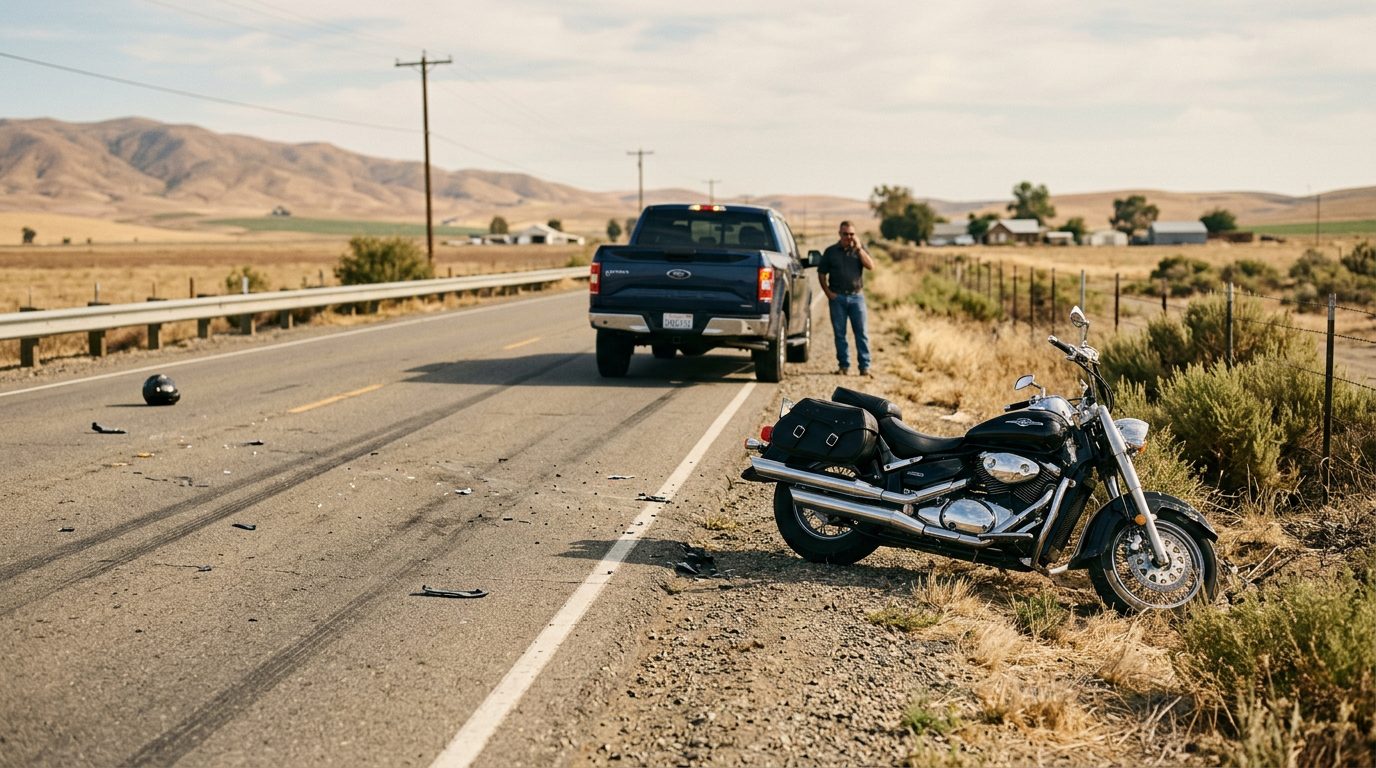
Photograph the scene before anything is moved or repaired. Photos show details that memory blurs within days.
Take pictures of the motorcycle and its damage, the other vehicles and their damage, and the roadway. Include skid marks, lane lines, traffic signals, signs, and the intersection or curve.
Write quick notes on the weather, the lighting, road conditions, and the direction each vehicle was traveling. Note where each vehicle came to rest.
Keep the helmet, gear, and damaged motorcycle parts. Don’t repair or throw them away before the claim is evaluated. Write your own account of the crash while the details are fresh, and keep it with your records.
Get Medical Evaluation Even When Injuries Seem Minor
Get a medical exam the same day, even if you feel you only have scrapes or bruises. Tell the provider exactly how the crash happened and where you hurt.
The exam starts a medical record of your symptoms, diagnosis, and treatment. That record is the proof your later claim will rely on, so don’t skip follow-up visits.
Keep every bill, appointment record, prescription receipt, and work absence note. Store them in one folder or one digital file so nothing gets lost.
Billing can get complicated.
Report the Crash and Notify Your Insurance Company
Injury crashes must be reported to the state, and you should tell your own insurer promptly. These are two separate duties.
For a crash involving injury or death, Cal. Veh. Code § 20008 requires the driver of a vehicle, other than a common carrier vehicle, to make a written report within 24 hours. It goes to the California Highway Patrol, or to the city police if the crash happened inside a city.
Cal. Veh. Code § 16000 requires a driver to report within 10 days if anyone is injured or killed, or if damage to the property of any one person is over $1,000. The report goes on a form approved by the department, and it can be filed personally or through an insurance agent, broker, or legal representative.
Tell your own insurer what happened and give the facts.
The other driver’s insurer does not work for you. Be careful with recorded statements, and don’t sign a release or settlement paper before talking with a lawyer. If you have Medicare, CMS says you must notify Medicare when a claim is made against a liability insurer.
What to Say to Others, and What to Avoid Saying After a Crash
Keep what you say short, factual, and free of guesses about fault. Speculation about who caused a crash can be used against you later.
A short message to family or a friend works well. Say where you are, that you were in a crash, and that you’re getting checked out. Leave out how it happened and who was at fault.
Avoid phrases like “I didn’t see him,” “I was going too fast,” or “I think I caused it.” Don’t guess at speeds. Stick to what you saw and felt.
California uses pure comparative negligence (shared fault).
Post nothing about the crash, your injuries, or your activities while you recover. Anything you post can be read by the other side.
Keep a simple daily journal. Note your pain, what you can’t do at work and at home, and any conversations about the crash, with dates.
Not sure what your next step is?
Talk it through with our team — the first consultation is free, confidential, and carries no obligation.
When to Talk With a Motorcycle Accident Lawyer
Talking with a lawyer early helps you learn which deadlines may apply to your situation. Deadlines can pass quickly, and some are shorter than people expect.
Cal. Code Civ. Proc. § 335.1 requires an action for injury to a person caused by another’s wrongful act or neglect to be brought within two years. Under Cal. Code Civ. Proc. § 335.1, an action for injury to an individual caused by the wrongful act or neglect of another must be filed within two years, subject to exceptions.
If a public entity such as a city or county may be involved, Gov. Code § 911.2 generally requires a claim for injury to a person within six months. Property claims for injuring goods or chattels, which can include a motorcycle, fall under the three-year rule in Cal. Code Civ. Proc. § 338. The exact deadline depends on the facts of your case.
Talking with a lawyer often makes sense for a rider who is badly hurt. It also helps a family member juggling medical bills and insurer calls. Someone facing a serious injury, such as a brain injury, may need guidance on work and medical decisions too. Our motorcycle accident lawyer page and our brain injury motorcycle crash page cover these topics in more detail.
Quick Answers
How long do I have to file a motorcycle injury claim in California?
California’s general rule for personal injury claims is two years. Other deadlines can be shorter or longer depending on the facts.
Do I have to report a motorcycle crash to the state?
Yes, if it caused injury or death, a written report is due within 24 hours to the CHP or city police. Crashes causing injury or property damage over $1,000 also require a DMV report within 10 days.
Can I recover damages if I was partly at fault?
Yes, in California shared fault reduces your damages but does not bar recovery.
Your crash may have left you hurt, with bills and insurer calls piling up. You don’t have to sort it out alone. Colvin Accident Lawyers, based in Bakersfield, offers a free first consultation with no obligation to continue. La consulta inicial es gratuita, confidencial y sin compromiso de continuar. Reach out through our contact page to talk about your crash.
Colvin Accident Lawyers, Bakersfield, California — responsible for this site. Responsible lawyer: Donald Norman Colvin.
Steps to Take After a Motorcycle Crash
Get medical care
Seek evaluation even if you feel well at the scene. Some injuries, including head and spinal injuries, may not show symptoms right away.
Make sure the crash is reported
Ask the responding officer for a report and write down the agency and report number. Keep a copy of anything you receive.
Document the scene
If you can do so safely, photograph the vehicles, road conditions, traffic signs, skid marks and visible injuries. Note the names and contact details of witnesses.
Keep detailed records
Save medical bills, prescriptions, repair estimates, time missed from work and notes about how your injuries affect daily life.
Be careful with insurance calls
An insurance adjuster may contact you quickly, ask for a recorded statement or request a signature on a form. Talk with a lawyer before you agree to anything or give a statement about your injuries.
Why Start With a Conversation
Speak with our team
Call Colvin Accident Lawyers to talk through what happened, what injuries you have and what questions you need answered.
Built around serious injuries
Our practice includes motorcycle, car, truck, bus, pedestrian and bicycle accident cases, along with catastrophic injury and wrongful death matters.
Serving Kern County and nearby communities
We help riders and families in Bakersfield and Kern County, as well as Fresno, Visalia, Lancaster, Palmdale, Delano and Tehachapi.
Free, confidential first consultation
The initial consultation is free, confidential and carries no obligation to continue.