Motorcycle Accident Claims | Bakersfield, CA
Totaled Your Motorcycle? Get Answers Before You Accept an Offer
Colvin Accident Lawyers helps motorcycle riders in Kern County and nearby communities understand property damage claims after a crash. Start with a free, confidential consultation.
Colvin Accident Lawyers at a Glance
Bakersfield
Based in Bakersfield, California
Free
First consultation, confidential and with no obligation to continue
By Donald Norman Colvin · Published October 30, 2026
Short answer: can a rider recover for a totaled motorcycle and damaged gear?
In many California crashes, a rider can seek payment for a totaled motorcycle and damaged riding gear when another person’s negligence caused the damage. Whether that applies to you depends on the facts of your crash and on who is responsible. California law lets a person harmed by another’s unlawful act recover money from the person at fault (Civ. Code § 3281).
Many riders assume a totaled bike is simply lost money. That isn’t always so. What you can recover depends on the losses you can show and on who caused the crash.
Property losses are a separate category from bodily injury losses. They can come from the same crash, but they are measured and documented differently. A totaled motorcycle property damage claim in California usually covers the bike, the gear, towing, storage, and loss of use. It can also run alongside an injury claim. The sections below walk through each part.
If your motorcycle is at a tow yard and your gear is ruined, you may have a claim for those losses. Our team can help you sort them out, starting with a free talk. Talk it through with our team — the first consultation is free, confidential, and carries no obligation.

What property losses can be included in a California motorcycle claim
The motorcycle, riding gear, and loss-of-use costs are the main property losses. The bike is usually the largest item. Riders can also claim helmets, jackets, boots, gloves, saddlebags, and aftermarket parts or accessories installed on the bike.
Personal items damaged in the same crash, such as a phone, may be included when you can document them. Keep proof of what each item was and what it cost.
Towing and storage charges are common parts of the claim. Loss of use is another. That can mean a rental or other transportation while the motorcycle is out of service. California law calls repair or replacement costs and loss of use “economic damages,” which are monetary losses you can verify (Civ. Code § 1431.2).
Keep every tow invoice, storage bill, and rental receipt. Missing paperwork makes these costs harder to prove.
How a totaled motorcycle is valued and what happens to the salvage
A totaled motorcycle is generally valued at what it was worth just before the crash. For the breach of an obligation not arising from contract, California measures damages, except where otherwise expressly provided by this Code, as the amount that compensates for all the detriment proximately caused (Civ. Code § 3333).
Valuation often looks at comparable sales, the bike’s condition, its mileage, and recent upgrades. A recently upgraded bike may be valued differently than a stock one. Keep receipts for any work or parts you added.
If you keep the wreck, its remaining salvage value can reduce the payment for the bike. Ask for a written explanation of how the total figure was reached. Compare each line against your records.
When an insurer sends title or release forms, keep copies of everything you sign. A common mistake is signing paperwork before reading it. Read first, then sign.
Documenting and recovering damaged helmets and riding gear
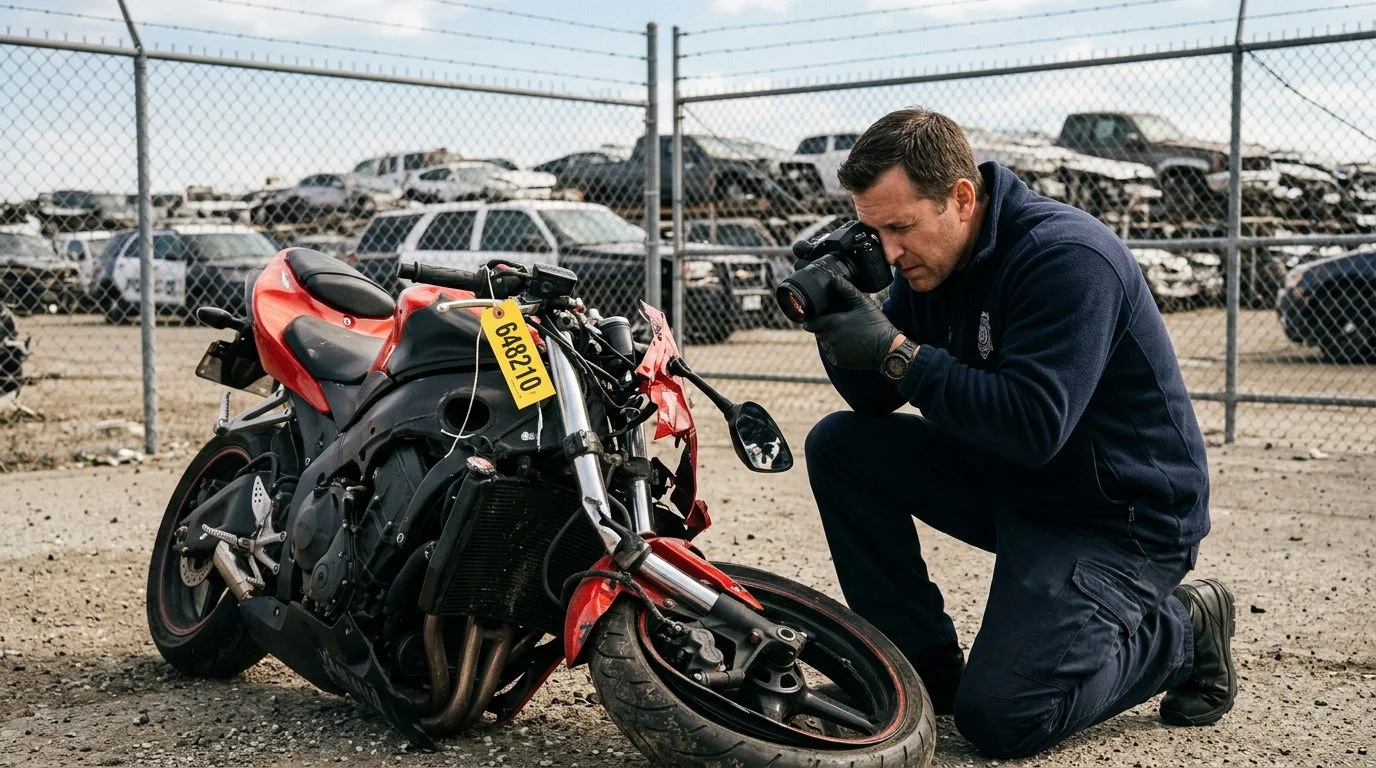
Documentation starts at the scene and continues until the claim is reviewed. Photograph every item where it lies, before you clean, repair, or throw anything away. Keep the helmet and gear in their post-crash condition until the claim is reviewed.
Records that support replacement value include receipts, order confirmations, manufacturer labels, serial numbers, and photos taken before the crash. Look through your phone for older pictures of your jacket or boots. A photo from a ride last summer can show the item’s condition.
Many riders replace a helmet after a hard impact. If you replace yours, keep both the damaged helmet and the replacement receipt. Together they show what was lost and what it cost to replace.
Start a simple log. Note the date of purchase, the price, where you bought each item, and how it was damaged. This turns memory into proof.
Which insurance coverages may pay for property losses
The at-fault driver’s property damage liability coverage is often the main source when that driver is insured and at fault. California requires drivers and owners to be able to establish financial responsibility, and to carry evidence of it in the vehicle (Veh. Code § 16020).
Your own collision coverage may pay first, if you carry it. Your insurer may then seek reimbursement from the at-fault party. That order of payment can affect how quickly you get money for the bike.
Uninsured motorist coverage has its own rules. California law requires insurers to provide uninsured motorist coverage, which the insurer and applicant may also delete completely, and where it applies it pays sums the insured can legally recover as damages for bodily injury, including death, from an uninsured motorist (Ins. Code § 11580.2). Under Cal. Ins. Code § 11580.2(a)(1), a bodily injury liability policy covering motor vehicle use generally must include uninsured-motorist coverage, with limits at least equal to subdivision (m) and in no case less than the Vehicle Code § 16056 minimums, although the insurer and the named insured may agree in writing to the options the statute allows. The statute’s text speaks to bodily injury and wrongful death.
Under Cal. Ins. Code § 790.03(h), knowingly committing or performing with such frequency as to indicate a general business practice the act of failing to provide promptly a reasonable explanation of the basis relied on in the insurance policy, in relation to the facts or applicable law, for the denial of a claim or for the offer of a compromise settlement is an unfair claims settlement practice (Ins. Code § 790.03).
Filing deadlines: property damage versus injury claims
Property damage and injury claims have different filing deadlines in California.
An action for injury to, or the death of, a person caused by another’s wrongful act or neglect must be brought within two years (Code Civ. Proc. § 335.1). So one crash can start two different clocks.
Reporting is a separate duty. A driver involved in a crash that caused property damage over $1,000, or injury or death, must report it within 10 days. The report can be made personally or through an insurance agent, broker, or legal representative (Veh. Code § 16000).
California’s insurance rules also list misleading a claimant about the statute of limitations as an unfair practice when it is knowingly committed or performed with such frequency as to indicate a general business practice (Ins. Code § 790.03).
Not sure what your next step is?
Talk it through with our team — the first consultation is free, confidential, and carries no obligation.
How property losses fit alongside an injury claim
Property losses fit into a larger case as their own category. An injury claim covers medical costs, lost income, and non-economic harm such as pain and suffering.
Non-economic damages are subjective losses, such as pain, suffering, and emotional distress. In personal injury, property damage, or wrongful death actions based on comparative fault, each defendant pays those only in direct proportion to its share of fault (Civ. Code § 1431.2).
A release signed for one claim can affect the other. Review any release before you sign it, and ask exactly what it covers. A release signed early can close off more than riders expect.
Common questions about motorcycle property claims
Compensation depends on the losses you can document and on who caused the crash. The law sorts losses into categories, and fault affects how much you recover.
Can I get paid for a totaled motorcycle in California?
Often, yes, when another party’s negligence caused the crash. Recovery depends on the losses you can document and on fault.
Does pain and suffering cover my motorcycle?
Under Civ. Code § 1431.2, non-economic damages such as pain, suffering and emotional distress are subjective, non-monetary losses, while costs of repair or replacement are economic damages. The section’s several-liability rule for non-economic damages applies in actions for personal injury, property damage, or wrongful death based upon principles of comparative fault.
What is the statute of limitations for property damage in California?
For a motorcycle as personal property, the period is three years (Code Civ. Proc. § 338). Injury and wrongful death claims generally have a two-year period (Code Civ. Proc. § 335.1).
Does the at-fault driver’s insurance pay for my motorcycle and gear?
It often does, when that driver is insured and at fault. The at-fault driver’s property damage liability coverage is usually the main source.

Talk with Colvin Accident Lawyers about your motorcycle losses
If your motorcycle is at a tow yard, your helmet is cracked, and an adjuster wants a signed form, you have decisions to make now. Colvin Accident Lawyers can review the crash facts, the property losses, and any injury claim together. The firm offers a free first consultation. It is confidential, with no obligation to continue. You can reach the firm through the contact page.
Colvin Accident Lawyers, Bakersfield, California — responsible for this site. Donald Norman Colvin is the responsible lawyer for this page.
How We Help Riders With Totaled Motorcycle Claims
Review the Damage Records
We look at the repair estimate, total loss valuation, photos and crash report to understand what your motorcycle was worth and what was lost.
Account for Every Loss
Property damage can include more than the bike itself, such as gear, custom parts, towing and storage fees. We help you identify and document those costs.
Review Insurer Offers With You
Before you respond to an adjuster or sign a release, we can explain what the offer covers and what it may leave out.
Clear, Plain-Language Answers
We explain each step of the claim in terms you can follow, so you can make informed decisions about your next move.
Before You Sign Anything
An insurance adjuster may ask you to accept a settlement quickly or sign a release. Read every document carefully, keep copies, and ask a lawyer to review it before you agree to anything.
Steps You Can Take Right Now
Photograph Your Motorcycle
Take pictures of the bike from every angle, including the damage, the scene and any debris, before it is moved or repaired.
Keep Every Receipt
Save towing, storage, rental, medical and gear receipts. Records make it easier to show what you lost.
Save Your Paperwork
Keep the crash report, the repair estimate, insurance correspondence and any total loss notices together in one place.
Call Us Before You Commit
Our team can review your situation during a free, confidential consultation with no obligation to continue.