After a Truck Accident, the First Steps Matter
By Donald Norman Colvin · Published November 26, 2026
Your truck crash may still feel unreal, and the proof you need can slip away fast. In a truck crash with a tire blowout, the failed tire, the scene, the police report number, and the trucking company’s records matter most. Each one moves on its own clock. This page explains what to collect, what a carrier may discard under routine rules, and which steps come first.
Preserving Evidence After a Truck Accident in California
Truck crash evidence sits in two places: at the scene and inside the trucking company’s files. The scene can change within hours as the road is cleared and the truck is moved. The company’s files follow their own retention schedules.
Federal rules set minimum keeping periods for carrier records. After those periods, a company’s management may destroy the records, under 49 C.F.R. § 379.3, but this does not excuse compliance with the lawful requirements of any other governmental body prescribing longer retention periods. Some periods are short. A driver vehicle inspection report and its certifications need only be kept three months, under 49 C.F.R. § 396.11, and these rules do not apply to private motor carriers of passengers (nonbusiness), driveaway-towaway operations, or motor carriers operating only one commercial motor vehicle.
Lawsuit deadlines are a separate clock. California generally allows two years to sue for injury caused by another’s wrongful act or neglect, under Code of Civil Procedure § 335.1. Waiting can cost you proof. This page covers evidence and general steps. Every case depends on its own facts.
Not sure what your next step is?
Talk it through with our team — the first consultation is free, confidential, and carries no obligation.
Safety, Medical Care, and Your Own Injury Record
Get to a safe spot if you can, call 911, and get medical care even if your injuries seem minor. Symptoms are not always clear right after a crash, so an early evaluation creates a dated record.
Your medical record is proof of the injury itself. It shows what you reported, when it was first noted, and the treatment that followed. Keep every bill, discharge paper, prescription receipt, and referral. Write down any missed work and the reason.
If Medicare paid for any of your care, Medicare may have made a conditional payment. As CMS explains, that payment must be repaid when a settlement, judgment, award, or other payment is made. Share Medicare coverage details early so they can be handled correctly.
Evidence in a Tire Blowout Truck Accident
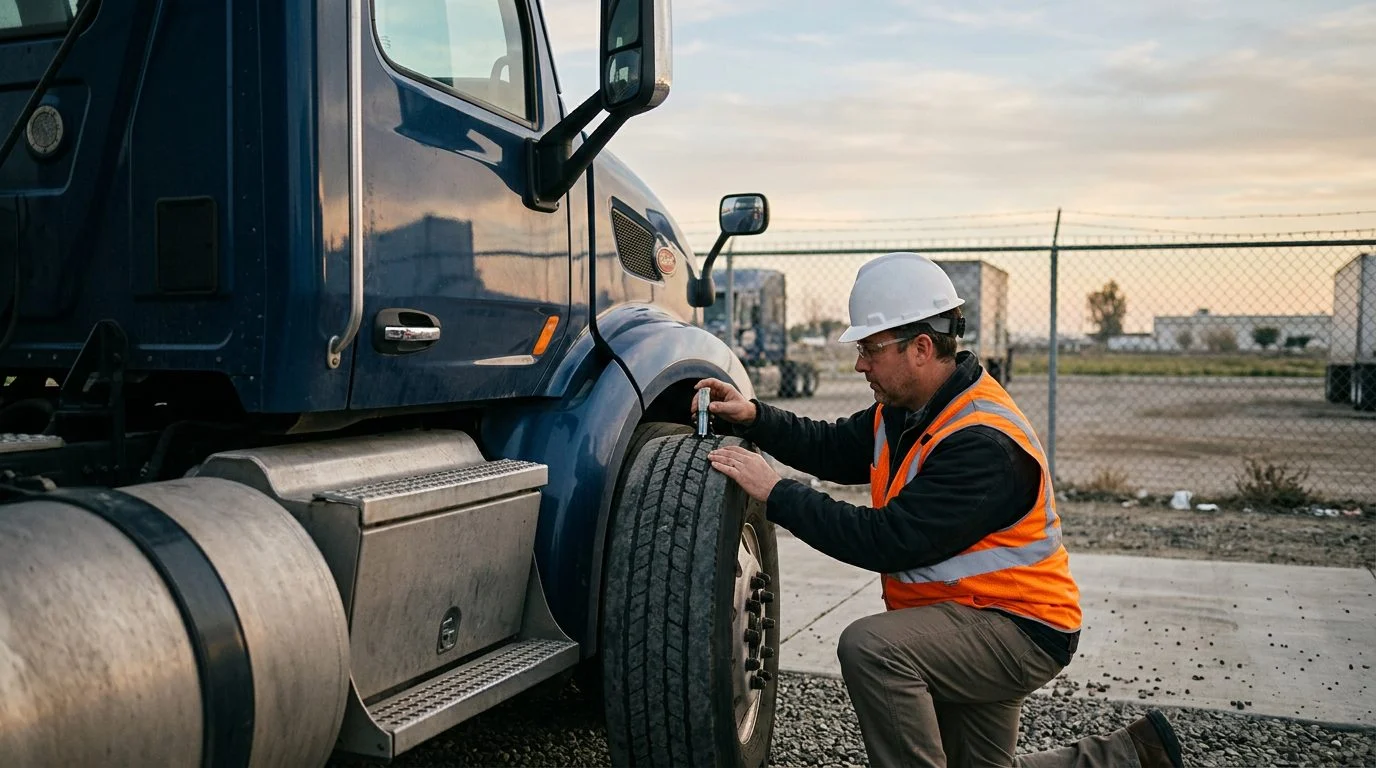
In a tire blowout, the failed tire and its wheel are usually the most important physical evidence. A sudden tread or sidewall failure can cause loss of control and leave debris across the roadway.
Federal rules bar operating a motor vehicle on a tire with exposed body ply or belt material, any tread or sidewall separation, a flat or audible leak, or a cut that exposes ply, under 49 C.F.R. § 393.75(a). Front tires on a truck must have at least 4/32 of an inch of tread depth, and other tires at least 2/32, under the same section. A worn or damaged tire raises that question directly.
At the scene, note the tire’s position on the truck, any visible tread or sidewall damage, where the debris landed, and the company name and unit number. Photograph tire pieces before anyone moves them. A torn tire can be repaired, retreaded, or replaced quickly if no one asks that it be kept. Once it is gone, that physical proof is gone too.
Evidence the Trucking Company Controls
The trucking company controls the records that show how the truck was driven, checked, and repaired. You usually cannot get these on your own.
Electronic logging device (ELD) data is one key category. A motor carrier must not alter or erase, or permit or require alteration or erasure of, the original information collected concerning the driver’s hours of service, the source data streams used to provide that information, or information contained in any ELD that uses the original information and HOS source data, under 49 C.F.R. § 395.30(f). The driver or support personnel must annotate each change or addition, under § 395.30(c)(2).
Except as provided in paragraph (d), the driver qualification file must be kept while the driver works for the carrier and for three years after, under 49 C.F.R. § 391.51(c). Periodic inspection reports must be kept for fourteen months, under 49 C.F.R. § 396.21(b)(1).
Driver inspection reports matter for tire questions. A driver must list any defect that would affect safe operation, and the carrier must repair it before the truck runs again, under 49 C.F.R. § 396.11(a). If a tire defect was reported and not fixed, the paperwork may show it.
Evidence You Can Gather Yourself in the First Days
Photos, witness names, and the police report number are the evidence most people can collect themselves. Start with photos as soon as it is safe to do so.
Photograph the vehicles, the roadway, lane markings, skid marks, debris, and the weather. Include the truck’s rear and sides. Collect names and phone numbers of witnesses, and write a short note of what each one saw while memory is fresh.
Get the police report number, the responding agency, and any citation information. Also record the names of the other drivers and their insurers. Reporting duties differ by vehicle. Under Vehicle Code § 20008(a), a non-common-carrier driver involved in any accident resulting in injuries to or death of any person must make, or cause to be made, a written report within 24 hours. A common carrier’s report is due by the 10th day of the following month, under § 20008(b).
Why Speed Matters: Preservation Demands and Early Case Steps
A preservation letter is a written request that the trucking company and its insurer keep specific records, parts, and equipment in place. Sending one early asks the company to hold evidence before routine schedules run.
Early case work commonly includes preservation requests, obtaining the police report, requesting medical records, and identifying every party that may share responsibility. Cal. Civ. Code § 1714 reads: “(a) Everyone is responsible, not only for the result of his or her willful acts, but also for an injury occasioned to another by his or her want of ordinary care or skill in the management of his or her property or person, except so far as the latter has, willfully or by want of ordinary care, brought the injury upon himself or herself.” More than one party can be involved in a truck crash, depending on the facts.
Many people worry that their own fault ends the claim.
Avoid recorded statements to the trucking company’s insurer before you speak with a lawyer. Avoid posting about the crash online, because those posts can be used later.
Not sure what your next step is?
Talk it through with our team — the first consultation is free, confidential, and carries no obligation.
Talk With Colvin Accident Lawyers About Your Truck Accident
If a tire failed and key evidence may be disappearing, the next step is a conversation about your specific facts. Colvin Accident Lawyers is based in Bakersfield and represents accident victims and families in truck accident cases in Kern County and nearby communities, including tire blowout crashes.
The initial consultation is free, confidential, and carries no obligation to continue.
How long do I have to sue after a truck accident in California?
California generally allows two years to file an injury lawsuit, though exceptions can apply (Code Civ. Proc. § 335.1). The deadline depends on the facts of your case.
Does my own fault end my truck accident claim?
No. California reduces damages by your share of fault rather than barring recovery.
If a tire failed on the truck in your crash and the company’s records may be disappearing, call Colvin Accident Lawyers or use our contact form now.
Colvin Accident Lawyers, Bakersfield, California — responsible for this site. Responsible lawyer: Donald Norman Colvin.

Four Steps to Take Right Away
Get medical care
See a doctor even if your injuries seem minor. Some injuries, such as internal or head injuries, may not show symptoms right away, and a medical record links your care to the crash.
Report the crash
Make sure a police or highway patrol report is filed, and get the names of the drivers, passengers and any witnesses. Note the truck’s company name and the number on its door or trailer.
Document the scene
Photograph vehicles, road conditions, skid marks, cargo and your injuries. Keep notes on what you remember while it is still fresh.
Speak with a lawyer
Truck cases often involve several parties and detailed records. Talking with Colvin Accident Lawyers early can help you understand your options.
Be Careful With Insurance Calls
An insurance adjuster may call you soon after a crash and ask for a recorded statement. Before you give one or sign any release, consider speaking with a lawyer about what you say.
How Colvin Accident Lawyers Can Help
Focused on injury cases
The firm focuses on car, truck, motorcycle, bicycle, pedestrian, bus, dog bite, premises liability, catastrophic injury and wrongful death cases.
Organizing the evidence
We help gather and preserve police reports, medical records, photos and other documents that bear on your claim.
Support for families
When a loss is severe, we work with surviving family members to understand the facts and the options available to them.
Serving the Central Valley and Antelope Valley
We assist accident victims in Kern County, Fresno, Visalia, Lancaster, Palmdale, Delano and Tehachapi.
Clear communication
We explain each step so you know what to expect as your case moves forward.
A free first conversation
Your first consultation is free, confidential and comes with no obligation to continue.