Wrongful Death | Bakersfield, California
California Wrongful Death Claims and Comparative Fault: Answers for Grieving Families
When a loved one dies because of someone else's conduct, questions about fault and legal options can arise all at once. Our team is here to listen and explain them clearly.
By Donald Norman Colvin · Published November 12, 2026
Losing someone in a crash brings hard questions, and one of them is often who was at fault. If the person who died shared some blame, the family may wonder whether they can still recover anything.
Does a Share of Fault on the Decedent Lower Recovery?
Yes. Legal writing calls that person the decedent.
Here is a simple example. Say a court finds the family’s total damages equal 100 percent. If the decedent is assigned 20 percent of fault, the family can recover 80 percent of that total.
California’s general negligence statute, Civil Code section 1714, makes a person responsible for injuries caused by want of ordinary care, except so far as the injured person’s own willful or careless conduct brought the injury upon themselves. It excuses liability only “so far as” the injured person willfully or through want of ordinary care brought the injury on themselves.
If a crash took someone your family loved and the other side is pointing at that person's choices, you don't have to sort out the fault questions alone. Our team is ready to talk it through. Talk it through with our team — the first consultation is free, confidential, and carries no obligation.
How Pure Comparative Fault Works in California
Some people assume a driver who ran a red light loses everything. California’s rule works differently.
Each share is a percentage of the whole, so the shares add up to 100 percent.
The yardstick is ordinary care, meaning the care a reasonable person would use in the same situation. Families often focus only on the other side’s conduct, but the decedent’s choices get weighed too.
Wrongful Death Damages Versus Survival Damages
Under Code of Civil Procedure section 377.34(a), survival damages do not include damages for pain, suffering, or disfigurement.
The survival claim is the decedent’s own cause of action, brought by the decedent’s personal representative or successor in interest. Under Code of Civil Procedure section 377.30, it passes to the decedent’s successor in interest. A personal representative may bring it.
Survival damages are limited. Code of Civil Procedure section 377.34 limits them to losses the decedent sustained before death. Subdivision (a) excludes pain, suffering, or disfigurement.
Subdivision (b) allows those damages only for actions granted a trial preference under Section 36 before January 1, 2022, or filed on or after January 1, 2022, and before January 1, 2026. The window covers actions filed from January 1, 2022, up to January 1, 2026, so a claim filed now falls outside it.
Wrongful death damages have their own limit. Code of Civil Procedure section 377.61 says they may not include damages recoverable under the survival rule.
Who Can Recover Under California Law
Heirs listed in Code of Civil Procedure section 377.60 can bring a wrongful death claim. A personal representative can also bring it for them.
The list starts with the decedent’s surviving spouse, domestic partner, children, and children of deceased children. If none of those survive, it reaches persons who would inherit under intestate succession. Dependent putative spouses, stepchildren, and parents may also qualify, and if the parents would be entitled to sue but have died, the decedent’s legal guardians may bring the action as if they were the parents.
Each eligible heir has a stake in the claim, so confirm who qualifies early. Time matters too. A wrongful death lawsuit generally must be filed within two years of the death under Code of Civil Procedure section 335.1.
Economic Damages and the Fault Reduction
Economic damages are money losses that records can prove, such as medical bills, lost earnings, and burial costs. Civil Code section 1431.2 defines them as objectively verifiable monetary losses.
Civil Code section 3333 measures damages, for the breach of an obligation not arising from contract, as the amount that compensates for all the detriment proximately caused, except where the Code otherwise expressly provides.
Records do most of the work here. Keep pay stubs, tax returns, medical bills, and every funeral receipt from the start. A missing receipt can leave a loss unproven, so ask providers for itemized bills early.
Non-Economic Damages and How Fault Applies
Non-economic damages compensate for harms that have no set dollar value, such as emotional distress. Civil Code section 1431.2 describes them as subjective, non-monetary losses.
Fault reduces these damages too. Under Cal. Civ. Code § 1431.2, in an action for personal injury, property damage, or wrongful death based on principles of comparative fault, the liability of each defendant for non-economic damages is several only and not joint. Each defendant shall be liable only for the amount of non-economic damages allocated to that defendant in direct proportion to that defendant’s percentage of fault, and a separate judgment shall be rendered against that defendant for that amount.
Proof works differently than it does for receipts. Families often show these losses through testimony about daily routines, family roles, and the ways the person was missed. Write down who cooked, who drove the kids, and who handled the bills.
Not sure what your next step is?
Talk it through with our team — the first consultation is free, confidential, and carries no obligation.
Proposition 51 and Cases With More Than One Defendant
When several defendants share blame, each one generally owes only its own share of non-economic damages. Civil Code section 1431.2 says each defendant’s liability for non-economic damages is several only, in direct proportion to its percentage of fault.
Economic damages work differently.
A family can therefore recover different amounts from different defendants for different losses. Multi-party cases need a loss-by-loss review.
Evidence That Shapes the Fault Percentage
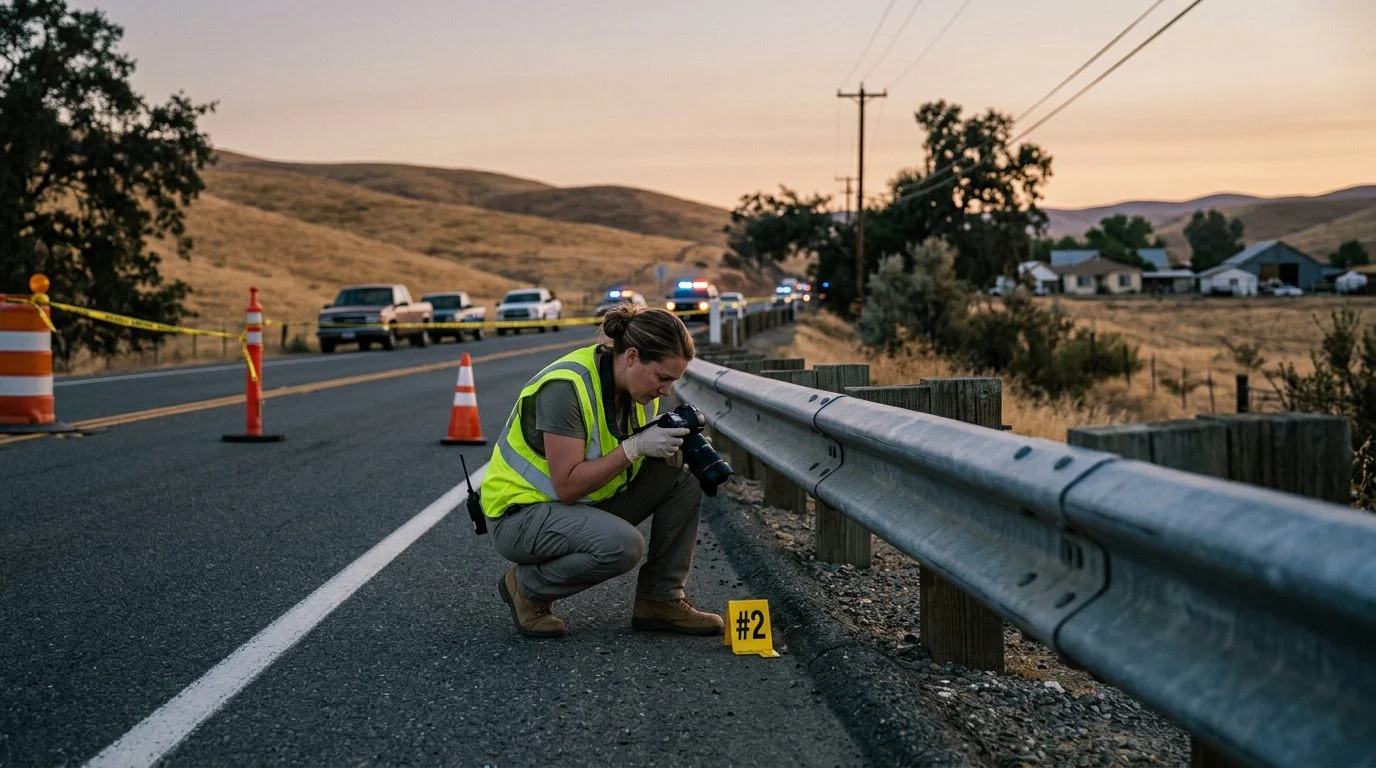
The fault percentage is built from evidence about what each driver, rider, or walker did before the crash. Common sources include police reports, witness statements, traffic camera footage, vehicle data recorders, and photos of the scene.
A broken traffic rule can carry weight. Under Evidence Code section 669, failure to use due care is presumed when the person violated a statute, ordinance, or regulation of a public entity, the violation proximately caused the harm, the harm was the kind the rule was meant to prevent, and the injured person was one of the class of persons for whose protection the statute, ordinance, or regulation was adopted. That presumption can be rebutted by proof that the person did what a reasonably prudent person would do while trying to follow the law.
Pedestrian cases turn on specific duties. Vehicle Code section 21950 requires drivers to yield to pedestrians crossing the roadway within any marked crosswalk or within any unmarked crosswalk at an intersection. It also requires pedestrians to use due care and not step suddenly into an immediate hazard.
Jury instructions address comparative fault too. The CACI civil jury instructions are published by the Judicial Council of California.
Start preserving evidence early. Ask for the police report, save photos and phone data, and write down witness names while memories are fresh. Be careful with social media posts about the crash, since anything posted can be read as evidence.
How Comparative Fault Comes Up in Settlement Talks
Insurers and other parties can raise the decedent’s conduct early to argue for a lower amount. Expect the fault question to come up.
Review every offer that assigns a fault percentage against the evidence and the damages math before you respond. Ask what fault percentage the offer assumes and which losses it counts. Each number should trace back to the evidence and to the losses listed above.
Remember that a fault percentage is a judgment about the facts, so it can be disputed. A settlement and a trial result are different outcomes, with different timing and risks. How that plays out depends on the facts of each case.
When to Talk With a Colvin Accident Lawyers Attorney
Colvin Accident Lawyers, based in Bakersfield, California, represents families in wrongful death cases arising from car, truck, motorcycle, bicycle, pedestrian, bus, and other accidents. Your first consultation is free, confidential, and comes with no obligation to continue.
Families often reach this point when a report or an insurer starts assigning blame to the person who died.
Does comparative fault reduce wrongful death damages in California?
Yes. A share of fault on the person who died generally reduces the family’s recovery by that percentage.
Who can file a wrongful death claim in California?
Heirs listed in Code of Civil Procedure section 377.60 can file. A personal representative can file for them.
How long does a family have to file?
A wrongful death lawsuit generally must be filed within two years of the death (Code Civ. Proc. § 335.1).
If a crash has left your family facing questions about blame, you don’t have to work through them alone. Contact our team to talk through what happened.
How Colvin Accident Lawyers Works With Your Family
Free, confidential first consultation
Your first consultation is free, confidential and comes with no obligation to continue.
Focused on your family
We take time to understand what your family has lost and what questions matter most to you.
Clear explanations
We explain how California law approaches fault, who may bring a wrongful death claim and what information is often important.
Serving communities across Kern County
We represent families in Bakersfield and nearby communities, including Fresno, Visalia, Lancaster, Palmdale, Delano and Tehachapi.
Evidence can change over time
Accident scenes, vehicle damage, records and witness memories can change as time passes. Speaking with a lawyer early can help you understand what information to keep.
Questions Families Often Ask
How does fault affect a claim?
Learn how shared responsibility is discussed in a California wrongful death case and why it matters.
Who can bring a claim?
Find out which family members may be involved and how a personal representative may act on their behalf.
What happens in a consultation?
Bring your questions. We will review what happened, answer your questions and explain your options with no obligation.
Why contact a lawyer now?
Early conversations can help families make informed decisions while they focus on their loss.