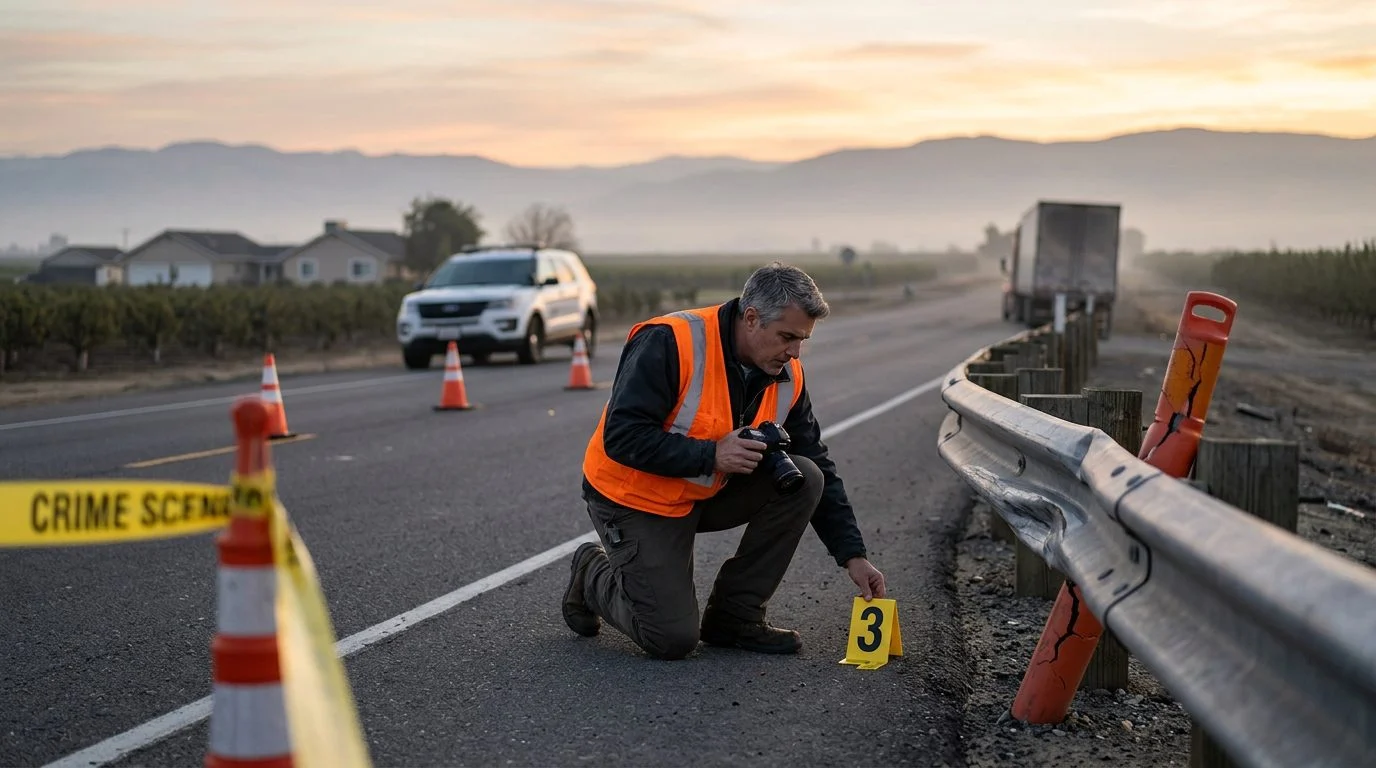
Bakersfield, CA | Trucking Wrongful Death
When a Trucking Company's Driver Ignores the Clock, Families Need Answers
Colvin Accident Lawyers represents families who have lost a loved one in a crash involving a commercial truck.
By Donald Norman Colvin · Published November 13, 2026
Losing someone in a crash with a commercial truck brings grief and hard questions at once. A trucking company wrongful death lawyer looks at whether the driver or the company broke federal hours-of-service rules, which limit how long a driver may work and drive. Those rules matter when the records and the law connect a violation to the fatal crash.
What an Hours-of-Service Wrongful Death Claim Is and Who It’s For
An hours-of-service wrongful death claim argues that a driver or trucking company broke federal driving and rest limits, and that the violation helped cause a death. Wrongful death claims arise after a death caused by another person’s wrongful act or negligence.
California law sets out who may bring the claim. The decedent’s surviving spouse, domestic partner, children, and issue of deceased children may sue or, if there is no surviving issue of the decedent, the persons, including the surviving spouse or domestic partner, who would be entitled to the property of the decedent by intestate succession may sue. Dependents such as a parent, stepchild, or putative spouse may sue if they were dependent on the decedent, and a minor who resided for the previous 180 days in the decedent’s household and was dependent on the decedent for one-half or more of the minor’s support may also sue, or a personal representative may sue on their behalf (California Code of Civil Procedure section 377.60).
This page is most useful if you are:
- A spouse, domestic partner, or child of the person who died
- A putative spouse, children of the putative spouse, stepchild, or parent who was dependent on the decedent may sue, as may the legal guardian of the decedent if the parents are deceased.
- Someone trying to understand whether a truck crash death may involve a claim
A truck case differs from a car or motorcycle death case in one key way.
If your family lost someone in a truck crash, you may have a claim worth discussing, and we can review the records you already have with you. Talk it through with our team — the first consultation is free, confidential, and carries no obligation.

The Hours-of-Service Rules That Matter in a Fatal Crash
The federal rules limit how long a property-carrying driver may work and drive before resting. These are the main limits, as the regulation states them:
- Rest before a shift: A driver may not drive without first taking 10 consecutive hours off duty.
- 14-hour window: A driver may not drive after 14 consecutive hours from coming on duty, following 10 hours off.
- 30-minute break: After more than 8 hours of driving time, driving is not permitted without at least a consecutive 30-minute interruption, unless a short-haul exception applies.
- Weekly totals: A driver may not drive after 60 hours on duty in 7 consecutive days, or 70 hours in 8 days, depending on whether the carrier runs every day of the week.
- Reset: A 34-hour off-duty period can end a 7- or 8-day period.
The rules on driving time for property-carrying commercial motor vehicle drivers are set out in 49 C.F.R. § 395.3, which provides that a driver may not drive without first taking 10 consecutive hours off duty, except as otherwise provided in § 395.1.
Fatigue has its own rule. A driver may not operate a commercial vehicle when fatigue, illness, or another cause has impaired, or is so likely to become impaired, the driver’s ability or alertness as to make it unsafe, and a carrier may not require or permit it, except in a grave emergency where compliance would increase the hazard, in which case the driver may continue to the nearest place where that hazard is removed (49 CFR § 392.3).
These limits stack. A driver can stay inside the daily limit and still exceed the weekly total. A review should cover several days, not only the day of the crash.
How Hours-of-Service Violations Are Shown After a Fatal Crash
Violations are shown by comparing a driver’s duty-status record with dispatch, GPS, fuel, and other trip records. The duty-status record is the central document. A motor carrier subject to the requirements of this part must require each driver to record duty status for each 24-hour period, except for a private motor carrier of passengers (nonbusiness).
Three parts of that rule matter after a crash:
- Each change of duty status must record the name of the city, town, or village, with the state abbreviation; if the change occurs at a location other than a city, town, or village, show the highway number and nearest milepost, the highway number and service plaza, or the highway numbers of the nearest two intersecting roadways, followed by the nearest city, town, or village and state abbreviation. That creates a location trail.
- No one may tamper with an ELD so it fails to record and keep required data.
Investigators line up these entries against the time and place of the crash. A gap between a log and a fuel receipt or GPS trail is worth examining. Logs are one source, though. Witness statements and roadside inspection reports can add context.
Who May Be Responsible and What California Law Allows
Responsibility turns on what the records show about the trip and who made the decisions behind it. A claim may name:
- The trucking company, for its own conduct, such as dispatch practices and oversight.
Other California rules shape the claim:
- Punitive damages: These require proof by clear and convincing evidence of oppression, fraud, or malice (Civ. Code § 3294). With respect to a corporate employer, the advance knowledge and conscious disregard, authorization, ratification or act of oppression, fraud, or malice must be on the part of an officer, director, or managing agent of the corporation.
- Evidence presumption: Under Evidence Code § 669, a failure to use due care can be presumed when a statute, ordinance, or regulation of a public entity is violated, the violation causes death or injury, the death or injury results from an occurrence of the kind the regulation was designed to prevent, and the person harmed is one of the class the regulation was adopted to protect. That presumption can be rebutted. How it applies to federal rules like these is a question for each case.
- Survival damages: Code Civ. Proc. § 377.34 provides that, in an action or proceeding by a decedent’s personal representative or successor in interest on the decedent’s cause of action, the damages recoverable are limited to the loss or damage that the decedent sustained or incurred before death, including any penalties or punitive or exemplary damages that the decedent would have been entitled to recover had the decedent lived, and do not include damages for pain, suffering, or disfigurement; under subdivision (b), however, damages for pain, suffering, or disfigurement may be recoverable only if the action or proceeding was granted a preference pursuant to Section 36 before January 1, 2022, or was filed on or after January 1, 2022, and before January 1, 2026. Wrongful death damages under Code Civ. Proc. § 377.61 may be just under all the circumstances, but may not include § 377.34 damages.
How the Process Works: Steps and Timeline
Most claims move from a first consultation to evidence requests, investigation, insurer talks, and, if needed, a lawsuit. Timing varies with the number of parties, how complex the records are, and court schedules.
- Intake: You describe the crash, your family’s relationship to the person who died, and any records you have.
- Preservation: The firm can send a request asking the carrier to keep logs, ELD data, dispatch messages, and maintenance files.
- Investigation: Records are compared with the crash’s time, place, vehicle, and scene. Accident reconstruction professionals can be used where needed.
- Claim discussions: Insurers are asked to resolve the claim based on the records and the law.
- Lawsuit, if needed: If a fair resolution isn’t reached, a suit is filed and moves through discovery, depositions, and possibly trial.
Two timing points matter. Code Civ. Proc. § 335.1 sets a two-year period for an action for injury to, or the death of, an individual caused by another’s wrongful act or neglect. A person seeking to commence or continue an action as a decedent’s successor in interest must execute and file an affidavit or a declaration under penalty of perjury, with a certified copy of the death certificate attached (Code Civ. Proc. § 377.32).
What Colvin Accident Lawyers Offers Families in Central California
Colvin Accident Lawyers is based in Bakersfield, California, and accepts accident cases from families in Kern County, Fresno, Visalia, Lancaster, Palmdale, Delano, and Tehachapi. The firm handles truck accident, bus accident, and wrongful death matters, along with car, motorcycle, pedestrian, and other accident cases.
Donald Norman Colvin is the responsible lawyer for this page. Our team includes assistants and office staff who can help you gather the records a claim needs.
The first consultation is free, confidential, and carries no obligation to continue. During it, the firm explains what facts it needs and what records to gather, so you know what to expect.
Not sure what your next step is?
Talk it through with our team — the first consultation is free, confidential, and carries no obligation.
Frequently Asked Questions
How do I sue a trucking company?
A claim usually starts with a consultation, a records preservation request, and talks with the insurer. A lawsuit is filed if a fair resolution is not reached.
Can I call a lawyer to ask a question for free?
Start with the free, confidential first consultation described above, which carries no obligation to continue.
How hard is it to win a truck wrongful death case?
Results turn on the evidence, the records, and the law in each case. No lawyer can predict a particular outcome.
Do I need the crash report before I call?
No. Share whatever you have, and the firm can help identify which records to request.
Can an hours-of-service violation be shown if the logs look normal?
Logs are one source of evidence. Dispatch, GPS, and fuel records can be compared with them.

Talk With Colvin Accident Lawyers About Your Family’s Situation
If you are handling a sudden death, questions about a driver’s logs, or other difficult decisions, you do not have to sort it out alone. If your family lost someone in a crash with a commercial truck, Colvin Accident Lawyers can talk through the crash and the records you already have. Call Colvin or contact us now.
How We Approach a Trucking Wrongful Death Case
Early Records Requests
We work to identify and request driver logs, electronic logging device data, dispatch records, and maintenance files before they can be lost.
Accountability for the Company
We look at the carrier's hiring, training, supervision, and scheduling decisions, not only the driver's actions on the day of the crash.
Support for Grieving Families
We explain each step in plain language so surviving family members understand the process and their options.
Direct Communication
You will know who is handling your case and how to reach them when questions come up.
Act Quickly to Protect Evidence
Electronic logging device data, dispatch messages, and driver logs are not always kept indefinitely. Records that exist now may be overwritten or discarded later.
Records That Can Matter in a Hours-of-Service Case
Electronic Logging Device Data
Shows driving time, on-duty time, and rest breaks recorded by the truck's system.
Dispatch and Load Records
Can show delivery deadlines and whether the driver was pressured to keep moving.
Fuel, Toll, and Receipt Records
Can help confirm where the truck was and when, which may conflict with the logs.
Driver Qualification Files
Can reveal prior violations, training gaps, and the carrier's hiring and supervision practices.