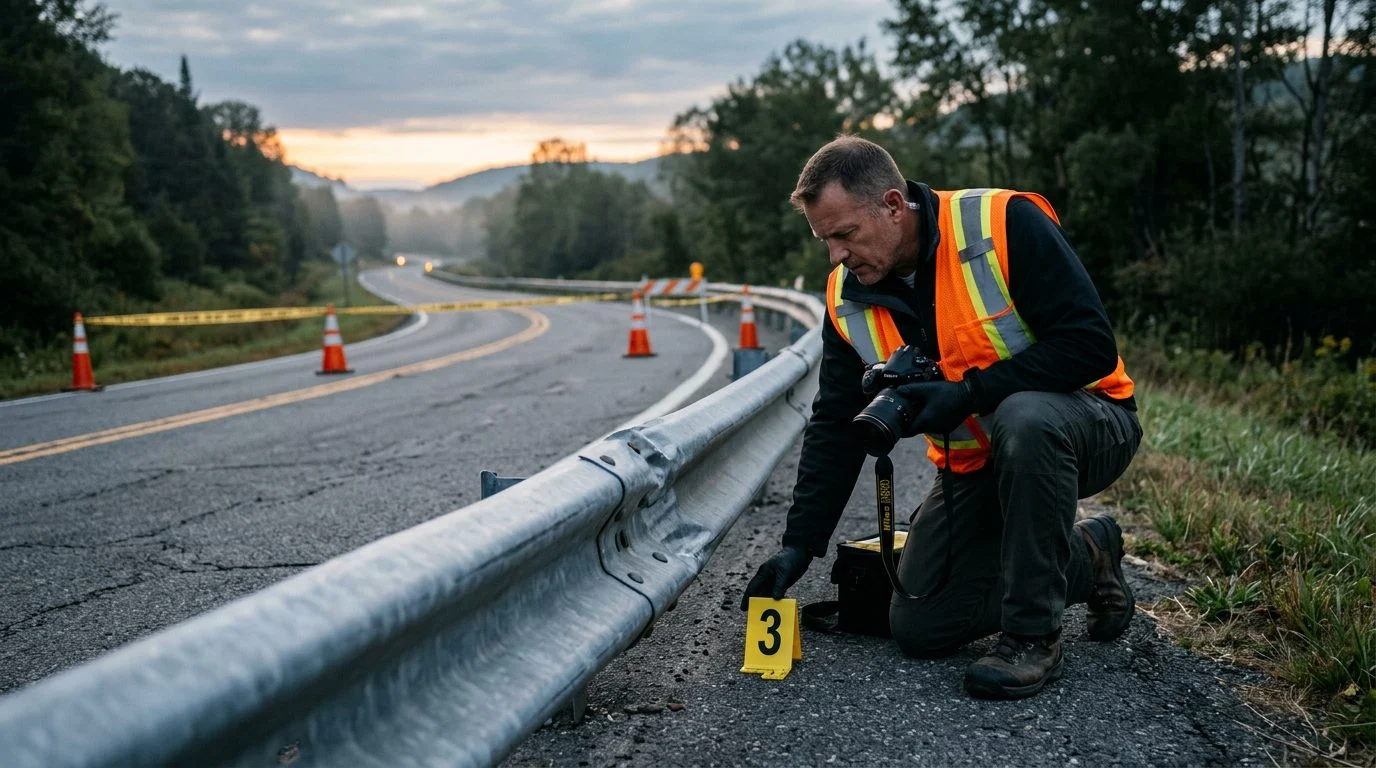
Wrongful Death · Kern County and Surrounding Communities
Wrongful Death Claims After a Road Defect Crash
When a dangerous road condition contributes to a fatal crash, families deserve clear answers. Colvin Accident Lawyers reviews the facts with families in Bakersfield, Fresno, Visalia, Lancaster, Palmdale, Delano and Tehachapi.
By Donald Norman Colvin · Published November 4, 2026
A wrongful death claim over a road defect asks a public agency to answer for a death caused by a dangerous road condition it owned or controlled. These claims follow different rules than a lawsuit against a driver. The most urgent step is usually a written government claim, which generally must be presented within six months. This page explains who can bring a claim, when a road condition can support liability, and what to expect next.
What a Road-Defect Wrongful Death Claim Is and Who Can Bring It
A road-defect wrongful death claim is a case brought by family members after a death caused by a dangerous condition on a public road. The claim may name a city, a county, or a state agency such as Caltrans, depending on who maintains the road.
California law sets out who may sue. Under Cal. Code Civ. Proc. § 377.60, the decedent’s surviving spouse, domestic partner, children, and issue of deceased children may bring the claim. Others may too, including dependent parents and, in some cases, a minor who lived in the decedent’s household.
These claims can arise from many crash types. Cars, trucks, motorcycles, bicycles, pedestrians, and bus crashes can all involve a road condition.
Colvin Accident Lawyers is based in Bakersfield, California. We represent accident victims and families in Kern County, Fresno, Visalia, Lancaster, Palmdale, Delano, and Tehachapi. Donald Norman Colvin is the responsible lawyer for this site.
If a road defect played a part in your loved one's death, your family may have a claim, and our team can review the deadlines with you. Talk it through with our team — the first consultation is free, confidential, and carries no obligation.

When a Road Condition Can Support Liability Under California Law
Under Cal. Gov. Code § 835, a public agency can be liable for injury or death caused by a dangerous condition of its property if the family shows that the condition was dangerous at the time of the injury, proximately caused the death, and created a reasonably foreseeable risk of that kind of harm, and either a negligent or wrongful act or omission of a public employee within the scope of employment created the dangerous condition, or the agency had actual or constructive notice of it a sufficient time before the injury to protect against it. Under Cal. Gov. Code § 835, the family must show several things. The property was in a dangerous condition at the time of the crash. That condition caused the death. It created a reasonably foreseeable risk of this kind of harm.
The family must also show that an employee’s negligent act, within the scope of employment, created the condition, or that the agency had notice of it in time to act.
A “dangerous condition” means a substantial risk of injury, not a minor or trivial one. See Cal. Gov. Code § 830. Examples families ask about include large potholes, missing or hidden signs, failed guardrails, and defective traffic signals.
Notice is often the hardest element. Under Cal. Gov. Code § 835.2, actual notice means the agency had actual knowledge of the condition and knew or should have known of its dangerous character. Cal. Gov. Code § 835.2 reads: “(b) A public entity had constructive notice of a dangerous condition within the meaning of subdivision (b) of Section 835 only if the plaintiff establishes that the condition had existed for such a period of time and was of such an obvious nature that the public entity, in the exercise of due care, should have discovered the condition and its dangerous character.” Constructive notice means the condition existed long enough, and was obvious enough, that the agency, using due care, should have discovered the condition and its dangerous character. Cal. Gov. Code § 835.2 reads: “(b) A public entity had constructive notice of a dangerous condition within the meaning of subdivision (b) of Section 835 only if the plaintiff establishes that the condition had existed for such a period of time and was of such an obvious nature that the public entity, in the exercise of due care, should have discovered the condition and its dangerous character.”
Punitive damages work differently here. Under Cal. Gov. Code § 818, a public entity is not liable for punitive-type damages. Each case turns on its own facts.
The Government Claim Deadline and Why It Comes First
A written claim against a public entity generally must be presented within six months. Under Cal. Gov. Code § 911.2, this six-month deadline, which runs from the accrual of the cause of action, applies to a claim for death or injury to a person.
Under Gov. Code § 911.2(b), for a claim presented to the Department of General Services, the presentation date is the date the claim is submitted with the $25 filing fee. Under Gov. Code § 911.2(b), for a claim presented to the Department of General Services, when a fee waiver is granted, the presentation date is the date the claim is submitted with the fee-waiver affidavit. Under Gov. Code § 911.2(b), for a claim presented to the Department of General Services, when a fee waiver is denied, the claim is treated as presented on the date it was submitted with the affidavit, as long as the filing fee is paid within 10 calendar days after the denial notice is mailed.
A lawsuit cannot come first. Except as provided in Sections 946.4 and 946.6, under Cal. Gov. Code § 945.4, no suit for money or damages may be brought until the written claim has been presented to the public entity and acted on by the board or deemed rejected by the board.
Under Cal. Code Civ. Proc. § 377.62, an action under Section 377.30 may be joined with an action under Section 377.60 arising out of the same wrongful act or neglect. Under Cal. Gov. Code § 911.4, when a claim that must be presented within six months (such as a claim for death, injury to person, or injury to personal property or growing crops) is not presented in time, a written application for leave to present the claim may be made within a reasonable time, not to exceed one year after the claim accrues. The application must state the reason for the delay.
Confirm the crash date and the responsible agency early. The claim goes to the public entity that owned or controlled the road.
What Families Can Recover in a Wrongful Death Case
Families can seek the damages a court finds just under all the circumstances (CACI civil jury instructions). Under Cal. Code Civ. Proc. § 377.61, the court also decides how the award is divided among the people entitled to it.
A wrongful death action can be joined with a survival action from the same crash. Under Cal. Code Civ. Proc. § 377.62, an action under Section 377.60 and an action under Section 377.31 arising out of the same wrongful act or neglect may be consolidated for trial as provided in Section 1048.
The amount in any case depends on the facts. Those facts can include the decedent’s age, work history, and family relationships. No amount can be predicted before the facts are reviewed.
Records usually help prove the claim. Families often gather the death certificate, the crash report, photos of the road condition, and any records of prior complaints or repairs.
How a Road-Defect Wrongful Death Case Moves Forward
The process usually moves in clear steps, though timing varies.
- Free consultation. The family shares the crash date, the location, the road condition, and any police or agency reports.
- Evidence preservation. Photos of the defect are saved, and records requests go out about prior complaints and repairs.
- Written claim. The claim is prepared and presented within the six-month deadline, and the response period is tracked.
- Lawsuit, if needed. If the claim is denied or not resolved, a suit can follow once the claim is acted on or deemed rejected.
- Investigation and negotiation. A detailed review of the evidence may be needed where the facts call for it. Trial preparation follows only if the case does not settle.
No timeline is promised. The agency, the records, and the court all affect how long each step takes.
Why Colvin Accident Lawyers for This Type of Case
Colvin Accident Lawyers helps families with crash claims involving cars, trucks, motorcycles, bicycles, pedestrians, buses, and premises conditions. Road-defect claims often overlap with these crash types.
Our team includes assistants and office staff. They can help track the claim deadline and request the records a family needs.
We explain each step in plain language. That way, families can understand their options before making a decision.
We are based in Bakersfield and serve families in Kern County, Fresno, Visalia, Lancaster, Palmdale, Delano, and Tehachapi. Our lawyers will review the specific facts of each family’s situation.
Not sure what your next step is?
Talk it through with our team — the first consultation is free, confidential, and carries no obligation.
Questions Families Ask About Road-Defect Wrongful Death Claims
Can I sue a city or county for a road defect that caused a fatal crash?
Possibly. A claim may be possible if the dangerous condition elements are met.
How long do I have to file?
A written claim against a public entity generally must be presented within six months. Confirm the date for your crash promptly.
Do I need a claim before a lawsuit?
Yes. A suit for money or damages generally waits until the claim is acted on or deemed rejected.
Can punitive damages come from a city or county?
No. A public entity is not liable for punitive-type damages under California law.
What if another driver also caused the crash?
Several parties may share responsibility under pure comparative negligence. Each may face its own claim, so the facts of each role matter.
Talk With Our Team About Your Family’s Road-Defect Crash
If your family lost someone in a crash on a road you believe was unsafe, you may be deciding whether to act before the government claim deadline runs. Our free, confidential first consultation has no obligation to continue. In that consultation, we review the crash date, the location, and the road condition, and we confirm the deadlines that may apply. You can reach us through our contact page.
Colvin Accident Lawyers, Bakersfield, California — responsible for this site. Responsible lawyer: Donald Norman Colvin.
Why families contact Colvin Accident Lawyers
Free first consultation
Your initial consultation is free, confidential and comes with no obligation to continue.
Support for grieving families
Our team helps surviving family members understand the process and the questions they need to ask.
Speak with us directly
Call our office to talk through what happened and what information you have available.
Claims against public agencies move on their own timeline
A claim involving a city, county or other public agency can involve special notice procedures and deadlines that differ from other injury cases. Please do not wait to have the facts reviewed.
Road conditions that may contribute to a crash
Potholes and pavement failure
Deep potholes, crumbling edges and broken pavement can cause drivers and motorcyclists to lose control.
Missing or damaged signs and signals
Absent stop signs, faded markings or malfunctioning traffic signals may leave drivers without warning.
Unsafe design or lane changes
Abrupt lane drops, poorly marked curves and missing shoulders can create hazards that are hard to anticipate.
Debris and poor drainage
Standing water, loose gravel and debris on the roadway can cause sudden loss of traction and collisions.