Motorcycle Accident Lawyer | Bakersfield, CA
Hit by a Driver Turning Left in Bakersfield?
Colvin Accident Lawyers helps motorcyclists and their families understand what happened and who may be responsible in left-turn collisions. Your first consultation is free, confidential, and carries no obligation to continue.
By Donald Norman Colvin · Published October 29, 2026
Fault is not decided by the turn alone. It depends on the facts. Right-of-way, the traffic signal, what each driver could see, and how fast each vehicle was moving all matter. So does where the motorcycle sat in its lane.
A rider can share some responsibility. If the rider was speeding, ran a signal, or rode in a way that helped cause the crash, the other driver will raise it. That is why both drivers’ conduct gets examined, not just the turn itself.
These questions come up in Bakersfield, Fresno, Visalia, and other parts of Central California alike. The sooner the facts are written down, the clearer the picture becomes.
How Fault Is Shared in Left-Turn Crashes
California also has a general rule about careless conduct.
Motorcycles can look farther away than they are. A driver who misreads a motorcycle’s distance and turns anyway may still have failed to use ordinary care. In practice, investigators ask where the motorcycle was when the car started its turn. They ask whether the turning driver stopped or edged forward, and whether another vehicle blocked the view.
If a car turned in front of you on your motorcycle, our team can review the turn, the signal and the evidence with you and explain your options. Talk it through with our team — the first consultation is free, confidential, and carries no obligation.

When the Motorcyclist May Share Fault
A motorcyclist may share fault when their own conduct helped cause the crash. Speed is one example. The basic speed law says no one may drive faster than is reasonable or prudent for the weather, visibility, traffic, and road. It also bars any speed that endangers people or property.
A rider who was going well above a safe speed for that intersection gives the other driver a real argument. Breaking a traffic law can carry weight too. Under Evidence Code § 669, a person who violated a statute, ordinance, or regulation of a public entity is presumed to have failed to use due care, if the violation proximately caused the injury, the injury was of the kind the law was designed to prevent, and the injured person was one of the class of persons the law was meant to protect. The presumption applies when the violation caused the injury, the law was designed to prevent that kind of harm, and the injured person was one of the class of persons for whose protection the statute, ordinance, or regulation was adopted. It can be rebutted by showing the person did what a prudent person would have done.
Other facts get raised too. The other driver may claim the rider was weaving or sitting in a blind spot. Lane position, headlight use, and visibility all help rebuild the sequence. None of these points settles the case by itself. They’re weighed together with the turn itself.
Lane Splitting Does Not Decide Fault on Its Own
Lane splitting alone does not decide who caused a left-turn crash. Vehicle Code § 21658.1 defines lane splitting as driving a motorcycle with two wheels on the ground between rows of stopped or moving vehicles in the same lane. It also lets the California Highway Patrol develop guidance on the practice. The statute defines lane splitting. Fault is decided by the facts of each crash.
So the real questions are different. Was the split made safely at that moment? Did the turning driver look for motorcycles before turning? Investigators look at the lane the rider used, the rider’s speed, and whether the turning driver paused before moving. Each fact can push fault in one direction or the other.
Splitting does not excuse a turn made without looking. A turn made without looking does not erase a rider’s own mistakes either. The turn itself, including the gap and the speeds, stays at the center of the analysis.
How California’s Comparative Negligence Divides the Blame
California uses a comparative fault approach, so a person who is partly at fault may still recover, but damages can be reduced in proportion to that person’s share of fault.
Each side presents its version of the turn, and the evidence decides which version holds up.
That makes early documentation of the turn important.
When more than one defendant is involved, Civil Code § 1431.2 limits each defendant’s liability for non-economic damages to their own percentage of fault. Non-economic damages cover pain, suffering, and emotional distress. Economic damages cover objectively verifiable losses, such as medical expenses, lost earnings, and repair costs.
Evidence to Preserve After a Left-Turn Crash
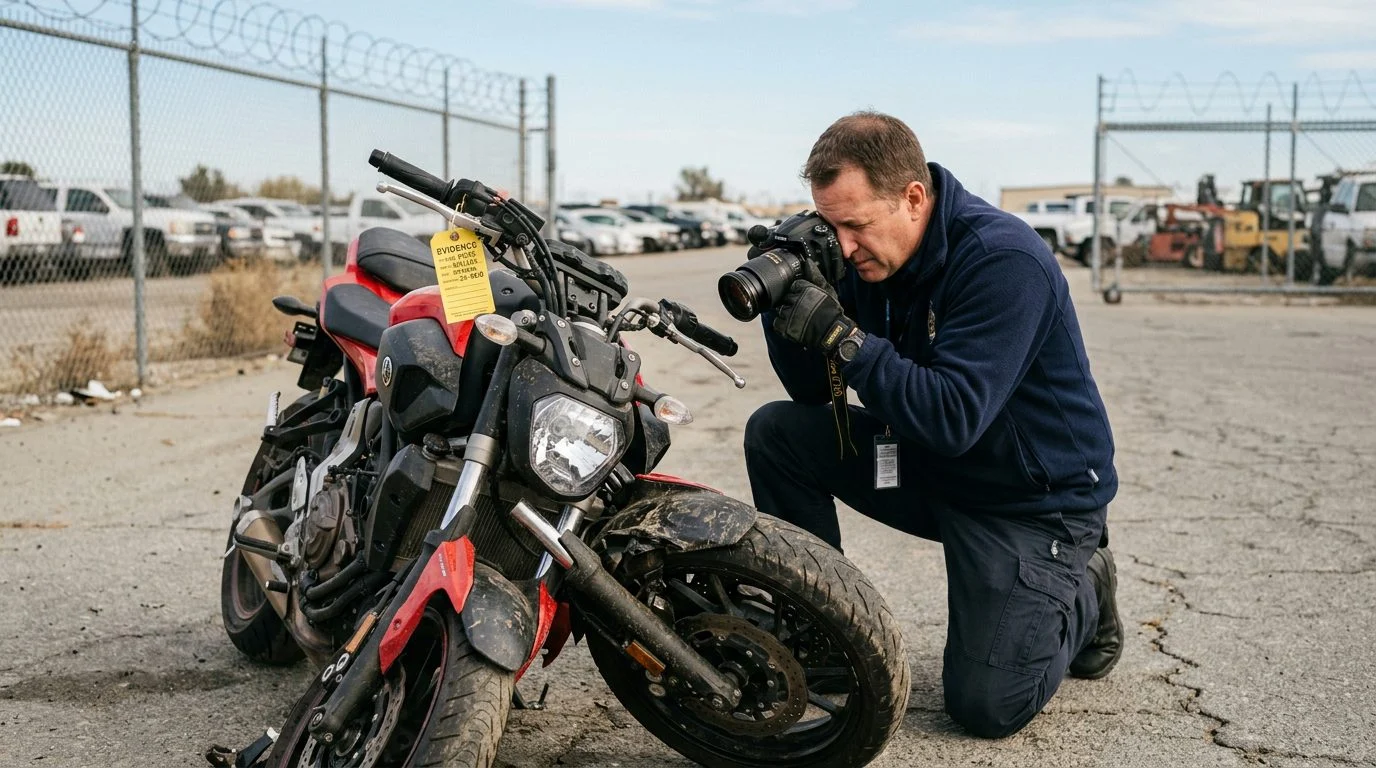
The most useful evidence shows the signal, the positions of both vehicles, and their speeds. Take photos of the intersection, the damage to both vehicles, any skid or gouge marks, and where each vehicle came to rest. Note the signal phase in effect when each vehicle entered.
Get names and phone numbers for witnesses. Write down anything the turning driver said at the scene. Keep the police report, medical records, and the motorcycle and riding gear that were damaged. Damaged gear can help show how the impact happened.
Video can disappear quickly. Dashcam footage and nearby security or traffic camera footage can be overwritten, so ask about it early. These records are the basis for reconstructing the crash, so the earlier they’re collected, the better the picture.
Timing matters on the reporting side too. The report can be made personally or through an insurance agent, broker, or legal representative.
Frequently Asked Questions
Is the driver turning left always at fault?
Who is at fault in a turning collision depends on the facts of that crash. Each crash has to be looked at on its own facts.
Can a motorcyclist recover if partly at fault?
Who was at fault is often a central question in motorcycle accident claims, and the answer depends on the facts of each case.
How long does an injured rider have to file a claim?
Under Code of Civil Procedure § 335.1, an action for injury to, or for the death of, an individual caused by the wrongful act or neglect of another must be brought within two years. Claims against a public entity, such as a city or county over a road defect or a public bus, are subject to shorter claim-presentation deadlines that apply before any lawsuit, so those claims should be discussed with a lawyer promptly. Waiting can make evidence harder to gather.
Does lane splitting make the motorcyclist liable?
Lane splitting alone does not establish fault.
Not sure what your next step is?
Talk it through with our team — the first consultation is free, confidential, and carries no obligation.
Talk With Colvin Accident Lawyers About Your Left-Turn Crash
After a car turns in front of you, you may be dealing with injuries, a damaged motorcycle, and an insurance adjuster asking questions. Those questions can feel urgent before you understand what they mean. Our team can talk with you, review the turn, the signal, and the evidence, and explain what the facts show. Colvin Accident Lawyers, Bakersfield, California, is responsible for this site, and Donald Norman Colvin is the attorney responsible for this page. Your first consultation is free, confidential, and carries no obligation to continue. When you’re ready, reach out through our contact page.
How we approach a left-turn motorcycle case
Facts before conclusions
Every crash is different. We look at the specific road, traffic, and signal conditions before drawing any conclusion about fault.
Organized evidence
We help gather and preserve police reports, photos, repair records, and other documents that describe how the collision happened.
Clear communication
We explain each step in plain language so you know what is happening with your claim and what questions to ask.
Rooted in Bakersfield
Our office serves riders and families in Bakersfield and throughout Kern County.
Be careful before you speak to an insurer
Insurance adjusters may contact you soon after a crash and ask for a recorded statement. Anything you say can be used in evaluating your claim. Talking with a lawyer first can help you understand what to say and what to avoid.
Facts that often matter in turning collisions
Right of way and traffic signals
Signal phase, yield signs, and oncoming traffic can all shape how a left-turn collision is reviewed.
Speed and following distance
The speed of the motorcycle and the distance at which it was visible to the turning driver are often examined closely.
Visibility and lane position
Mirrors, lighting, blind spots, and where a motorcycle was positioned in the lane can all be relevant facts.
Witnesses and video
Statements from witnesses, nearby business cameras, and vehicle data can help establish what each driver did.
Injured in a left-turn crash?
Talk with Colvin Accident Lawyers about your options.
Related practice areas
- What Rights Do You Have After a Motorcycle Crash in California?
- Can You Recover Damage to Your Motorcycle and Riding Gear After a Crash?
- California Dog Bite Lawyer: What Shapes a Settlement