Bakersfield, CA | Motorcycle Accident Legal Guide
Hurt in a Motorcycle Crash on a California Road? Start With Clear Answers.
Colvin Accident Lawyers helps injured riders and their families in Kern County and nearby communities understand their options after a crash. Your first consultation is free, confidential, and comes with no obligation to continue.
By Donald Norman Colvin · Published October 18, 2026
This motorcycle accident legal guide California riders and families can read explains who may be responsible, how shared fault works, and what deadlines and damages usually matter. In short, a rider hurt by another driver’s carelessness may have a personal injury claim. The facts of each crash decide how that claim plays out.
How California Law Treats a Motorcycle Injury Claim
A motorcycle injury claim is a civil case. It asks for money to make up for harm, and it is separate from any traffic ticket. California’s general negligence statute says everyone is responsible for injury caused by a want of ordinary care (Cal. Civ. Code § 1714).
A traffic citation looks at whether a law was broken. A civil claim looks at who caused the harm and what it cost. The two can overlap, but one does not decide the other. The police report, witness accounts, and physical evidence all feed into the civil question.
This guide covers fault, filing deadlines, damages, and special situations such as passengers, fatal crashes, and defective parts. Each section answers one common question in plain words. Read the sections that match your situation first.
If a crash left you or someone you love dealing with medical bills and insurance calls, our team is glad to talk through your options with you. Talk it through with our team — the first consultation is free, confidential, and carries no obligation.
How Is Fault Shared in a California Motorcycle Crash?
Fault is decided on evidence. Juries and insurers look at the crash report, witness statements, damage patterns on each vehicle, and any video. They also look at speed, lane position, and signals.
Non-economic damages work differently when more than one person is at fault. Each defendant pays only its own percentage of those damages, under Cal. Civ. Code § 1431.2. That split is one reason the number of parties in a crash matters.
Who Is Usually at Fault in a Vehicle and Motorcycle Collision?
Fault depends on what each driver did, not on the type of vehicle involved. A motorcycle does not make a rider at fault, and a car does not make a driver at fault. Facts have to show who failed to use reasonable care.
This page describes several common crash patterns. A driver turning left can cut across a motorcycle’s path. A driver changing lanes can move into a rider who is already in the space. A driver following too closely can leave no room to stop. A driver who fails to yield at an intersection can cause a crash the rider had no time to avoid.
Visibility often matters. A rider can be easy to miss in a blind spot or at an angle. A driver who looked but did not see the rider may still have failed to use reasonable care. Whether that happened is a question of facts.
Read the rules on related crashes too. Each raises different questions about who is responsible.
Common Ways Motorcycle Crashes Happen in California
Motorcycle crashes come in several common forms. Many involve another vehicle turning, changing lanes, or failing to yield. Others involve a car door opening into a rider’s path, road debris, or a loss of control on a curve.
Rear-end collisions and lane-change crashes are two types of traffic crashes. Each one turns on the specific movements of the drivers and the rider. A short phrase like “the car was at fault” does not settle the question.
Crashes near busy routes such as Highway 58 and Highway 99 in Kern County are judged the same way as any other crash. The facts of that crash, including speed, position, and signals, control the analysis. Nothing in this guide suggests a specific cause for any reader’s crash.
A crash involving a truck or bus can bring in different parties and rules. Those cases often have more than one company involved. Each adds its own paperwork and proof.
How Long Do You Have to File a Motorcycle Accident Lawsuit?
In general, a claim against a California public entity for death, personal injury, or damage to personal property or growing crops must be presented not later than six months after the cause of action accrues; other claims against public entities must be presented not later than one year after accrual. That rule comes from Government Code § 911.2. The California Courts Self-Help Guide also explains the general time limits for suing.
Wrongful death claims are subject to the two-year limit for an action for the death of an individual caused by the wrongful act or neglect of another, under Code of Civil Procedure § 335.1. Some claims against health care providers follow different rules, so the type of defendant matters.
Government entities add an extra step. A claim against a public entity for injury or death must be presented within six months after the claim arises (Gov. Code § 911.2). Because this window is short, it is worth knowing early.
Ongoing medical treatment and insurance talks do not replace knowing the deadline that fits your case. The information here is general. How timing works depends on the facts, the parties, and the type of claim.
What Damages Can a Motorcycle Injury Claim Include?
A claim can seek economic damages and non-economic damages. Economic damages are objectively verifiable losses, such as medical expenses, lost earnings, and the cost to repair or replace property. Non-economic damages are subjective losses, such as pain, suffering, emotional distress, and loss of companionship (Cal. Civ. Code § 1431.2).
Damages aim to compensate for the harm caused. For breach of an obligation not arising from contract, California measures damages, except where otherwise expressly provided by this Code, as the amount that compensates for all detriment proximately caused by the wrongful act, whether it could have been anticipated or not (Cal. Civ. Code § 3333). Future losses that are certain to result may also be awarded (Cal. Civ. Code § 3283).
Some claims can include punitive damages. These require proof by clear and convincing evidence of oppression, fraud, or malice (Cal. Civ. Code § 3294). Cal. Civ. Code § 3294 reads: “(b) An employer shall not be liable for damages pursuant to subdivision (a), based upon acts of an employee of the employer, unless the employer had advance knowledge of the unfitness of the employee and employed him or her with a conscious disregard of the rights or safety of others or authorized or ratified the wrongful conduct for which the damages are awarded or was personally guilty of oppression, fraud, or malice. With respect to a corporate employer, the advance knowledge and conscious disregard, authorization, ratification or act of oppression, fraud, or malice must be on the part of an officer, director, or managing agent of the corporation.” Some motorcycle claims do not turn on that standard.
Some limits also apply. California bars recovery of certain non-economic losses in specific cases, such as when the injured person was convicted of drunk driving at the time of the crash, with exceptions (Cal. Civ. Code § 3333.4).
No lawyer can tell you in advance how a case will end. What drives value is the injury, the proof, each party’s share of fault, and the insurance available. Past outcomes in other cases depend on their own facts.
Not sure what your next step is?
Talk it through with our team — the first consultation is free, confidential, and carries no obligation.
Can You Sue Someone for Crashing Your Motorcycle?
Yes, in many cases a rider can file a civil claim against the driver whose negligence caused the crash. The defendant owed a duty of care, broke that duty, caused the crash, and caused harm.
A claim may be handled through the at-fault driver’s insurance company. Policy limits can affect how much money is available to pay a claim. The driver’s own assets are a separate question.
Ownership can matter too. A vehicle owner is liable and responsible for death or injury to person or property resulting from a negligent or wrongful act or omission by a permissive driver in operating the vehicle (Cal. Veh. Code § 17150). That rule comes up when someone else, driving with the owner’s express or implied permission, was driving the car that hit the rider (Cal. Veh. Code § 17150).
Each case is different. Whether a claim exists, and against whom, depends on the facts of the crash and the parties involved.
Lane Splitting and Riding Rules in California
Lane splitting is a fault question, not an automatic admission.
Speed and traffic conditions are part of the picture. Someone reviewing a crash will look at how fast the rider was moving, how traffic was flowing, and whether the other driver had a fair chance to see the motorcycle.
Gear and equipment can also come up as evidence. The other side may raise them when arguing about fault. The goal is to show the facts of the crash, not to assume the rider caused it.
Insurers and courts weigh these facts differently in each case. Riders should not assume a rule will decide the outcome on its own.
Steps and Evidence to Preserve After a Motorcycle Crash
Start with medical care. Get checked even if injuries seem minor, because some harm shows up later. Keep records of every visit, test, and prescription.
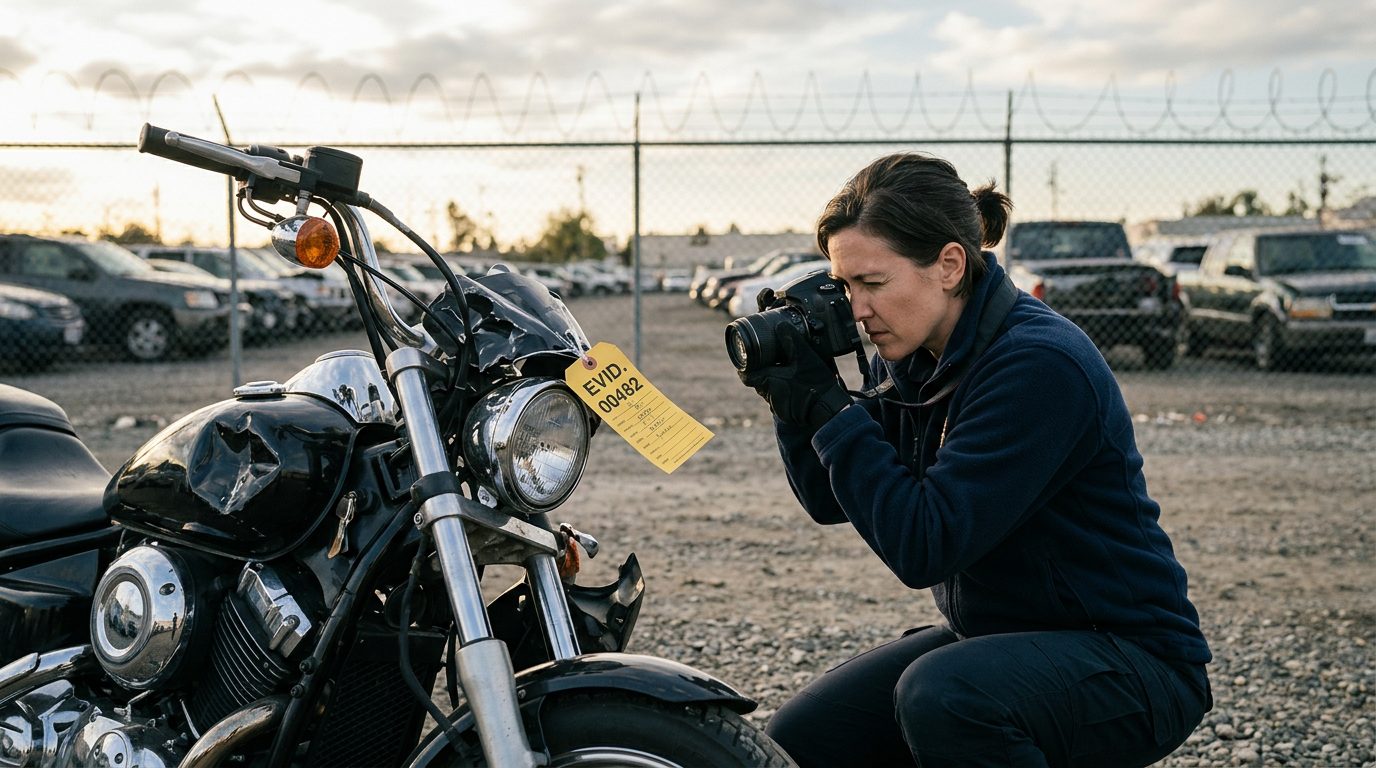
Report the crash to police and get the report number. Photograph the scene, the vehicles, the motorcycle, and your gear while the details are still fresh. Write down names and contact information for any witnesses.
Save other proof of the crash. Dashcam footage, surveillance video, phone records from the time of the crash, and motorcycle maintenance records can all matter to fault.
Be careful with recorded statements. An adjuster may ask you to give one soon after a crash. Anything you say can be used to judge fault and damages, so think before you speak.
Evidence that goes missing can hurt a case.
Special Situations: Passengers, Fatal Crashes, and Defective Parts
Passengers can have their own claims. A passenger hurt in a crash may have a claim against the driver of either vehicle, depending on who was at fault. Passengers are often not responsible for the crash, which keeps the focus on the drivers.
Families of a person killed in a crash can bring a wrongful death claim. California law allows a person who suffers detriment from another’s unlawful act to recover damages (Cal. Civ. Code § 3281). The losses a family can seek depend on the facts and the relationships involved.
Defective parts raise a separate question. That claim has its own proof needs, and the parts themselves often need to be preserved.
These situations are emotional. This guide keeps the discussion factual and avoids graphic detail. Each family or rider deserves a plain, clear explanation of the options.
Local Routes and Service Areas Across Central and Southern California
Colvin Accident Lawyers is based in Bakersfield, in Kern County. The firm is a personal injury practice focused on motorcycle, car, truck, bus, bicycle, pedestrian, dog bite, premises liability, catastrophic injury, and wrongful death cases.
Crashes in Fresno, Visalia, Lancaster, Palmdale, Delano, and Tehachapi raise the same legal questions covered in this guide. Fault, deadlines, and damages follow California law wherever the crash happened. The local facts still shape each case.
Route names help describe where a crash happened. They do not decide who was at fault. The crash report, the physical evidence, and the witness accounts do that work.
Riders and families with questions about how California law applies to their crash can contact Colvin Accident Lawyers for a free first consultation, which is confidential and carries no obligation to continue. Each situation depends on its own facts.
If a crash left you or someone you love dealing with medical bills and insurance calls, our team is glad to talk through your options with you. Talk it through with our team — the first consultation is free, confidential, and carries no obligation.
Talk With Colvin Accident Lawyers About Your Motorcycle Crash
If you are weighing insurance calls, the two-year deadline, and how shared fault may affect your claim, you don’t have to sort it out alone (Code Civ. Proc. § 335.1). The points above are a starting map, not a final answer for your crash.
Frequently Asked Questions
Can you sue someone for crashing your motorcycle in California?
In many cases, yes. A rider may bring a civil claim against the driver whose negligence caused the crash.
Separately, Civil Code § 3333.4 bars recovery of non-economic losses in certain situations, such as when the injured person owned a vehicle in the accident that was not insured as state law requires, or operated a vehicle and cannot establish financial responsibility as state law requires, subject to the limited exception in subdivision (c).
How long do you have to file a motorcycle accident lawsuit?
Generally, two years for a personal injury lawsuit under Code of Civil Procedure § 335.1.
Questions about lane splitting
often come up after a motorcycle crash, and how they apply depends on the specific facts of each case.
Who is usually at fault in a motorcycle collision?
Fault depends on what each driver did, shown by facts like the crash report and witness statements.
Our team at Colvin Accident Lawyers can talk with you about your crash and your options. Call us or contact us online for a free, confidential first consultation with no obligation to continue.
Donald Norman Colvin, Colvin Accident Lawyers, Bakersfield, California — responsible for this site.
How Colvin Accident Lawyers Works With Injured Riders
Start With a Call
Contact our office to describe what happened. There is no cost for your first consultation, and it is confidential.
Review Your Situation
We listen to the facts of your crash, your injuries, and the steps you have taken since, so you can make an informed decision.
Focus on Your Recovery
Our team handles communication with insurance companies and other parties so you can concentrate on your health.
Support for Families
When a crash causes a death or serious injury, we work with surviving family members to explain each step clearly and respectfully.
Before You Speak With an Insurance Adjuster
Insurance representatives may call soon after a crash and ask for a recorded statement. Consider speaking with a lawyer first so you understand what you are agreeing to.
Common Motorcycle Crash Situations We Handle
Driver Turns Across Your Path
Many motorcycle collisions happen when a driver turning left or pulling out does not see an approaching rider.
Road Hazards and Poor Conditions
Potholes, debris, uneven pavement, and unmarked hazards can cause a rider to lose control.
Crashes Involving Trucks or Buses
Large vehicles have big blind spots and longer stopping distances, and their crashes can cause catastrophic injuries.
Serious and Long-Term Injuries
Injuries such as spinal damage, broken bones, and head trauma can require extended medical care and time away from work.