Motorcycle Accidents | Bakersfield, CA
Hurt in a Motorcycle Crash Without Insurance? Talk With Us First
Colvin Accident Lawyers helps motorcycle riders and families in Kern County, Fresno, Visalia, Lancaster, Palmdale, Delano and Tehachapi understand their options. Your first consultation is free, confidential, and comes with no obligation to continue.
By Donald Norman Colvin · Published October 31, 2026
What happens if you get in a motorcycle accident without insurance? Every accident case is different. Under California Civil Code § 3333.4, except as provided in subdivision (c), a person shall not recover non-economic losses to compensate for pain, suffering, inconvenience, physical impairment, disfigurement, and other nonpecuniary damages in an action to recover damages arising out of the operation or use of a motor vehicle if any of the following applies: the injured person was operating the vehicle in violation of Vehicle Code § 23152 or 23153 and was convicted of that offense; the injured person owned a vehicle involved in the accident that was not insured as required by California’s financial responsibility laws; or the injured person was the operator of a vehicle involved in the accident and cannot establish financial responsibility as those laws require. The statute also contains exceptions, including one for certain owners injured by a motorist convicted of drunk driving, so whether the bar applies depends on the specific facts. The bar covers only those losses. Medical bills and lost wages fall under a different category. Civil Code § 3333.4 sets out this rule.
Riders in Bakersfield, Kern County, and nearby communities often face these questions while still hurting. This page walks through each step in plain terms.
What Happens at the Scene If You Have No Motorcycle Insurance
Your health and safety come first at the scene, whether or not you carry insurance. Check yourself and any passenger for injuries, move to safety if you can, and call for help.
Reporting still matters. California drivers must report a crash to the Department of Motor Vehicles within 10 days if it causes bodily injury, death, or property damage over $1,000. Vehicle Code § 16000 sets this duty. The driver must also name any person involved who is complaining of bodily injury.
Vehicle Code § 16020 requires all drivers and owners to be able to establish financial responsibility at all times and to carry evidence of it in the vehicle. Know what proof you have and where it is.
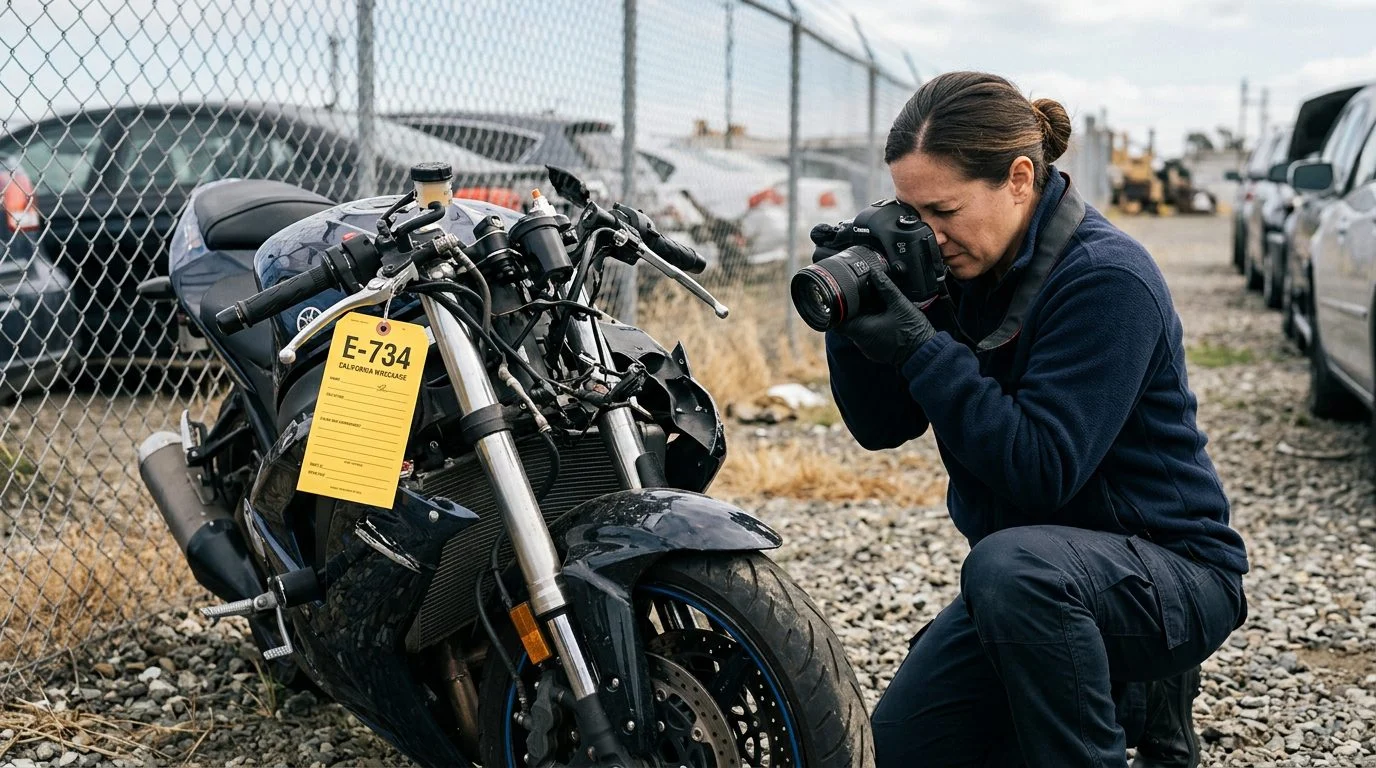
Take photos of the motorcycle, the road, any visible injuries, and the other vehicle. Write down the other driver’s name, plate number, and any witness contact details. Describe what you saw, but avoid guessing about speed or fault.
Is a Minor Accident Still a Claim?
Calling a crash “minor” describes how it looks, not how hard the body was hit. A claim depends on the harm you suffered. Under California’s general negligence rule, a person can be responsible for injury they cause through a lack of ordinary care.
Head injuries show why looks can mislead. According to the Administration for Community Living, a motorcycle crash can cause a traumatic brain injury, including severe brain damage.
See a doctor even when the bike looks only scratched. Keep every medical record, bill, and receipt. Note each day you miss from work. These records document economic losses. Civil Code § 1431.2 describes economic damages as objectively verifiable monetary losses, including medical expenses and loss of earnings.
What Not to Tell the Insurance Company After an Accident
Stick to the basic facts. Give the date, the place, and the people involved. Don’t guess about speed, fault, or how badly you’re hurt.
Be careful with what you say about fault. Under Evidence Code § 1160, a sympathetic statement or kind gesture relating to the pain, suffering, or death of a person involved in an accident, and made to that person or to the family of that person, is not admissible as an admission of liability. A statement of fault is not protected by that section, though. So avoid saying “it was my fault,” even in passing.
Other habits cause trouble too. Don’t sign a release before you understand what rights it gives up. Don’t call your injuries minor before a doctor has checked them. Think before you give a recorded statement. Write your own notes soon after the crash, while details are fresh, so your account stays consistent.
Does Your Car Insurance Cover a Motorcycle Accident?
The answer turns on your policy wording. Some car policies exclude motorcycles, while others carry limited coverage for them. Check which coverages you bought and read the exclusions.
Uninsured motorist coverage can matter when the at-fault driver has no insurance. But that coverage has a limit tied to the same statute. Under Civil Code § 3333.4, an insurer is not liable under a liability or uninsured motorist policy for the non-economic losses of an owner or operator barred by that section.
Household policies raise a separate question. The definition of “uninsured motor vehicle” in Insurance Code § 11580.2 excludes a vehicle owned or operated by the named insured or a resident of the same household. Who owned the motorcycle and who was riding it both matter. Bring your policy to any consultation so the coverage question can be checked against the crash facts.
If the Other Driver Was at Fault and Had No Insurance
If the other driver caused the crash and had no insurance, you may still have a claim against that driver. Under Civil Code § 1714, everyone is responsible for injury caused by their want of ordinary care. Cal. Civ. Code § 1714 reads: “(a) Everyone is responsible, not only for the result of his or her willful acts, but also for an injury occasioned to another by his or her want of ordinary care or skill in the management of his or her property or person, except so far as the latter has, willfully or by want of ordinary care, brought the injury upon himself or herself.” The claim runs against that driver directly. Your own uninsured motorist coverage, if you carry it, may be another source.
Identity matters. In unincorporated areas, the report goes to the sheriff or the California Highway Patrol. You must also file a sworn statement with your insurer within 30 days after that report.
Time limits matter most. Under Code of Civil Procedure § 335.1, an action for injury caused by another’s wrongful act must be brought within two years. The California Courts Self-Help Guide says personal injury lawsuits generally must be filed within two years of the injury, subject to exceptions and tolling (rules that pause or extend the clock).
If the Accident Was Partly or Entirely Your Fault
Partial fault does not end your claim in California. Under Li v. Yellow Cab Co., your damages shrink in proportion to your fault.
The bar on non-economic losses under Civil Code § 3333.4 applies separately. An uninsured rider may be barred from pain and suffering damages even when the other driver was mostly to blame.
When more than one party is at fault, the rules split responsibility. Under Civil Code § 1431.2, each defendant is liable for non-economic damages only in direct proportion to that defendant’s percentage of fault.
If you receive legal papers after a crash, don’t ignore them. Deadlines may apply, and each step can affect your position.
Helmets, Passengers, and Other Riders
A passenger’s position can differ. The bar in Civil Code § 3333.4 reaches an owner of an uninsured vehicle involved in the accident, or an operator of a vehicle involved in the accident who cannot establish financial responsibility as required by the financial responsibility laws of this state. Based on that wording, a passenger who neither owned nor operated the motorcycle is not described in those parts. A passenger may have a claim against the at-fault driver under the general negligence rule.
Serious injuries raise the stakes for everyone. According to the National Institute of Neurological Disorders and Stroke, an injury to the spinal cord between the C1 and C4 segments can stop breathing. The nerves in that region control the diaphragm and the lungs’ expansion.
Each person involved should keep medical records and crash documentation. That includes photos, the names of people at the scene, and every bill. Family members helping a rider can gather the same records, including any police report.

Talk With Colvin Accident Lawyers About Your Crash
If you’re hurt, shaken, and unsure whether an uninsured crash still leaves you a claim, you don’t have to sort it out alone. Donald Norman Colvin is the responsible lawyer for this site. Our team can talk through your injuries, your coverage, and your fault questions with you.
Colvin Accident Lawyers offers a free first consultation. It is confidential and carries no obligation to continue. Contact Colvin Accident Lawyers to start that conversation.
Frequently asked questions
What happens if you get in a motorcycle accident without insurance?
You may still have a claim, but non-economic losses like pain and suffering can be barred. Medical bills and lost wages are not named in that bar.
How long do you have to file?
California generally gives two years for an injury lawsuit. Exceptions and tolling can change that period.
Can a passenger still make a claim?
A passenger may have a claim against the at-fault driver. Civil Code § 3333.4(b) and (c) also address insurance: except as provided in subdivision (c), an insurer shall not be liable, directly or indirectly, under a policy of liability or uninsured motorist insurance to indemnify for non-economic losses of a person injured as described in subdivision (a). However, a person described in paragraph (2) of subdivision (a), meaning the owner of a vehicle involved in the accident that was not insured as required by the state’s financial responsibility laws, shall not be barred from recovering non-economic losses for pain, suffering, inconvenience, physical impairment, disfigurement, and other nonpecuniary damages if that person was injured by a motorist who, at the time of the accident, was operating his or her vehicle in violation of Section 23152 or 23153 of the Vehicle Code and was convicted of that offense. The statute’s subdivision (c) exception, which preserves recovery for an owner injured by a convicted drunk-driving motorist, can change this result, so the application depends on the facts of each case.
Colvin Accident Lawyers, Bakersfield, California — responsible for this site.
How Colvin Accident Lawyers Can Help
Clear answers about your situation
We explain how a motorcycle crash without insurance is evaluated, using the facts of your case, and what questions to ask next.
Protection when insurers call
We can handle communication with insurance companies so you can focus on your recovery.
Careful review of your records
We review the police report, medical records, repair estimates and other documents that bear on your claim.
Support for families
When a crash causes a death or serious injury, we work with surviving family members through a difficult time.
Steps to Take After a Motorcycle Crash
Get medical care right away
Even if you feel okay, see a doctor. Some injuries show up hours or days later, and medical records matter to your claim.
Document the scene
If you can, photograph the location, vehicles, road conditions and your injuries. Write down witness names and contact details.
Keep every record
Save bills, receipts, repair estimates, pay stubs and notes about missed work. Organized records help us evaluate your case.
Speak with a lawyer before signing
Talk with Colvin Accident Lawyers before you give a recorded statement or sign any release or settlement paperwork.
Be Careful With Early Insurance Offers
An insurance company may contact you soon after a crash and offer to pay. Before you accept an offer, give a recorded statement, or sign any document, talk with a lawyer about what that offer covers and what it may give up.