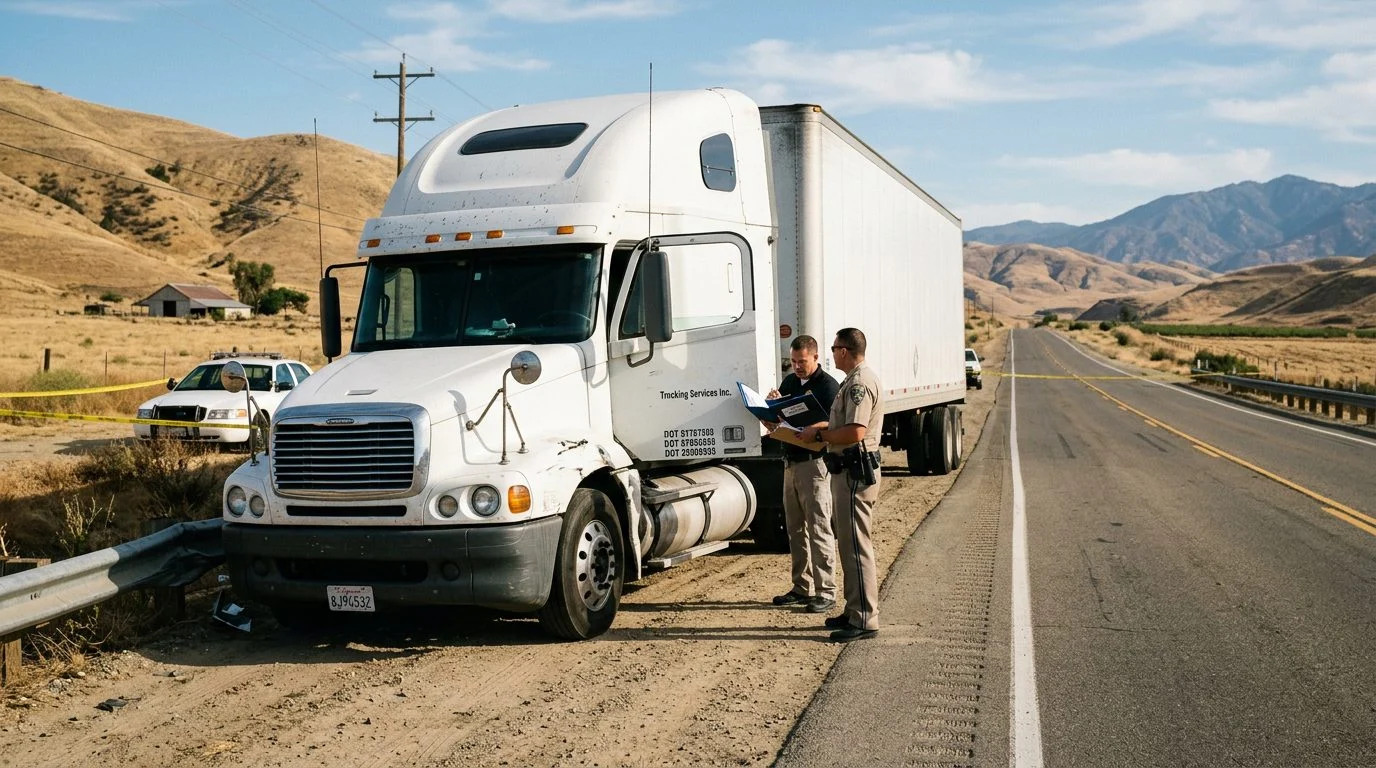
Wrongful Death · Bakersfield, California
Preserve Trucking Records Before They Disappear
When a loved one dies in a truck crash, the company's paperwork, electronic data and communications can decide what your family learns. Here is what to ask for and why acting early helps.
By Donald Norman Colvin · Published November 12, 2026
If someone you love died in a crash with a commercial truck, you may be wondering what the trucking company has on record. The short answer is that the company keeps logs, driver files, maintenance records, and crash data, and much of it sits in its own systems.
Knowing how to preserve trucking records after a fatal crash starts with knowing what exists. This guide explains each record type, how long federal rules require it be kept, and what to do now. It is written for families in Bakersfield, Kern County, and nearby areas.
What a Trucking Company Keeps After a Fatal Crash
A trucking company keeps many records about its truck and its driver. Most of them stay in company files and computer systems, not at the crash scene.
The company creates these records as part of running its trucks, often long before any crash happens. The main groups include:
- Crash and accident reports the company keeps
- Driver qualification files
- Vehicle inspection, repair, and maintenance records
- Dispatch, trip, and messaging records
- Records of post-crash drug and alcohol testing
Families often don’t know these records exist. The California Highway Patrol also writes its own collision report, which is a separate record. The CHP crash report request page explains who may request one and how to ask.
California law also sets out who may bring a wrongful death claim. Under Code of Civil Procedure § 377.60, that includes certain surviving family members and dependents, or the decedent’s personal representative on their behalf. For the bigger picture, see our wrongful death lawyer page.
If you're sorting through a crash that took the life of someone you love, you don't have to work out which records matter on your own. We can help you think it through. Talk it through with our team — the first consultation is free, confidential, and carries no obligation.

Electronic Logging Device (ELD) and Hours-of-Service Records
An electronic logging device, or ELD, records a driver’s duty status, and it is a key record to ask about after a fatal crash. Federal rules require carriers to have each driver record duty status for every 24-hour period. See 49 C.F.R. § 395.8.
Each change of duty status must show the name of the city, town, or village, with the State abbreviation.
The logs show when a driver was driving, on duty but not driving, or off duty. The carrier must keep these records for at least six months from receipt, according to FMCSA retention guidance.
Federal rules require drivers to keep their records of duty status current to the time shown for the last change of duty status.
Federal rules also bar a carrier from altering or erasing original ELD information. See 49 C.F.R. § 395.30.
Compare the log times with fuel receipts, toll records, and dispatch messages. If the records disagree, raise that gap in writing.
ECM “Black Box” Data and Electronic Data Downloads
The engine control module (ECM) in many heavy trucks stores data about how the engine was run. People often call this “black box” data.
This data comes from the engine’s own module, not from the company’s paperwork. A technician reads it through a download. If the module kept the data, the download can show details such as speed and braking before a crash.
The main risk is the truck itself. A carrier may repair the truck, move it, or put it back on the road. Any of those steps can change what the module holds. Ask in writing that the truck and its module be kept as they are until a download is made.
Keep the ECM and ELD records separate in your notes. The ELD shows driving hours and location. The ECM shows how the engine was operated. Each one can check the other.
Dash Cam and Video Footage
Some commercial trucks carry dash cameras. Their video can show the road before and during a crash.
Video may sit on a camera’s local memory, in a cloud account, or on a fleet-management platform. Each place may have a different owner or vendor, so ask about all of them.
Footage can show lane position, signals, following distance, and how other drivers acted. That view can matter when people ask how a crash happened.
Video from nearby businesses or traffic cameras is a separate question. Those owners are not the carrier, and each may keep recordings for its own period. Raise that question early, in writing, and note the business name if you know it.
Write down whether you saw a camera mounted on the truck, and where it was.
How Long Federal Rules Require Carriers to Keep These Records
Federal rules set minimum keeping periods, and they differ by record. Logs and supporting documents must be kept for at least six months from the date of receipt.
- Duty status records and supporting documents: at least six months from receipt, under 49 C.F.R. § 395.8
- Accident register: three years after each accident, under 49 C.F.R. § 390.15
- Driver qualification files: for as long as the driver works for the carrier, plus three years, under 49 C.F.R. § 391.51
- Inspection and maintenance records: one year, and six months after the vehicle leaves the carrier’s control, under 49 C.F.R. § 396.3
These are minimums, not a deadline for your claim. A wrongful death case can take longer than these periods to develop. That gap is why a written request matters, even when a company says it follows federal rules.
California generally allows two years to bring a wrongful death action, under Code of Civil Procedure § 335.1. Some cases have different deadlines, so check the date early.
Other Time-Sensitive Evidence
Dispatch messages, device data, and post-crash testing records can matter as much as the truck’s own files.
After a crash involving a loss of human life, the employer must test each surviving driver who was performing safety-sensitive work. Under 49 C.F.R. § 382.303, post-accident alcohol and controlled substances testing of a surviving commercial motor vehicle driver is required only in specified circumstances. One is a crash involving a death, if the driver was performing safety-sensitive functions with respect to the vehicle. Another is when the driver receives a citation for a moving traffic violation arising from the crash (within 8 hours for alcohol testing, 32 hours for controlled substances testing) and someone suffered a bodily injury treated immediately away from the scene, or a vehicle had disabling damage requiring it to be towed. The rule has exceptions, such as occurrences involving only loading or unloading cargo. If a test required by 49 C.F.R. § 382.303 is not administered within two hours following the accident, the employer must prepare and maintain on file a record stating the reasons the test was not promptly administered.
Also ask for phone or in-cab device data, GPS or telematics history, and dispatch logs. These can show when the driver was contacted and where the truck was. Scenes and vehicles can be cleared quickly, so photos and notes made early matter.
The coroner’s findings are a separate source. You can compare them with company records as the case develops. See our coroner report page for how that works.
Not sure what your next step is?
Talk it through with our team — the first consultation is free, confidential, and carries no obligation.
Carrier Response After a Truck Crash and Evidence Destruction or Spoliation
Spoliation means destroying, changing, or losing evidence that matters to a claim.
A carrier may send an insurer, a claims representative, or a safety team to respond. Keep a written record of every contact, including the date, the person’s name, and what was said. Save letters, emails, and voicemails.
Federal rules forbid any carrier from making a fraudulent or intentionally false entry on a record it must keep. See 49 C.F.R. § 390.35. Carriers must also give authorized investigators access to accident records within the time they set, under 49 C.F.R. § 390.15.
Families often worry that crash data was deleted. The timing matters, including when the company learned of the crash and when a written request arrived. Whether any loss was improper depends on the facts.
How missing or changed records can affect fault is a separate question. Our comparative fault page explains that topic.

Putting a Preservation Request in Writing and Talking With Colvin Accident Lawyers
A preservation letter, sometimes called a spoliation letter, tells the trucking company in writing which records and data must be kept.
While the details are fresh, gather these items:
- The carrier’s name and the DOT number on the truck
- The crash report number
- Copies of any letters, texts, or notes of calls from the company
- The names of any nearby businesses that may have cameras
You may be reading this while planning a funeral or handling paperwork. You don’t need to know every record name yet.
Frequently Asked Questions
How long must a trucking company keep driver logs?
Federal rules require carriers to keep records of duty status and supporting documents for at least six months from receipt.
Can a trucking company delete crash data?
Federal rules bar a carrier from altering or erasing original ELD information. Whether a particular company followed those rules depends on the facts.
How long does a family have to file a wrongful death claim in California?
California generally allows two years under Code of Civil Procedure § 335.1, though some cases have different deadlines.
If you’re trying to protect records that could matter in your loved one’s case, you don’t have to sort it out alone. Colvin Accident Lawyers, based in Bakersfield, California, offers a free, confidential first consultation with no obligation to continue. You can contact us here.
Don't wait for the trucking company to offer its records
A trucking company controls its own files, and its insurer may be working on its defense from the first day. Families who ask in writing for specific records early on give their attorney a clearer starting point.
How Colvin Accident Lawyers can help
Focused on wrongful death and truck cases
The firm focuses on wrongful death, truck accident and other serious injury cases for families across Kern County and the surrounding region.
Organized record requests
We help identify which trucking, driver and vehicle records matter most in your loved one's case and how to ask for them.
Free, confidential first consultation
Your first consultation is free, confidential, and comes with no obligation to continue.
Support for grieving families
We understand that families are dealing with loss while also facing an unfamiliar legal process, and we explain each step in plain language.
Records worth asking about after a fatal truck crash
Driver logs and electronic logging device data
Hours-of-service logs and the electronic data behind them can show when the driver was on duty, driving and resting before the crash.
Maintenance and inspection files
Repair orders, pre-trip and post-trip inspection reports, and brake or tire records can show the condition of the truck before the collision.
Dispatch and communication records
Messages, load assignments and dispatcher notes may reveal delivery pressure or schedule demands placed on the driver.
Driver qualification and training files
Hiring records, prior violations, drug and alcohol testing history and training documents help show how the company selected and supervised its driver.